

Archive position — measured, not model output
0 likes on Devpost
2,263 of the 7,850 archived projects have more likes, and 5,587 share exactly 0 — so this project's #5,989 place in the like-ranked listing is a tie-break inside that group, not a ranking.
Projects (log scale)
Likes on Devpost. ▲ marks this project's group.
Show the figures
| Likes | Projects | Share of archive |
|---|---|---|
| 0 | 5,587 | 71.2% |
| 1 | 1,758 | 22.4% |
| 2 | 284 | 3.6% |
| 3–4 | 132 | 1.7% |
| 5–9 | 75 | 1.0% |
| 10+ | 14 | 0.2% |
 User Stories BotA demo video on every pull request
Get a demo video on every new feature
GitHub App that watches your pull requests and records a narrated, captioned demo.
Save time on demo prep and make informed decisions faster with a video walkthrough of every new feature.
Executive Summary
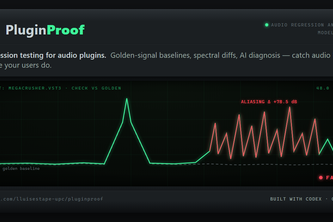
PluginProof is an audio plugin regression testing tool that the author describes as a "pytest for sound". It snapshots a golden baseline of how a VST3 plugin sounds and compares subsequent builds against it using automated metrics and AI diagnosis. The tool is presented as a desktop application, CLI, and GitHub Actions integration, with support for multiple AI providers including local Ollama.
The description states PluginProof measures frequency response, THD+N, aliasing, and NaN/denormal stability through real plugin binaries, and uses AI to diagnose what broke when tests fail. It includes a rule-based fallback and supports both cloud and local AI engines.
Key commercial due-diligence questions:
- Is there actual market demand for this tool?
- What is the target customer's current pain point and willingness to pay?
- How does this compare to existing audio development workflows?
- Are there any competitors or substitutes?
The single most important open question: What is the actual adoption rate of this tool among audio plugin developers, and how does it fit into their existing CI/CD pipelines?
What The Product Actually Is
The description states PluginProof:
- Measures VST3 plugins using real plugin binaries
- Snapshots a golden baseline of plugin sound
- Compares subsequent builds against the baseline with per-metric thresholds (PASS/WARN/FAIL)
- Provides spectrum overlays and exit codes for CI integration
- Uses AI to diagnose what broke when tests fail, with GPT-5.6 as default engine
- Supports multiple AI providers including Anthropic and Ollama
- Includes rule-based offline fallback
- Ships as a desktop app (pywebview), CLI, and GitHub Actions gate
The author describes it as a "real product" not a PoC, with:
- Windowed desktop app with phosphor CRT UI
- Single-file Windows exe on GitHub release
- Typer CLI
- GitHub Actions gate that blocks PRs with audio regressions in under two minutes
Inferred: The tool is built using Python and integrates with VST3 plugins via the pedalboard library.
Positioning & Claim Evolution
The description states PluginProof positions itself as:
- "The missing pytest for sound"
- A regression testing solution for audio plugins
- A lab instrument-like measurement system for plugin behavior
- An alternative to manual ear-based testing in the industry
It claims to bridge a gap between web development (Jest snapshots) and audio development (no equivalent tool).
Inferred: The positioning evolved from solving an internal problem of the author (audio plugin developer) to a general solution for the audio plugin development community.
Target Customer & ICP
The description states:
- The author develops audio plugins (guitar effects including a distortion called MegaCrusher)
- The target is audio plugin developers who currently test by ear
- The tool addresses "the whole industry" that tests by ear
- It's aimed at developers working with VST3 plugins specifically
Inferred: The ICP appears to be individual audio plugin developers or small teams developing VST3 plugins, particularly those in the guitar effects space.
Business Model & Pricing Evidence
Not evidenced. The description does not mention any pricing model, revenue streams, or commercialization strategy beyond the author's own use case.
Technical & Delivery Signals
The description states PluginProof:
- Uses numpy/scipy for measurement engine
- Implements Welch H1 transfer functions, least-squares sine fitting for THD
- Has aliasing score that counts only non-harmonic image energy
- Uses Spotify's pedalboard to host VST3 plugins
- Built with Codex session using GPT-5.6
- Includes pywebview desktop app
- Uses PyInstaller packaging
- Integrates with GitHub Actions CI workflow
- Supports multiple AI providers (OpenAI, Anthropic, Ollama)
- Has rule-based offline fallback
Inferred: The tool is built for deterministic measurement and CI integration, with a focus on reproducible results.
Traction & Maturity Signals
The description states:
- A real bug demo was shown in the repo
- Both plugin builds and golden baseline are in the repo for reproduction
- There's a live blocked PR showing CI gate catching bugs
- The tool is presented as "a real product, not a PoC"
- It ships with a windowed desktop app, CLI, and GitHub Actions integration
Not evidenced: No customer data, usage metrics, or adoption rates are provided.
Competitive Context
The description states:
- Web developers have Jest snapshots and visual regression testing
- Audio developers have nothing equivalent
- The tool addresses a gap in audio development workflows
Inferred: There is no direct competitor mentioned, but the positioning suggests a lack of existing tools for automated audio plugin regression testing.
Open Questions & Risks
The description states:
- The author is a solo developer (team size: 1)
- It's built using AI coding assistants (Codex, GPT-5.6)
- No revenue or customer data provided
- The tool is described as "a real product" but no evidence of commercial adoption
- The author's own use case is limited to their own plugin development
Open questions:
- Solo developer with no traction data
- No pricing or business model information
- No evidence of market demand beyond the author's personal need
- No mention of competitors or substitutes
- The tool appears to be a solution to an internal problem rather than a market opportunity
Questions the description leaves open
- What is your actual customer base and how many developers are using this tool?
- How do you plan to monetize this tool given that it's currently described as a personal project?
- What specific problems in audio plugin development workflows are you solving, and how widespread is this problem?
- Are there any existing tools or competitors in this space that you're aware of?
- What is your roadmap for expanding beyond VST3 plugins to other formats (AU, CLAP)?
- How do you plan to scale beyond a solo developer?
- What are the technical challenges in making this tool work across different audio plugin formats and platforms?
Overall Assessment
Not evidenced. The description does not provide any information about:
- Revenue or financial performance
- Customer acquisition or retention metrics
- Market size or TAM
- Competitive positioning or market share
- Financial projections or funding history
The tool is described as a "real product" but there's no evidence of commercial traction, adoption, or revenue generation. The author is a solo developer working on their own plugin development needs, with no indication of broader market demand or commercial viability.
The description states this is for the OpenAI 2026 hackathon submission, suggesting it may be in early development or prototype stage rather than a mature product ready for investment or partnership.
User Stories BotA demo video on every pull request
Get a demo video on every new feature
GitHub App that watches your pull requests and records a narrated, captioned demo.
Save time on demo prep and make informed decisions faster with a video walkthrough of every new feature.
Source
Submitted to the OpenAI 2026 hackathon on Devpost. Project home on Devpost. Back to the full gallery on Devpost.
This competitive analysis was produced by top-founders.com (opens in a new tab)
Generated by a language model from this project's public Devpost page — its tagline, the author's own write-up and any built-with tags listed there — as captured in August 2026. Short quotations are the author's words. It is an opinion on the idea as a business, not on the people behind it, and it reflects the description as published then. If the project has moved on, request a correction below. The analysis is not independent research and contains no verified traction, revenue or customer data.
An independent guide by KFG International LLC — not affiliated with, endorsed by, or connected to Devpost or OpenAI.