

Archive position — measured, not model output
0 likes on Devpost
2,263 of the 7,850 archived projects have more likes, and 5,587 share exactly 0 — so this project's #5,991 place in the like-ranked listing is a tie-break inside that group, not a ranking.
Projects (log scale)
Likes on Devpost. ▲ marks this project's group.
Show the figures
| Likes | Projects | Share of archive |
|---|---|---|
| 0 | 5,587 | 71.2% |
| 1 | 1,758 | 22.4% |
| 2 | 284 | 3.6% |
| 3–4 | 132 | 1.7% |
| 5–9 | 75 | 1.0% |
| 10+ | 14 | 0.2% |
 User Stories BotA demo video on every pull request
Get a demo video on every new feature
GitHub App that watches your pull requests and records a narrated, captioned demo.
Save time on demo prep and make informed decisions faster with a video walkthrough of every new feature.
Executive Summary
What the company appears to be
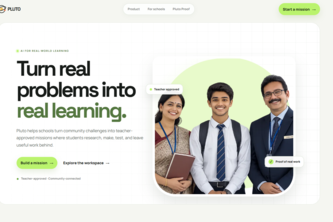
Pluto is a self-reported teacher-controlled AI-powered learning workspace designed to connect schools with local community organisations by structuring real-world challenges into guided student missions. It is described as an open pilot project submitted to the OpenAI 2026 hackathon, built using Next.js, React, TypeScript, OpenAI, Codex, SQLite, Zod, Vercel, and GitHub Actions.
What changed
The description indicates a shift from generic AI tools toward a more structured, policy-aware, and accountable system for student learning. It positions itself as an alternative to black-box AI in education by emphasizing teacher control over mission design, student assignment, and assessment.
Single most important open question
Is there any evidence of real-world adoption or pilot use beyond the demo environment? The description makes no claims about actual deployment, revenue, or customer traction — only a self-reported prototype with a public repository.
What The Product Actually Is
The description states that Pluto is a teacher-controlled learning workspace that connects schools and community organisations. It allows partners to submit local challenges, which are then shaped into structured missions by AI tools (specifically Codex and GPT-5.6). These missions include curriculum links, roles, milestones, deliverables, sources, rubrics, and safeguards.
Students work through checkpoints, research, collaborate, document evidence, reflect, and submit their work. Teachers assess individual contributions, while partners validate the usefulness of outcomes. The system generates a “Pluto Proof” record that includes consent awareness, audit history, and evidence provenance.
The product supports three AI modes:
- Live AI: Uses configured OpenAI models.
- Template mode: Deterministic local structures when live generation is unavailable.
- Restricted policy mode: Enforces server-side safety limits on coaching.
It also features an assignment engine that proposes balanced student teams based on interests, strengths, availability, accessibility needs, and role coverage — all of which must be approved by a teacher.
The system includes:
- Partner challenge intake
- Teacher mission review and approval
- Roster import and team assignment
- Student workspace with research, artefacts, reflection, and submission flows
- Evidence linking, consent, publication controls, audit history
- Per-student assessment and gradebook export
- Pluto Proof verification record
It is built using Next.js, React, TypeScript, OpenAI, Codex, SQLite, Zod, Vercel, and GitHub Actions.
Not evidenced No evidence of actual users, real data handling, or production deployment beyond the demo environment. The product is described as an open pilot foundation, not a production-ready system.
Positioning & Claim Evolution
The description states that Pluto aims to address two key problems:
- Schools want learning to feel useful beyond the classroom.
- Community organisations have meaningful local problems but lack safe, structured ways to work with students.
It positions itself as an alternative to generic AI tools by asserting:
- AI helps structure complex work but does not silently decide truth, assignments, or grades.
- Teachers remain responsible for mission approval, student access, assessment, and publication.
- Partners validate usefulness, not individual student grades.
- The system clearly labels every AI state (Live AI, Template, Restricted).
- It enforces policy boundaries server-side.
Pluto’s positioning is framed around accountability, control, and structured learning. It claims to offer a “different contract” in education AI — one that prioritizes teacher agency and ethical use of AI over automation.
Inference This suggests a move away from tools that treat AI as a black box toward systems where educators maintain oversight and responsibility for outcomes.
Target Customer & ICP
The description identifies three main user types:
- Partners: Local community organisations with real challenges.
- Teachers: Responsible for reviewing missions, assigning students, assessing work, and publishing results.
- Students: Engage in structured learning missions with clear roles and deliverables.
- School administrators: Likely involved in managing access and operational support.
It also mentions that the system is designed for use by schools and educators working with external partners to create meaningful student experiences.
Not evidenced No evidence of actual customers, target segments, or market segmentation beyond these user roles. No mention of specific school sizes, geographic scope, or institutional adoption.
Business Model & Pricing Evidence
The description does not contain any information about pricing, monetisation, or business model. It only describes the product’s functionality and technical architecture.
Not evidenced No indication of how Pluto intends to generate revenue, whether through subscription, licensing, grants, or other means.
Technical & Delivery Signals
Pluto is built with:
- Frontend: Next.js, React, TypeScript
- Backend/Infrastructure: OpenAI (Codex and GPT-5.6), SQLite, Zod
- Deployment: Vercel, GitHub Actions
- AI Implementation: Codex used for interface consolidation, workflow logic, policy enforcement, deployment fixes, design refinement, type checking, linting, testing, and builds.
- GPT-5.6: Powers live mission generation and coaching paths when configured.
It includes:
- Server-side authorization
- Migrations
- Evidence handling
- Assignment constraints
- Audit path recording
Not evidenced No information on scalability, data security, cloud infrastructure beyond Vercel, or integration capabilities with LMS/SIS systems. No mention of managed identity, storage, malware scanning, monitoring, accessibility validation, localization, or operational support.
Traction & Maturity Signals
The description states that Pluto is an open pilot foundation, not a production system for real student data. It includes:
- A public repository with a seeded Kochi waste-separation mission
- Demo accounts for partner, teacher, student, and admin roles
- Pilot password: pluto-demo
It explicitly notes that before school-wide deployment, Pluto still needs:
- Managed identity
- Managed relational and object storage
- Retention and deletion controls
- Malware scanning
- Monitoring
- Accessibility validation
- Localisation
- LMS/SIS integrations
- Operational support
Not evidenced No evidence of real-world pilots, customer feedback, or actual usage beyond the demo environment. No mention of traction metrics, user engagement, or adoption rates.
Competitive Context
The description does not provide any information about competitors or competitive positioning. It does not name other platforms or tools in the education AI space.
Not evidenced No evidence of market analysis, competitive landscape, or differentiation from existing solutions.
Open Questions & Risks
- Unproven traction: The product is described as a demo and pilot, with no real-world usage or customer data.
- Limited maturity: The system is explicitly stated to be incomplete for production use, lacking features like managed identity, storage, compliance, and integrations.
- Unclear monetisation: No business model or pricing strategy is described.
- AI dependency without clarity on governance: While it claims to enforce policy boundaries, there’s no evidence of how these are enforced in practice or audited.
- Single-founder team: The project is attributed to one person (Koushik Ghosh), raising questions about scalability and resource capacity.
Questions the description leaves open
- What specific feedback have you received from teachers, students, or partners during the pilot phase?
- How do you plan to scale beyond the current demo environment into a production-ready system?
- Have you identified any real-world use cases or partnerships with schools or community organisations?
- What are your plans for addressing compliance, data privacy, and accessibility requirements?
- Is there any intention to monetize this platform? If so, what is your go-to-market strategy?
- How do you intend to manage the transition from AI-assisted mission creation to full autonomy in a classroom setting?
Overall Assessment
This project is described as an open pilot foundation submitted to a hackathon and not yet ready for production use. It shows technical capability, a clear problem statement, and a thoughtful approach to AI accountability in education.
However, there is no evidence of traction, customers, or revenue — only a self-reported prototype with a demo environment. The lack of real-world deployment, business model clarity, and team capacity raises significant concerns for investment or partnership consideration at this stage.
Confidence level: Low
Next step: If further development is planned, seek evidence of pilot usage, feedback loops, and early traction before considering deeper due diligence.
User Stories BotA demo video on every pull request
Get a demo video on every new feature
GitHub App that watches your pull requests and records a narrated, captioned demo.
Save time on demo prep and make informed decisions faster with a video walkthrough of every new feature.
Source
Submitted to the OpenAI 2026 hackathon on Devpost. Project home on Devpost. Back to the full gallery on Devpost.
This competitive analysis was produced by top-founders.com (opens in a new tab)
Generated by a language model from this project's public Devpost page — its tagline, the author's own write-up and any built-with tags listed there — as captured in August 2026. Short quotations are the author's words. It is an opinion on the idea as a business, not on the people behind it, and it reflects the description as published then. If the project has moved on, request a correction below. The analysis is not independent research and contains no verified traction, revenue or customer data.
An independent guide by KFG International LLC — not affiliated with, endorsed by, or connected to Devpost or OpenAI.