

Archive position — measured, not model output
0 likes on Devpost
2,263 of the 7,850 archived projects have more likes, and 5,587 share exactly 0 — so this project's #5,992 place in the like-ranked listing is a tie-break inside that group, not a ranking.
Projects (log scale)
Likes on Devpost. ▲ marks this project's group.
Show the figures
| Likes | Projects | Share of archive |
|---|---|---|
| 0 | 5,587 | 71.2% |
| 1 | 1,758 | 22.4% |
| 2 | 284 | 3.6% |
| 3–4 | 132 | 1.7% |
| 5–9 | 75 | 1.0% |
| 10+ | 14 | 0.2% |
 User Stories BotA demo video on every pull request
Get a demo video on every new feature
GitHub App that watches your pull requests and records a narrated, captioned demo.
Save time on demo prep and make informed decisions faster with a video walkthrough of every new feature.
Executive Summary
What the company appears to be
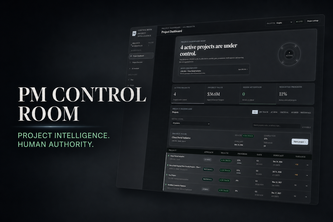
PM Control Room is a self-reported AI-powered project intelligence workspace designed for waterfall and hybrid project delivery. The author states it aims to centralize scattered project evidence, detect risks, explain their impact, and recommend actions while keeping the project manager in control.
What changed
The project was built as a prototype during OpenAI Build Week using Codex and GPT-5.6. It is described as a full-stack application with a dashboard, recommendation engine, and controlled decision workflow (Detect → Explain → Recommend → Approve → Act). The author claims it supports both waterfall and hybrid delivery models.
Single most important open question
Is there any evidence of real-world usage or adoption beyond the prototype? The description does not indicate whether PM Control Room has moved beyond a demo or proof-of-concept stage, nor if it has been tested with actual project managers or teams.
What The Product Actually Is
The description states that PM Control Room is an AI-powered project intelligence workspace for waterfall and hybrid delivery. It is built as a full-stack Codex Site using Cloudflare-compatible services (D1 for structured data, R2 for document storage). The application follows a controlled decision workflow:
- Detect → Explain → Recommend → Approve → Act
It allows users to:
- Monitor multiple projects from a central dashboard
- Identify emerging risks, schedule variance, and delivery concerns
- Understand why a project requires attention
- Receive explainable, evidence-based recommendations
- Review and approve actions before they are executed
- Navigate project plans, risks, actions, decisions, reports, procurement, and work items
The author claims the system was built using Codex and GPT-5.6 for development lifecycle support including design, implementation, testing, and deployment.
Evidence
- The description states this is an AI-powered workspace.
- It describes a controlled workflow: Detect → Explain → Recommend → Approve → Act.
- The author says it supports both waterfall and hybrid delivery models.
- Built with Codex and GPT-5.6 during OpenAI Build Week.
- Uses Cloudflare-compatible services (D1, R2).
- Designed to centralize project evidence and turn it into actionable intelligence.
Inference The product is described as a prototype built in a short timeframe; no indication of production readiness or real-world deployment.
Positioning & Claim Evolution
The author positions PM Control Room as an intelligent workspace that brings together fragmented project data, explains its implications, and recommends actions while maintaining human control. It is not presented as a replacement for the project manager but rather as a tool to enhance their decision-making.
Key claims:
- The goal was not to replace the project manager.
- It gives project managers better intelligence while keeping human judgment at the center.
- It turns scattered evidence into understandable and actionable intelligence.
- It avoids single-score health indicators in favor of reasoning-based explanations.
Evidence
- The tagline: “AI-powered project intelligence that detects delivery risks, explains their impact, and recommends action—while keeping the project manager in control.”
- The write-up says: “The goal was not to replace the project manager. It was to give them better intelligence while keeping human judgment and authority at the center.”
- The system is described as explaining why a project requires attention instead of labeling it.
Inference This positioning implies a focus on responsible AI use, where automation supports rather than supplants decision-making. However, no evidence exists that this approach has been validated with users or tested in practice.
Target Customer & ICP
The description identifies the primary user as the project manager, who is positioned as the final decision authority in the system. The tool is intended for use in waterfall and hybrid project delivery environments.
It supports:
- Monitoring multiple projects
- Navigating plans, risks, actions, decisions, reports, procurement, and work items
- Supporting both waterfall and hybrid delivery approaches
There is no mention of other stakeholders like executives, team leads, or clients. The system appears tailored to a single role: the project manager.
Evidence
- “The goal was not to replace the project manager.”
- “It supports both waterfall and hybrid project delivery.”
- “Maintain the project manager as the final decision authority.”
Inference The ICP is likely a mid-to-senior-level project manager working in structured or hybrid environments. No evidence of segmentation by industry, company size, or geography.
Business Model & Pricing Evidence
Not evidenced.
The description does not contain any information about pricing, monetization strategy, revenue model, or customer acquisition plans. There is no indication of whether the tool will be sold as SaaS, freemium, enterprise licensing, or otherwise.
Evidence
- No mention of business model.
- No pricing details.
- No customer or revenue data.
Technical & Delivery Signals
The application was built using:
- Codex
- GPT-5.6
- React
- TypeScript
- Cloudflare Workers
- D1 (structured data)
- R2 (document storage)
It is described as a full-stack Codex Site, with the author stating that Codex supported the entire development lifecycle including design, implementation, testing, and deployment.
The system uses AI to reason across project evidence, explain delivery signals, and generate recommendations that remain subject to human review and approval.
Evidence
- Built using Codex and GPT-5.6.
- Uses React, TypeScript, Cloudflare Workers, D1, R2.
- The author claims the AI explains reasoning behind recommendations.
- AI-generated outputs are reviewed and approved by humans.
Inference The technical stack suggests a modern, serverless architecture built with AI-assisted development tools. However, no evidence of scalability, performance metrics, or production-grade infrastructure is provided.
Traction & Maturity Signals
Not evidenced.
There is no mention of:
- Customers
- Revenue
- Usage data
- Product adoption
- Beta testing
- Market validation
The project is described as a prototype built during a hackathon event (OpenAI Build Week), with no indication of post-contest development or real-world use.
Evidence
- Built as a contest-ready prototype.
- No mention of users, customers, or traction beyond the author's own experience.
Inference The tool is likely in early-stage development and has not yet entered production or market testing.
Competitive Context
Not evidenced.
There is no reference to competitors, existing solutions in the project intelligence or AI-assisted PM space, or how PM Control Room differentiates from them. The description does not provide any competitive positioning or landscape analysis.
Evidence
- No mention of competitors.
- No differentiation strategy described.
- No market size or competitive dynamics discussed.
Open Questions & Risks
- Prototype-only status: The system is described as a contest-ready prototype with no evidence of production use or real-world validation.
- No business model: There is no indication of how the product will be monetized or whether it has any revenue streams.
- Unproven AI integration: While AI is central to the offering, there’s no evidence that the AI reasoning or recommendations have been tested or validated in practice.
- Single-founder team: The project was built by one person (Luis Diego), which raises questions about scalability and long-term execution capability.
- No customer feedback or validation: No mention of user testing, interviews, or feedback loops with actual project managers.
Evidence
- Built during a hackathon.
- One-person team.
- No traction, revenue, or customer data.
Questions the description leaves open
- What specific project management challenges did you observe in your own experience that led to this idea?
- Have you tested PM Control Room with any real project managers or teams? If so, what feedback did you receive?
- How does the system handle edge cases where AI reasoning might conflict with human judgment?
- Is there a plan to move beyond the prototype into a production-ready product?
- What is your intended go-to-market strategy and how do you plan to acquire users?
- Are there any existing partnerships or integrations planned with project management platforms like Jira, Asana, or MS Project?
- How will you ensure that AI recommendations remain transparent and explainable in a real-world setting?
Overall Assessment
Not evidenced.
There is no information available regarding:
- Valuation
- Funding rounds
- Investors or partners
- Strategic fit for potential acquirers or investors
The project is described as a prototype built during a hackathon, with no indication of commercial traction, funding, or strategic alignment. It remains unclear whether this represents an opportunity for investment or partnership.
Evidence
- No financial data.
- No investor or partner information.
- No indication of commercial viability or scalability.
Inference At this stage, PM Control Room is a conceptual prototype with no demonstrated path to market or monetization. Any investment or partnership decision would require further evidence of traction, product-market fit, and business model development.
User Stories BotA demo video on every pull request
Get a demo video on every new feature
GitHub App that watches your pull requests and records a narrated, captioned demo.
Save time on demo prep and make informed decisions faster with a video walkthrough of every new feature.
Source
Submitted to the OpenAI 2026 hackathon on Devpost. Project home on Devpost. Back to the full gallery on Devpost.
This competitive analysis was produced by top-founders.com (opens in a new tab)
Generated by a language model from this project's public Devpost page — its tagline, the author's own write-up and any built-with tags listed there — as captured in August 2026. Short quotations are the author's words. It is an opinion on the idea as a business, not on the people behind it, and it reflects the description as published then. If the project has moved on, request a correction below. The analysis is not independent research and contains no verified traction, revenue or customer data.
An independent guide by KFG International LLC — not affiliated with, endorsed by, or connected to Devpost or OpenAI.