

Archive position — measured, not model output
0 likes on Devpost
2,263 of the 7,850 archived projects have more likes, and 5,587 share exactly 0 — so this project's #5,994 place in the like-ranked listing is a tie-break inside that group, not a ranking.
Projects (log scale)
Likes on Devpost. ▲ marks this project's group.
Show the figures
| Likes | Projects | Share of archive |
|---|---|---|
| 0 | 5,587 | 71.2% |
| 1 | 1,758 | 22.4% |
| 2 | 284 | 3.6% |
| 3–4 | 132 | 1.7% |
| 5–9 | 75 | 1.0% |
| 10+ | 14 | 0.2% |
 User Stories BotA demo video on every pull request
Get a demo video on every new feature
GitHub App that watches your pull requests and records a narrated, captioned demo.
Save time on demo prep and make informed decisions faster with a video walkthrough of every new feature.
Executive Summary
The description states that PNSS AI Sales & Support Assistant is an agentic AI solution designed to answer customer enquiries, recommend products, generate quotations, troubleshoot issues, schedule appointments and follow up with customers via WhatsApp and email. It uses retrieval-augmented generation (RAG) and is built with a modular architecture supporting both local and cloud AI models. The system retrieves information from an approved company knowledge base and supports multilingual conversations.
The author claims the solution connects conversational AI with real business workflows, understands customer intent, and prepares useful outputs like quotations and follow-ups. It includes human review checkpoints for important actions and is designed to support SMEs in responding faster and delivering consistent service.
Key open questions include: What is the actual scope of the knowledge base? How does it handle data privacy and access control? Is there any evidence of real-world testing or integration with existing systems?
Confidence Level: Low — this is a self-reported project description, not independently verified. No revenue, customer traction or operational evidence is provided.
What The Product Actually Is
The description states that PNSS AI Sales & Support Assistant is an agentic AI assistant designed to:
- Answer customer enquiries using information from an approved company knowledge base
- Communicate in multiple languages
- Ask follow-up questions to understand customer requirements
- Recommend suitable products and solutions
- Generate reviewable quotation drafts
- Assist with technical troubleshooting using manuals and support records
- Create appointments and calendar reminders
- Prepare customer follow-up messages
- Support communication through web chat, WhatsApp and email
- Escalate uncertain or sensitive cases to a human employee
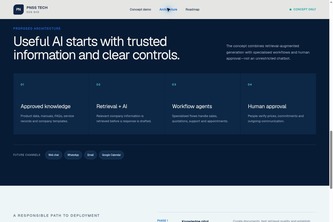
The system uses retrieval-augmented generation (RAG) and is built with an agentic workflow. It processes company documents such as brochures, manuals, FAQs and service records into a searchable knowledge base. When a question is received, the system retrieves relevant information and provides it to the AI model as context before generating a response.
Different workflow agents handle tasks like product selection, sales qualification, quotation preparation, technical troubleshooting, appointment scheduling and customer follow-up.
Important actions such as confirming prices, issuing quotations, sending emails and making appointments remain subject to human review and approval.
The architecture supports both locally hosted AI models for greater privacy and cloud services where external integrations are required.
Evidence: All of this is self-reported by the author. No independent verification or demonstration is provided.
Positioning & Claim Evolution
The description states that the project was built to address a problem faced by small and medium-sized businesses (SMEs) who store important information across various formats like brochures, manuals, emails and employee experience. When customers send enquiries, teams spend considerable time searching for information before replying.
The author claims they wanted to build more than a general chatbot, aiming instead to create an AI Sales Engineer and Support Assistant that:
- Understands company-approved information
- Supports daily business workflows
- Helps employees respond more quickly and consistently
They describe the solution as connecting conversational AI with real sales and technical-support workflows, allowing it to understand customer intent, retrieve relevant knowledge, recommend next actions and prepare useful outputs.
The system is positioned as a practical AI assistant concept that can be extended with additional tools and communication channels over time.
Inference: The positioning implies a shift from generic chatbots toward purpose-built AI assistants for SMEs, but the description does not provide evidence of prior versions or evolution in product design.
Target Customer & ICP
The description states that the solution is aimed at small and medium-sized businesses (SMEs). These businesses are described as those that store important information across various formats like brochures, manuals, emails and employee experience.
The system is intended to help these businesses respond faster, preserve organisational knowledge and deliver more consistent customer service.
Evidence: The target customer is stated but no segmentation or persona details are provided beyond the general category of SMEs.
Business Model & Pricing Evidence
Not evidenced.
The description does not contain any information about pricing models, revenue streams, monetisation strategy or business model. No claims are made regarding how the product would be sold or who pays for it.
Technical & Delivery Signals
The system is built using:
- RAG (Retrieval-Augmented Generation)
- Agentic workflow architecture
- Multiple integrations: WhatsApp, email, web chat, calendar, Gmail, Google APIs
- Technology stack: FastAPI, LangChain, Ollama, Qwen, ChromaDB, PostgreSQL, Docker, n8n, HTML, JavaScript, Python
The system is designed to support both:
- Locally hosted AI models (for privacy)
- Cloud services (for external integrations)
It supports multilingual conversations and includes human review checkpoints for important actions.
Evidence: All technical details are self-reported. No demonstration or operational evidence is provided.
Traction & Maturity Signals
Not evidenced.
The description does not contain any information about:
- Customers or users
- Revenue or monetisation
- Product usage metrics
- Real-world testing or deployment
- Adoption rate or feedback from users
The project was submitted to a hackathon and has no known traction beyond that context.
Competitive Context
Not evidenced.
The description does not mention any competitors, market positioning relative to existing solutions, or competitive advantages. No information is provided about the broader marketplace for AI sales and support assistants.
Open Questions & Risks
- No evidence of real-world usage or testing: The project was submitted to a hackathon and lacks any operational history.
- Unverified claims: All features and capabilities are self-reported without independent validation.
- Lack of clarity on data handling: While the system is designed for privacy, there's no information on how data is stored, secured or accessed.
- No pricing or monetisation strategy: No indication of how this would be commercialised.
- Single-person team: The project was built by one individual (cslimmy-coder LIM), which may limit scalability or depth of development.
Questions the description leaves open
- What is the actual scope and structure of the knowledge base used? How is it maintained?
- How does the system ensure accuracy when retrieving information from documents?
- What are the specific human review checkpoints for critical actions like issuing quotations or scheduling appointments?
- Has there been any real-world testing with sales or support teams?
- What are the plans for integrating live pricing and inventory data?
- How is user access control and data security implemented?
- Are there any existing partnerships or pilot customers?
- How does the system handle escalation to humans — what triggers this, and how is it managed?
- What is the current status of the product — is it ready for deployment or still in prototype phase?
- What are the long-term goals for scaling and monetisation?
Overall Assessment
Not evidenced.
There is no evidence of revenue, customers, traction or financial performance to assess viability for investment or partnership. The project is described as a hackathon submission with no operational history or commercial validation.
The description indicates that the solution aims to become a "dependable digital teammate" for SMEs but lacks any demonstration of real-world impact or business readiness.
Confidence Level: Very low — this is a self-reported, unverified concept with no evidence of traction, revenue or customer adoption.
User Stories BotA demo video on every pull request
Get a demo video on every new feature
GitHub App that watches your pull requests and records a narrated, captioned demo.
Save time on demo prep and make informed decisions faster with a video walkthrough of every new feature.
Source
Submitted to the OpenAI 2026 hackathon on Devpost. Project home on Devpost. Back to the full gallery on Devpost.
This competitive analysis was produced by top-founders.com (opens in a new tab)
Generated by a language model from this project's public Devpost page — its tagline, the author's own write-up and any built-with tags listed there — as captured in August 2026. Short quotations are the author's words. It is an opinion on the idea as a business, not on the people behind it, and it reflects the description as published then. If the project has moved on, request a correction below. The analysis is not independent research and contains no verified traction, revenue or customer data.
An independent guide by KFG International LLC — not affiliated with, endorsed by, or connected to Devpost or OpenAI.