

Archive position — measured, not model output
1 like on Devpost
505 of the 7,850 archived projects have more likes, and 1,758 share exactly 1 — so this project's #2,070 place in the like-ranked listing is a tie-break inside that group, not a ranking.
Projects (log scale)
Likes on Devpost. ▲ marks this project's group.
Show the figures
| Likes | Projects | Share of archive |
|---|---|---|
| 0 | 5,587 | 71.2% |
| 1 | 1,758 | 22.4% |
| 2 | 284 | 3.6% |
| 3–4 | 132 | 1.7% |
| 5–9 | 75 | 1.0% |
| 10+ | 14 | 0.2% |
 User Stories BotA demo video on every pull request
Get a demo video on every new feature
GitHub App that watches your pull requests and records a narrated, captioned demo.
Save time on demo prep and make informed decisions faster with a video walkthrough of every new feature.
Executive Summary
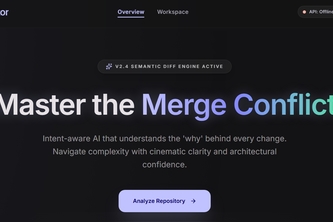
The Mediator is an AI-powered web application described by its author as a tool to help developers understand and resolve Git merge conflicts with explainable recommendations, branch intent analysis, and risk assessment. The project was built during the OpenAI 2026 hackathon by one developer, Krish Shah, using technologies including React, TypeScript, Express.js, Firebase, Google Gemini API, and Vercel.
The author states that the tool analyzes Git merge conflicts and provides explanations of why conflicts occur, identifies architectural risks, summarizes conflicts, and suggests safe merge strategies. It also stores analysis securely for future reference.
What Changed: The project is a self-contained hackathon submission with no evidence of prior development or commercial traction. It represents an idea in early-stage conceptualization and implementation.
Single Most Important Open Question: Is there any evidence that developers are currently using this tool, or that it has been adopted beyond the author’s own use case?
What The Product Actually Is
The description states:
- The Mediator is an AI-powered web application.
- It analyzes Git merge conflicts.
- It provides explainable recommendations.
- It explains branch intent, identifies architectural risks, and summarizes conflicts.
- It suggests the safest merge strategy.
- Every analysis is securely stored for developers to revisit.
The author describes it as a tool that helps resolve Git merge conflicts by offering AI-driven insights into why they occur and how to safely resolve them. The application is built with React, TypeScript, Express.js, Firebase, Google Gemini API, and Vercel.
Inference: Based on the technology stack and functionality described, it appears to be a full-stack web application designed for developers working in collaborative environments where Git merge conflicts are common.
Positioning & Claim Evolution
The author states:
- The tool addresses "Git merge conflicts are one of the biggest pain points in collaborative software development."
- Existing tools "show conflicting lines of code but rarely explain why the conflict happened or which resolution is the safest."
- The Mediator aims to "make merge conflicts easier to understand and resolve."
Claim: The product positions itself as a solution for developers who struggle with Git merge conflicts, especially in team settings.
Inference: The positioning reflects an attempt to improve developer experience by adding AI-driven clarity and safety to a common workflow. It does not claim to be part of any existing platform or ecosystem beyond its own standalone web application.
Target Customer & ICP
The description states:
- The tool is aimed at developers.
- It helps with Git merge conflicts, which are a pain point in collaborative software development.
Inference: The primary customer is likely a developer or engineering team working on projects using Git, particularly those that experience frequent merge conflicts due to collaboration.
Not evidenced: No specific segment of developers (e.g., startups, enterprise, freelancers) is identified. No evidence of ICP beyond general developer use cases.
Business Model & Pricing Evidence
The description states:
- The tool is a web application.
- It uses AI APIs like Google Gemini and OpenAI Codex.
- It includes secure authentication and persistent analysis history.
Not evidenced: No mention of pricing, monetization strategy, or business model. There is no indication whether the tool will be offered as SaaS, freemium, or open-source.
Technical & Delivery Signals
The description states:
- Built with React, TypeScript, Vite, Express.js, Firebase Authentication, Cloud Firestore, Google Gemini API, Vercel, Render.
- Used OpenAI Codex and GPT-5.6 for implementation, refactoring, debugging, architecture discussions, code reviews, prompt refinement, and documentation.
- Deployment involved solving issues between frontend and backend, configuring Firebase Authentication, and improving AI-generated explanation quality.
Inference: The tool is a full-stack web application with secure authentication and persistent storage. It integrates AI APIs to enhance functionality.
Not evidenced: No evidence of scalability, performance metrics, or production readiness beyond the author’s own deployment experience.
Traction & Maturity Signals
The description states:
- The project was built during the OpenAI 2026 hackathon.
- The author claims to have successfully deployed the project with a production-ready architecture.
- It includes features like secure authentication, persistent analysis history, and explainable AI explanations.
Not evidenced: No evidence of user adoption, customer feedback, or revenue. No data on usage frequency, retention, or growth.
Competitive Context
The description states:
- Git merge conflicts are a common pain point in collaborative development.
- Existing tools "show conflicting lines of code but rarely explain why the conflict happened or which resolution is the safest."
Inference: The tool enters a space where developers need better understanding and resolution of merge conflicts. It competes with generic Git tools, IDE integrations, or other AI-assisted development platforms.
Not evidenced: No mention of competitors, market positioning, or differentiation from existing tools.
Open Questions & Risks
- No traction or user base: The project is a hackathon submission with no evidence of adoption.
- Single-person team: The entire product was built by one developer (Krish Shah), raising questions about scalability and long-term maintenance.
- Unverified claims: All functionality, features, and performance are self-reported without external validation.
- Limited commercial viability: No pricing, monetization, or business model described.
- AI dependency: Reliance on third-party AI APIs (Google Gemini, OpenAI) introduces risk of cost increases or API limitations.
Questions the description leaves open
- What is the actual user base for this tool? Is it being used beyond your own development?
- How do you plan to monetize this product, if at all?
- Are there any existing competitors in this space, and how does this tool differentiate from them?
- What are the technical limitations of relying on AI APIs like Google Gemini or OpenAI for core functionality?
- How do you intend to scale beyond a single developer team?
Overall Assessment
Not evidenced: No financials, revenue, or customer data exist to support an investment or partnership decision.
Inference: Based on the self-reported description alone, this is a concept in early-stage development. It lacks commercial traction, user adoption, or clear business model. The tool may have potential as a developer utility but currently offers no evidence of viability beyond its author’s own use case.
The project is not ready for investment or partnership consideration without further evidence of traction, product-market fit, or commercialization strategy.
User Stories BotA demo video on every pull request
Get a demo video on every new feature
GitHub App that watches your pull requests and records a narrated, captioned demo.
Save time on demo prep and make informed decisions faster with a video walkthrough of every new feature.
Source
Submitted to the OpenAI 2026 hackathon on Devpost. Project home on Devpost. Back to the full gallery on Devpost.
This competitive analysis was produced by top-founders.com (opens in a new tab)
Generated by a language model from this project's public Devpost page — its tagline, the author's own write-up and any built-with tags listed there — as captured in August 2026. Short quotations are the author's words. It is an opinion on the idea as a business, not on the people behind it, and it reflects the description as published then. If the project has moved on, request a correction below. The analysis is not independent research and contains no verified traction, revenue or customer data.
An independent guide by KFG International LLC — not affiliated with, endorsed by, or connected to Devpost or OpenAI.