

Archive position — measured, not model output
1 like on Devpost
505 of the 7,850 archived projects have more likes, and 1,758 share exactly 1 — so this project's #2,071 place in the like-ranked listing is a tie-break inside that group, not a ranking.
Projects (log scale)
Likes on Devpost. ▲ marks this project's group.
Show the figures
| Likes | Projects | Share of archive |
|---|---|---|
| 0 | 5,587 | 71.2% |
| 1 | 1,758 | 22.4% |
| 2 | 284 | 3.6% |
| 3–4 | 132 | 1.7% |
| 5–9 | 75 | 1.0% |
| 10+ | 14 | 0.2% |
 User Stories BotA demo video on every pull request
Get a demo video on every new feature
GitHub App that watches your pull requests and records a narrated, captioned demo.
Save time on demo prep and make informed decisions faster with a video walkthrough of every new feature.
Executive Summary
What the company appears to be
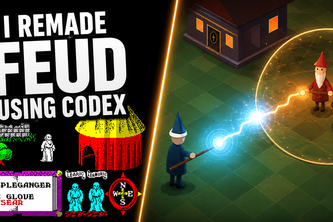
The Other Wizard is a self-contained browser-based game built by one developer (Rob Knott) using AI-assisted development tools like OpenAI Codex, Bolt and GitHub. It is described as a spiritual successor to the 1980s ZX Spectrum game Feud, reimagined with modern gameplay mechanics, isometric visuals, and AI-enhanced development.
What changed
The project was built from scratch using AI tools in a single-person development cycle, demonstrating how one person can use AI-assisted coding to produce a complete playable game. It was submitted as part of the OpenAI 2026 hackathon.
Single most important open question
Is there evidence of traction, revenue or customer adoption beyond the author’s own development and submission? The description states no such data exists.
What The Product Actually Is
The description states that The Other Wizard is a browser-based isometric game set in a medieval fantasy world. It includes:
- A large map with buildings, ruins, trees, and obstacles
- Collision-aware movement
- AI-controlled rival wizard with independent navigation
- Ingredient collection, inventory management, and spell preparation
- Combat mechanics (offensive and defensive magic)
- Visual effects, audio, and interface elements
- Fully deployed online build
The product is described as a complete playable game, not a prototype or demo.
Evidence
- “The Other Wizard is a complete browser-based isometric game set in a large medieval fantasy world.”
- “The game includes: ...”
- “A fully deployed browser build that can be played online.”
Inference It is an original game built with modern tools, not a remaster or re-release of Feud.
Positioning & Claim Evolution
The description states that The Other Wizard is a modern spiritual successor to Feud, not a remake. It was built to explore what the core idea of Feud could become when rebuilt from scratch using modern web technology and AI tools.
It positions itself as an experiment in AI-assisted game development by one person, with the goal of showing that AI can give independent creators access to forms of production previously requiring teams.
Evidence
- “I did not want to remaster Feud or recreate it tile by tile.”
- “This project was built as part of Late Night Systems, my new build-focused YouTube channel...”
- “AI can give independent creators access to forms of production that previously required specialist teams.”
Inference The positioning is more about the development process and tool use than a commercial product or market offering.
Target Customer & ICP
Not evidenced. The description does not state who the target customer is, nor does it define an ideal customer profile (ICP). It only describes the author’s own intent and experience.
Evidence
- No mention of user personas, demographics, or target audience.
- The project was submitted to a hackathon, suggesting a developer or tech-savvy audience.
Business Model & Pricing Evidence
Not evidenced. There is no indication of pricing, monetization strategy, or business model in the description.
Evidence
- No mention of revenue streams, subscriptions, sales, or paid features.
- The game is described as a personal project and hackathon submission.
Technical & Delivery Signals
The author states that the game was built using:
- Bolt (for early prototype)
- OpenAI Codex (for code inspection, implementation, and refinement)
- GitHub (for version control)
- Other tools: stitch, storyblocks, suno (audio/visual assets)
Development workflow involved iterative testing, problem identification, and AI-assisted feature implementation.
Evidence
- “I started the project in Bolt to create the first playable yet failed version...”
- “Once the codebase became more complex, I moved the project into GitHub and used OpenAI Codex...”
- “My usual workflow was: Play → Identify problem → Describe experience → Ask Codex → Review & test → Iterate.”
Inference The use of AI tools suggests a modern, experimental development approach. The author’s own account implies a high degree of personal involvement in the technical process.
Traction & Maturity Signals
Not evidenced. There is no mention of users, downloads, engagement, or adoption metrics beyond the author's own development experience.
Evidence
- No data on player numbers, retention, or usage.
- The project was submitted to a hackathon — not an indication of market traction.
Competitive Context
Not evidenced. The description does not reference competitors or similar products in the market.
Evidence
- No mention of other games, platforms, or developers working in the same space.
- The game is described as a spiritual successor to Feud, but no comparison to modern game offerings is made.
Open Questions & Risks
- No commercial traction or revenue model: The project appears to be a personal experiment and hackathon submission with no evidence of monetization or user base.
- Single-person development: While impressive, the lack of team or external support raises questions about scalability or long-term viability.
- Unverified claims: All descriptions are self-reported and unverified — no third-party validation or data exists.
- No clear ICP or target audience: The project lacks a defined customer base or commercial intent.
Questions the description leaves open
- What is the intended user base for this game?
- Are there any plans to monetize or commercialize The Other Wizard?
- How does the author plan to scale beyond one-person development if they wish to expand the project?
- Has the author considered legal implications of using AI tools in creative development, especially around intellectual property?
- What are the long-term goals for this project beyond the hackathon submission?
Overall Assessment
Not evidenced. The description does not provide any information about funding, investment interest, or partnership opportunities.
Evidence
- No mention of investors, funding rounds, or commercial partnerships.
- The project is described as a personal experiment and hackathon submission.
Inference This appears to be a personal development experiment, not an investment-ready venture. There is no evidence of traction, revenue, or scalable business model.
User Stories BotA demo video on every pull request
Get a demo video on every new feature
GitHub App that watches your pull requests and records a narrated, captioned demo.
Save time on demo prep and make informed decisions faster with a video walkthrough of every new feature.
Source
Submitted to the OpenAI 2026 hackathon on Devpost. Project home on Devpost. Back to the full gallery on Devpost.
This competitive analysis was produced by top-founders.com (opens in a new tab)
Generated by a language model from this project's public Devpost page — its tagline, the author's own write-up and any built-with tags listed there — as captured in August 2026. Short quotations are the author's words. It is an opinion on the idea as a business, not on the people behind it, and it reflects the description as published then. If the project has moved on, request a correction below. The analysis is not independent research and contains no verified traction, revenue or customer data.
An independent guide by KFG International LLC — not affiliated with, endorsed by, or connected to Devpost or OpenAI.