

Archive position — measured, not model output
0 likes on Devpost
2,263 of the 7,850 archived projects have more likes, and 5,587 share exactly 0 — so this project's #4,034 place in the like-ranked listing is a tie-break inside that group, not a ranking.
Projects (log scale)
Likes on Devpost. ▲ marks this project's group.
Show the figures
| Likes | Projects | Share of archive |
|---|---|---|
| 0 | 5,587 | 71.2% |
| 1 | 1,758 | 22.4% |
| 2 | 284 | 3.6% |
| 3–4 | 132 | 1.7% |
| 5–9 | 75 | 1.0% |
| 10+ | 14 | 0.2% |
 User Stories BotA demo video on every pull request
Get a demo video on every new feature
GitHub App that watches your pull requests and records a narrated, captioned demo.
Save time on demo prep and make informed decisions faster with a video walkthrough of every new feature.
Executive Summary
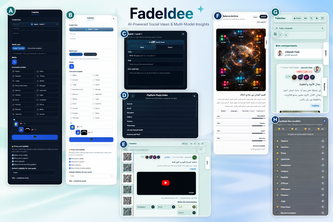
FadeIdee is a self-reported multilingual publishing platform built with GPT-5.6 and Codex, designed to turn ideas into human-reviewed posts, social discovery, and interactive QR worlds. The author states it supports 12 interface languages, live structured content feeds, public publisher profiles, search and SEO pages, relationship flows, limited model-based comments, reactions, trust and moderation layers, media cards, light/dark themes, and an interactive QR system that recomposes post elements into visual layouts.
The platform is described as being built by a single developer (Fade3bd Jobaseh) using vanilla HTML/CSS/JS with Cloudflare infrastructure. It has passed through more than 100 versioned builds and contains hundreds of published posts. The author claims the system preserves source relationships in content cards and includes human review before publication.
Key commercial due-diligence questions include: Is there any evidence of actual users or revenue? What is the true scope of AI integration beyond what's described? How does the platform handle scaling, security, and monetization?
The single most important open question
Does FadeIdee have any verified user traction, revenue, or customer data to support its positioning as a viable product?
What The Product Actually Is
The description states that FadeIdee is:
- A multilingual publishing platform
- Designed to turn ideas into human-reviewed posts
- Supports social discovery and interactive QR worlds
- Built with GPT-5.6 and Codex
- Uses vanilla HTML, CSS, JavaScript with Cloudflare Pages, Workers, D1, browser storage
- Includes live structured content feed, public publisher profiles, search/SEO pages, relationship flows, limited model-based comments, reactions, trust/moderation layers, media cards, light/dark themes, 12 interface languages
The system is described as having a "Level 1 assistant" that generates one concise draft from an idea, which never publishes automatically. The author must manually review, edit, or transfer the result into the publishing flow.
The QR system is not just a collection of links; each QR item carries the source post identity and recomposes selected post elements into different layouts when opened.
Inference The platform appears to be a solo-built prototype with AI-assisted drafting features, but no evidence of actual users or monetization exists in the description.
Positioning & Claim Evolution
The author positions FadeIdee as:
- A multilingual publishing platform
- That turns ideas into human-reviewed posts
- With social discovery and interactive QR worlds
- Built using GPT-5.6 and Codex
The claim evolution shows a progression from idea generation to structured content creation, public discourse, and community interaction through QR-based visual recomposition.
The author emphasizes that AI assists with creation but publication and responsibility remain human-controlled.
Inference The positioning suggests an early-stage platform focused on AI-assisted publishing with social features, but lacks evidence of traction or commercial viability.
Target Customer & ICP
Not evidenced. The description does not specify target customers or ideal customer profiles (ICP). No information is provided about who uses the platform or how it meets their needs beyond general claims about multilingual publishing and AI assistance.
Business Model & Pricing Evidence
Not evidenced. There is no mention of pricing, monetization strategies, revenue models, or business model details in the description.
Technical & Delivery Signals
The platform was built by one developer (Fade3bd Jobaseh) using:
- Vanilla HTML/CSS/JavaScript
- Cloudflare Pages, Workers, D1
- Browser storage and responsive mobile-first interfaces
- GPT-5.6 for architecture discussions, debugging, multilingual interface work, code revision, test planning, and versioned development
- Codex during final Build Week phase
The project has passed through more than 100 versioned builds with hundreds of published posts.
Challenges mentioned include:
- Mobile browser issues (suspended pages, stuck loading states, video interruptions)
- Multilingual design complexity
- Separating public reading, publisher tools, relationships, moderation, local storage, database state, and AI-assisted creation without cross-layer control
Security lessons learned:
- AI features must have human control, strict quotas, isolated credentials, and automatic kill switches
- Security and cost control are product features, not administrative details
Inference The technical stack suggests a lightweight, solo-built platform with strong focus on user experience and security. However, no evidence of scalability or production-grade infrastructure is provided.
Traction & Maturity Signals
The description states:
- Hundreds of published posts
- 12 interface languages
- More than 100 versioned builds
- Live platform operating (as of submission)
- Public demo still running after a billing anomaly incident
However, there is no evidence of:
- Revenue or monetization
- Customer base or user engagement metrics
- Adoption rates or retention data
- Any third-party verification or independent testing
Inference The platform appears mature enough for public demonstration but lacks any verified traction or commercial success indicators.
Competitive Context
Not evidenced. No mention of competitors, market positioning, or competitive landscape is provided in the description.
Open Questions & Risks
Key risks and open questions identified from the self-reported description:
- Solo developer team (1 person) may limit scalability and support
- Heavy reliance on AI tools like GPT-5.6 and Codex raises concerns about dependency, cost control, and security
- Billing anomaly detected during final testing indicates potential financial oversight issues
- No evidence of user traction or revenue suggests unproven market demand
- Platform is described as a "working platform rather than a static concept or design mockup" but lacks any independent validation
Inference The platform's reliance on AI tools and lack of verified traction raise significant concerns about long-term viability, scalability, and commercial sustainability.
Questions the description leaves open
- What is the actual user base or customer data behind the hundreds of published posts?
- How do you plan to monetize this platform given no pricing or revenue model was mentioned?
- Can you provide evidence of any real-world usage beyond the public demo?
- What are your plans for scaling beyond a solo developer build?
- How do you ensure cost control and security with AI tools like GPT-5.6 and Codex?
- Are there any third-party integrations or dependencies that could affect long-term operation?
- What is the timeline for moving from prototype to full commercial product?
Overall Assessment
Not evidenced. No information is provided about investment history, funding rounds, valuation, or partnership status.
Inference Given the lack of verified traction, revenue, customer data, and business model details, there is insufficient evidence to support an investment or partnership decision based solely on this self-reported description. The platform appears to be a prototype with strong technical execution but unproven commercial viability.
User Stories BotA demo video on every pull request
Get a demo video on every new feature
GitHub App that watches your pull requests and records a narrated, captioned demo.
Save time on demo prep and make informed decisions faster with a video walkthrough of every new feature.
Source
Submitted to the OpenAI 2026 hackathon on Devpost. Project home on Devpost. Back to the full gallery on Devpost.
This competitive analysis was produced by top-founders.com (opens in a new tab)
Generated by a language model from this project's public Devpost page — its tagline, the author's own write-up and any built-with tags listed there — as captured in August 2026. Short quotations are the author's words. It is an opinion on the idea as a business, not on the people behind it, and it reflects the description as published then. If the project has moved on, request a correction below. The analysis is not independent research and contains no verified traction, revenue or customer data.
An independent guide by KFG International LLC — not affiliated with, endorsed by, or connected to Devpost or OpenAI.