

Archive position — measured, not model output
0 likes on Devpost
2,263 of the 7,850 archived projects have more likes, and 5,587 share exactly 0 — so this project's #4,035 place in the like-ranked listing is a tie-break inside that group, not a ranking.
Projects (log scale)
Likes on Devpost. ▲ marks this project's group.
Show the figures
| Likes | Projects | Share of archive |
|---|---|---|
| 0 | 5,587 | 71.2% |
| 1 | 1,758 | 22.4% |
| 2 | 284 | 3.6% |
| 3–4 | 132 | 1.7% |
| 5–9 | 75 | 1.0% |
| 10+ | 14 | 0.2% |
 User Stories BotA demo video on every pull request
Get a demo video on every new feature
GitHub App that watches your pull requests and records a narrated, captioned demo.
Save time on demo prep and make informed decisions faster with a video walkthrough of every new feature.
Executive Summary
What the company appears to be
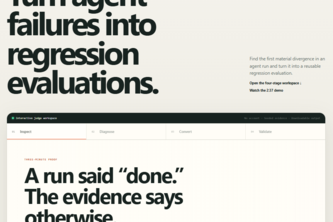
Fail2Eval is a self-reported tool designed to capture AI agent failures and convert them into structured regression evaluations that improve system reliability. The project was built by one person (Leon-Claude Hobson-Coard) as part of an OpenAI 2026 hackathon submission.
What changed
The author states this is a new approach to AI reliability, treating failures not as isolated incidents but as data points for continuous improvement through feedback loops. It represents a shift from viewing failures as endpoints to seeing them as learning opportunities.
The single most important open question
Does Fail2Eval actually function as described, or is it a conceptual framework that has not yet been implemented in a working system?
What The Product Actually Is
The description states that Fail2Eval "transforms AI agent failures into reusable regression evaluations." It captures failure scenarios, analyzes contributing factors, and converts those into structured evaluation cases.
It describes a workflow: Failure → Understanding → Evaluation → Improvement.
The author claims it uses OpenAI technologies including GPT-5.6 and Codex for analysis and implementation workflows.
The system is described as having a "design philosophy" that more capable AI requires stronger feedback loops, better evaluation methods, and systems that preserve learning.
However, the description does not provide evidence of actual functionality or a working prototype beyond its conceptual framework.
Not evidenced Whether Fail2Eval functions as described, whether it has been tested with real AI agents, or whether the conversion from failure to evaluation is operational.
Positioning & Claim Evolution
The author positions Fail2Eval as an approach to AI reliability that treats failures not as endpoints but as valuable engineering assets. It is presented as a way to help AI systems learn from failure in a structured, measurable way.
The claim evolution shows:
- Initial inspiration: AI failures contain valuable information but are rarely captured effectively.
- Core positioning: Fail2Eval turns failures into reusable tests for system improvement.
- Long-term vision: A reliability layer where every significant agent failure contributes to better AI behavior.
Inference The author sees this as a shift from traditional error handling toward a learning-based approach to AI systems.
Not evidenced Whether the product has moved beyond concept, whether it has been tested in real-world scenarios, or whether there is any evidence of adoption or feedback loops.
Target Customer & ICP
The description states that Fail2Eval is aimed at developers working with AI agents who want to improve system reliability through structured evaluation and learning from failures.
It targets users who are building or managing AI systems where agent behavior needs to be measured, improved, and tested over time.
Inference The target audience likely includes software engineers, ML engineers, and DevOps teams working with autonomous AI agents.
Not evidenced Specific customer segments, actual user personas, or evidence of early adopters or pilot programs.
Business Model & Pricing Evidence
The description does not contain any information about pricing, monetization, or business model.
It is not evident whether Fail2Eval intends to be a SaaS offering, a tool for internal use, or something else entirely.
Not evidenced Any indication of how the product would be sold, who would pay, or what revenue streams are envisioned.
Technical & Delivery Signals
The project was built using:
- Technologies: ai-agents, ai-evaluation, ai-reliability, codex, generative-ai, github, gpt-5.6, llm, next.js, openai, python, react, regression-testing, typescript, vercel
- Frameworks: OpenAI GPT-5.6 and Codex
- Development approach: Use of AI tools for implementation, debugging, architecture refinement, and documentation
The author mentions that Codex accelerated development by assisting with various workflows.
Inference The tool is built using modern AI-assisted development practices and integrates with existing developer ecosystems.
Not evidenced Whether the system is actually functional, whether it has been deployed, or whether there are any delivery artifacts beyond a hackathon submission.
Traction & Maturity Signals
The description states that this was submitted to the OpenAI 2026 hackathon on Devpost.
It mentions accomplishments such as building a foundation for treating AI failures as engineering assets and exploring a future where AI agents become more reliable through accumulated operational learning.
However, there is no evidence of:
- Revenue
- Customers
- Product usage
- Market traction
- Any form of commercialization or deployment
Not evidenced Any signs of product maturity, adoption, or user engagement beyond the hackathon submission.
Competitive Context
The description does not mention any competitors or existing solutions in the space of AI agent reliability, failure analysis, or regression testing for AI systems.
It is unclear whether Fail2Eval operates within a competitive landscape or if it is positioned as a novel approach.
Not evidenced Any information about existing tools or platforms that address similar problems.
Open Questions & Risks
- Concept vs. Reality Gap: The description is entirely self-reported and unverified, with no evidence of actual functionality.
- Single Developer Limitation: The project is built by one person, which raises questions about scalability and long-term maintenance.
- Unproven Value Proposition: There's no evidence that the system actually works or provides measurable improvements in AI reliability.
- Lack of Commercial Viability Signals: No pricing, monetization, or customer data are provided.
Inference The project appears to be a conceptual prototype rather than a working product, which may limit its immediate commercial viability.
Questions the description leaves open
- What specific AI agent failures have you tested Fail2Eval on? Was it able to convert them into usable evaluation cases?
- How does Fail2Eval determine the "contributing factors" in a failure scenario?
- Can you demonstrate how the system translates unstructured failure data into structured evaluation insights?
- Have you validated the effectiveness of these evaluations in improving AI agent behavior over time?
- What are the technical limitations or edge cases where Fail2Eval might fail to produce useful outputs?
- Is there any plan for integrating with existing CI/CD pipelines or testing frameworks?
Overall Assessment
The description indicates that Fail2Eval is a self-reported hackathon project built by one individual. It does not provide evidence of traction, revenue, customers, or even a working prototype.
Assessment Not ready for investment or partnership consideration at this stage. The project appears to be in an early conceptual phase with no demonstrated functionality or market validation.
Confidence Level Low — based entirely on self-reported claims and unverified assertions.
User Stories BotA demo video on every pull request
Get a demo video on every new feature
GitHub App that watches your pull requests and records a narrated, captioned demo.
Save time on demo prep and make informed decisions faster with a video walkthrough of every new feature.
Source
Submitted to the OpenAI 2026 hackathon on Devpost. Project home on Devpost. Back to the full gallery on Devpost.
This competitive analysis was produced by top-founders.com (opens in a new tab)
Generated by a language model from this project's public Devpost page — its tagline, the author's own write-up and any built-with tags listed there — as captured in August 2026. Short quotations are the author's words. It is an opinion on the idea as a business, not on the people behind it, and it reflects the description as published then. If the project has moved on, request a correction below. The analysis is not independent research and contains no verified traction, revenue or customer data.
An independent guide by KFG International LLC — not affiliated with, endorsed by, or connected to Devpost or OpenAI.