

Archive position — measured, not model output
0 likes on Devpost
2,263 of the 7,850 archived projects have more likes, and 5,587 share exactly 0 — so this project's #4,033 place in the like-ranked listing is a tie-break inside that group, not a ranking.
Projects (log scale)
Likes on Devpost. ▲ marks this project's group.
Show the figures
| Likes | Projects | Share of archive |
|---|---|---|
| 0 | 5,587 | 71.2% |
| 1 | 1,758 | 22.4% |
| 2 | 284 | 3.6% |
| 3–4 | 132 | 1.7% |
| 5–9 | 75 | 1.0% |
| 10+ | 14 | 0.2% |
 User Stories BotA demo video on every pull request
Get a demo video on every new feature
GitHub App that watches your pull requests and records a narrated, captioned demo.
Save time on demo prep and make informed decisions faster with a video walkthrough of every new feature.
Executive Summary
What the company appears to be
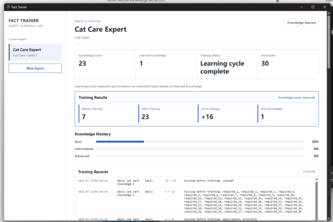
FactTrainer is a self-reported experimental AI agent training platform. The author describes it as a prototype that enables users to train personalized AI agents using user-provided materials. It implements a structured learning pipeline involving a "Teacher" agent for organizing knowledge, a "Trainer" pipeline for transferring knowledge, and a persistent local agent state.
What changed
The project is presented as an experimental hackathon submission (OpenAI 2026 hackathon), not a commercial product or service. It is described as a prototype with limited functionality, focused on proving the concept of a learning workflow rather than delivering production-ready features.
Single most important open question
Is there evidence that FactTrainer has moved beyond the prototype stage, or whether it will ever be commercialized?
What The Product Actually Is
The description states:
- FactTrainer is an experimental AI agent training platform.
- It allows users to create agents and train them using user-provided materials.
- It implements a structured learning pipeline with components like a Teacher agent, Trainer pipeline, and knowledge graph storage.
- The system converts learning materials into concepts, attributes, relations, rules, and causal links.
- Agents can answer questions based on learned knowledge and preserve state locally.
Inference The product is described as a prototype that enables material-based learning workflows for AI agents. It does not appear to be a finished product or service but rather an experimental tool built for demonstration purposes.
Positioning & Claim Evolution
The description states:
- The platform aims to explore a different approach to AI assistants, one that learns from user-provided materials instead of relying on large pretrained knowledge or document retrieval.
- It is positioned as a way to build personalized AI agents with structured knowledge representation.
- It claims to enable “material learning and structured knowledge” while acknowledging that advanced language and reasoning are still under development.
Inference The positioning is experimental and exploratory, not commercial. The author frames it as an attempt to prove the feasibility of a new kind of agent training workflow, rather than a finished solution or product.
Target Customer & ICP
The description states:
- The platform allows users to upload materials and train agents using them.
- It is described as enabling “personalized AI agents.”
Not evidenced No specific customer segments, personas, or use cases are mentioned. No indication of who the target customers are beyond generic “users.”
Business Model & Pricing Evidence
The description states:
- The training process uses the Gemini API for Teacher-assisted knowledge extraction.
- After training, the agent’s learned knowledge and answering ability run locally without requiring an API key.
- No API key is included in the repository for security reasons.
Inference There is no evidence of a commercial business model or pricing structure. The platform appears to be experimental and not monetized. The local execution post-training suggests no ongoing service fees, but no details are given about how it might be monetized if it were to evolve.
Technical & Delivery Signals
The description states:
- Built with: agent, ai, css, html, javascript, knowledge-graph, python, tauri.
- Implements a structured learning pipeline with teacher, trainer, and knowledge graph components.
- Supports local execution after training.
- Uses the Gemini API for initial knowledge extraction.
Inference The technical stack suggests a prototype built with web technologies (HTML, JS) and a Rust-based framework (Tauri). It is not clear if this is a desktop or web application, but it is clearly experimental in nature.
Traction & Maturity Signals
The description states:
- The core learning pipeline is functional.
- The prototype can create independent agents, train them from uploaded materials, store learned knowledge locally, and answer questions based on trained knowledge.
- It preserves agent state after restarting.
Not evidenced No evidence of revenue, customers, or adoption. No data on usage, retention, or engagement. No mention of any production deployment or user base.
Competitive Context
The description states:
- Many AI assistants today rely on large pretrained knowledge or simple document retrieval.
- FactTrainer explores a different approach — one that enables agents to learn from user-provided materials and build their own knowledge system.
Inference It appears to be positioned as an alternative to existing AI assistant models, but no specific competitors are named or described. The author does not reference any existing platforms in this space.
Open Questions & Risks
- Prototype only: The project is explicitly described as a prototype and experimental hackathon submission.
- No commercialization path: No evidence of monetization, pricing, or business model.
- Limited scope: The system is described as not yet supporting advanced language understanding or reasoning.
- No traction or adoption: No data on users, customers, or product usage.
- Security and access: No API key is included in the repository for security reasons — this may limit demonstration or integration capabilities.
Questions the description leaves open
- What are the specific use cases you envision for FactTrainer beyond the prototype?
- Are there any plans to commercialize the platform, and if so, what would that look like?
- How do you plan to scale beyond a single-user, local execution model?
- What is your roadmap for improving natural language understanding and reasoning capabilities?
- Have you considered integrating with existing AI platforms or APIs beyond Gemini?
Overall Assessment
Not evidenced There is no evidence of any commercial traction, revenue, or customer base. The project is described as a prototype submitted to a hackathon, not a product in development or deployment.
Inference At this stage, FactTrainer does not appear to be a viable investment or partnership opportunity. It is an experimental idea with no demonstrated path to market or monetization. Any potential value lies in its conceptual novelty, but that is not sufficient for due-diligence-level commercial evaluation.
User Stories BotA demo video on every pull request
Get a demo video on every new feature
GitHub App that watches your pull requests and records a narrated, captioned demo.
Save time on demo prep and make informed decisions faster with a video walkthrough of every new feature.
Source
Submitted to the OpenAI 2026 hackathon on Devpost. Project home on Devpost. Back to the full gallery on Devpost.
This competitive analysis was produced by top-founders.com (opens in a new tab)
Generated by a language model from this project's public Devpost page — its tagline, the author's own write-up and any built-with tags listed there — as captured in August 2026. Short quotations are the author's words. It is an opinion on the idea as a business, not on the people behind it, and it reflects the description as published then. If the project has moved on, request a correction below. The analysis is not independent research and contains no verified traction, revenue or customer data.
An independent guide by KFG International LLC — not affiliated with, endorsed by, or connected to Devpost or OpenAI.