

Archive position — measured, not model output
0 likes on Devpost
2,263 of the 7,850 archived projects have more likes, and 5,587 share exactly 0 — so this project's #5,983 place in the like-ranked listing is a tie-break inside that group, not a ranking.
Projects (log scale)
Likes on Devpost. ▲ marks this project's group.
Show the figures
| Likes | Projects | Share of archive |
|---|---|---|
| 0 | 5,587 | 71.2% |
| 1 | 1,758 | 22.4% |
| 2 | 284 | 3.6% |
| 3–4 | 132 | 1.7% |
| 5–9 | 75 | 1.0% |
| 10+ | 14 | 0.2% |
 User Stories BotA demo video on every pull request
Get a demo video on every new feature
GitHub App that watches your pull requests and records a narrated, captioned demo.
Save time on demo prep and make informed decisions faster with a video walkthrough of every new feature.
Executive Summary
What the company appears to be
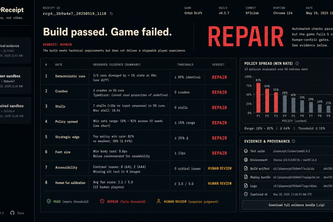
PlayReceipt is a self-reported tool for auditing AI-built games, designed to provide objective evidence of game quality across reliability, balance, accessibility, and human calibration. It claims to offer a deterministic audit process that produces verifiable receipts with four possible outcomes: PASS, REPAIR, HUMAN_REVIEW, or UNVERIFIED.
What changed
The project was developed as part of OpenAI Build Week, with no prior history or traction evidenced. It is described as new work created specifically for the hackathon, including a novel audit engine, GitHub Action, CLI, HTTP API, and dashboard.
Single most important open question
Is there any evidence that PlayReceipt has been used in production or by external users beyond its own developers?
What The Product Actually Is
The description states that PlayReceipt audits eight explicit gates across reliability, balance, accessibility, and human calibration. It returns a deterministic receipt ID derived from SHA-256, based on input evidence.
It supports multiple interfaces:
- CLI
- HTTP API
- Responsive dashboard
- Repository-local Codex skill
- GitHub Action
The system is described as having no runtime npm dependencies, and all components are built using Node.js, JavaScript, and tools like Codex and GPT-5.6.
Inference It appears to be a developer-facing tool for validating game builds through automated checks, with an emphasis on transparency and auditability rather than automation of subjective elements like fun.
Positioning & Claim Evolution
The author states that AI coding tools can make a build "green" but do not prove player choices matter, accessibility controls exist, or a game is fun. PlayReceipt aims to provide an “evidence-based” release gate instead of synthetic scores.
It positions itself as a tool that makes missing claims visible and provides a forensic ledger of audit results.
Inference The positioning evolved from a general-purpose AI-assisted development tool toward a more specific, trust-building mechanism for game quality assurance — especially in areas where automation cannot fully replace human judgment.
Target Customer & ICP
The description does not name specific customers or personas. However, it implies use by:
- Game developers working with AI tools
- CI/CD engineers looking to enforce quality gates
- Judges or reviewers who want to audit game builds
It also mentions a “judge” role that can paste evidence JSON into the app without an account.
Inference The target ICP likely includes indie and professional game developers using AI-assisted workflows, particularly those concerned with automated testing and compliance with accessibility or reliability standards.
Business Model & Pricing Evidence
There is no mention of pricing, monetization strategy, or business model in the description. The tool is described as open-source, deployed publicly on Vercel, and available via GitHub Action.
Not evidenced
Technical & Delivery Signals
The system uses:
- Codex and GPT-5.6
- Node.js and JavaScript
- SHA-256 for content-addressed receipts
- No database or submission-history write path
- Deterministic engine that produces identical outputs from identical inputs
- CLI, HTTP API, dashboard, GitHub Action, and repository-local skill
It includes:
- Eleven regression tests
- Public Vercel deployment
- Independent review trail
- No runtime npm dependencies
Inference The architecture is lightweight and deterministic. It emphasizes reproducibility and auditability over scalability or user management features.
Traction & Maturity Signals
There is no evidence of revenue, customers, or adoption beyond the author's own development efforts. The project was submitted to a hackathon and has no archived history or usage data.
Not evidenced
Competitive Context
The description does not reference competitors or similar tools in the market. It focuses on its unique approach to combining AI with deterministic auditing and human boundaries.
Not evidenced
Open Questions & Risks
- The tool is described as a hackathon project with no prior traction or commercial history.
- No evidence of real-world usage or feedback from external users.
- Relies heavily on self-reported claims about functionality, not independent validation.
- The system explicitly excludes automation of "fun" — which may limit its utility in broader game development workflows.
Inference There is a risk that the tool lacks market relevance or adoption unless it evolves beyond its current prototype state.
Questions the description leaves open
- Has PlayReceipt been used outside of this hackathon context?
- Are there any real-world test cases or feedback from developers using it?
- How does PlayReceipt handle edge cases in evidence input that might not be covered by the current regression tests?
- What is the plan for expanding beyond the current four assessment types and eight gates?
- Is there a roadmap for integrating with popular game engines or development platforms?
Overall Assessment
Not evidenced.
The project is described as a new hackathon creation with no revenue, customers, or traction. It shows technical maturity in its implementation but lacks commercial evidence to support investment or partnership interest at this stage.
User Stories BotA demo video on every pull request
Get a demo video on every new feature
GitHub App that watches your pull requests and records a narrated, captioned demo.
Save time on demo prep and make informed decisions faster with a video walkthrough of every new feature.
Source
Submitted to the OpenAI 2026 hackathon on Devpost. Project home on Devpost. Back to the full gallery on Devpost.
This competitive analysis was produced by top-founders.com (opens in a new tab)
Generated by a language model from this project's public Devpost page — its tagline, the author's own write-up and any built-with tags listed there — as captured in August 2026. Short quotations are the author's words. It is an opinion on the idea as a business, not on the people behind it, and it reflects the description as published then. If the project has moved on, request a correction below. The analysis is not independent research and contains no verified traction, revenue or customer data.
An independent guide by KFG International LLC — not affiliated with, endorsed by, or connected to Devpost or OpenAI.