

Archive position — measured, not model output
0 likes on Devpost
2,263 of the 7,850 archived projects have more likes, and 5,587 share exactly 0 — so this project's #5,984 place in the like-ranked listing is a tie-break inside that group, not a ranking.
Projects (log scale)
Likes on Devpost. ▲ marks this project's group.
Show the figures
| Likes | Projects | Share of archive |
|---|---|---|
| 0 | 5,587 | 71.2% |
| 1 | 1,758 | 22.4% |
| 2 | 284 | 3.6% |
| 3–4 | 132 | 1.7% |
| 5–9 | 75 | 1.0% |
| 10+ | 14 | 0.2% |
 User Stories BotA demo video on every pull request
Get a demo video on every new feature
GitHub App that watches your pull requests and records a narrated, captioned demo.
Save time on demo prep and make informed decisions faster with a video walkthrough of every new feature.
Executive Summary
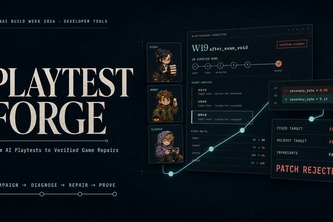
What the company appears to be: PLAYTEST FORGE is a self-reported tool for automated game playtesting using AI agents. The author states it enables an “auditable loop” of Campaign → Diagnose → Repair → Prove, where GPT-5.6 Luna plays through a game and Codex proposes minimal repairs validated via holdout seeds.
What changed: The project was built as part of the OpenAI 2026 hackathon submission. It is described as a prototype for AI-driven game testing, with no evidence of prior commercialization or product release.
Single most important open question: Is there any evidence that this tool has been used in production or by teams beyond the author?
Analysis basis: The entire analysis is based on the self-reported project description provided by the author. No external verification, traction data, revenue, or customer information is available. All claims are treated as stated by the author and not proven.
What The Product Actually Is
The description states that PLAYTEST FORGE is a system for automated game playtesting using AI agents. It includes:
- GPT-5.6 Luna, which plays the game through bounded personas.
- Codex, described as the main agent, which reviews evidence and source code, selects a causal hypothesis, applies a constrained repair, and validates it with holdout seeds.
- Godot as the game engine.
- Python for gameplay recording and evidence contracts (using Pydantic).
- React for presenting evidence.
- OpenAI API to supply GPT-5.6 Luna's decisions.
- A Replay mechanism that works offline, labeled separately from live OpenAI campaigns.
Inference: The system appears to be a prototype or hackathon project focused on reproducible AI-driven game testing and repair workflows. It is not described as a commercial product or platform.
Positioning & Claim Evolution
The author states the goal was to create an “auditable loop” of Campaign → Diagnose → Repair → Prove, aiming to solve the problem that AI playtesting produces feedback but teams still struggle to turn it into reproducible fixes.
Key claims:
- It combines scripted tests with LLM exploration.
- It avoids relying on a single metric or unproven repair.
- It allows developers to make final decisions while automating diagnosis and validation.
Inference: The positioning is that of an experimental, developer-oriented tool for improving game development workflows through AI-assisted testing. It is not positioned as a commercial SaaS offering or marketplace.
Target Customer & ICP
The description does not explicitly identify the target customer or ideal customer profile (ICP). However, it implies use by:
- Game developers working with Godot.
- Teams seeking reproducible fixes in game development.
- Developers who want to validate AI-generated repairs.
Inference: The likely users are indie or small teams of game developers using Godot and looking for automated testing tools that support evidence-based repair workflows. No explicit segmentation or customer data is provided.
Business Model & Pricing Evidence
There is no evidence in the description of a business model, pricing structure, or monetization strategy. The project is described as a hackathon submission with no indication of commercial use or revenue streams.
Not evidenced: No information on how PLAYTEST FORGE would be sold, licensed, or priced.
Technical & Delivery Signals
The system uses:
- Godot 4.4 for game execution.
- Python and Pydantic for typed gameplay and evidence contracts.
- OpenAI API for GPT-5.6 Luna's decisions.
- React for UI presentation.
- Codex Skill to orchestrate testing, diagnosis, repair, and verification.
- Replay mechanism that works offline and is labeled separately from live campaigns.
Inference: The tool is built with a focus on reproducibility and offline validation. It uses typed contracts and deterministic replay, suggesting an emphasis on auditability and traceability.
Traction & Maturity Signals
The project is described as:
- A hackathon submission (OpenAI 2026).
- Built by one person (Bo Zhang).
- Not yet commercialized or released.
- Used to test a Godot game demo.
- Demonstrated with two outcomes: one accepted fix and one rejected candidate.
Not evidenced: No evidence of customer adoption, revenue, usage metrics, or product maturity beyond the prototype stage.
Competitive Context
The description does not mention direct competitors. It implies that current tools for AI playtesting either:
- Rely on scripted tests (which verify rules but not repair effectiveness), or
- Use LLM agents (which explore goals but do not validate repairs).
Inference: PLAYTEST FORGE attempts to bridge a gap in existing AI testing tools by introducing a structured, reproducible workflow. No known competitors are named.
Open Questions & Risks
- Unproven commercial viability: The project is described as a hackathon submission with no evidence of product-market fit or traction.
- Single-person team: No indication of team size beyond one person (Bo Zhang).
- No pricing or monetization model: No evidence of how the tool would be sold or used commercially.
- Limited scope: Only tested on a Godot demo, not scalable to broader game engines or workflows.
- Self-reported claims: All descriptions are unverified and self-evidenced.
Inference: The project is experimental and lacks commercial readiness. It may not yet have a clear path to market adoption or monetization.
Questions the description leaves open
- What is the actual use case for PLAYTEST FORGE beyond this demo?
- Has it been tested on any production games or with other game engines?
- Is there a plan to scale beyond a single developer’s workflow?
- How does it integrate into existing development pipelines?
- Are there any plans to monetize or commercialize the tool?
- What are the limitations of the current approach, and how would they be addressed at scale?
Overall Assessment
The project is described as a hackathon submission with no evidence of traction, revenue, or commercial use. It is not yet a product but an experimental prototype.
Assessment: Not ready for investment or partnership. The tool shows potential in a niche area (AI-assisted game testing) but lacks evidence of market demand, scalability, or monetization strategy. Further development and validation are needed before considering any strategic engagement.
User Stories BotA demo video on every pull request
Get a demo video on every new feature
GitHub App that watches your pull requests and records a narrated, captioned demo.
Save time on demo prep and make informed decisions faster with a video walkthrough of every new feature.
Source
Submitted to the OpenAI 2026 hackathon on Devpost. Project home on Devpost. Back to the full gallery on Devpost.
This competitive analysis was produced by top-founders.com (opens in a new tab)
Generated by a language model from this project's public Devpost page — its tagline, the author's own write-up and any built-with tags listed there — as captured in August 2026. Short quotations are the author's words. It is an opinion on the idea as a business, not on the people behind it, and it reflects the description as published then. If the project has moved on, request a correction below. The analysis is not independent research and contains no verified traction, revenue or customer data.
An independent guide by KFG International LLC — not affiliated with, endorsed by, or connected to Devpost or OpenAI.