

Archive position — measured, not model output
4 likes on Devpost
89 of the 7,850 archived projects have more likes, and 39 share exactly 4 — so this project's #94 place in the like-ranked listing is a tie-break inside that group, not a ranking.
Projects (log scale)
Likes on Devpost. ▲ marks this project's group.
Show the figures
| Likes | Projects | Share of archive |
|---|---|---|
| 0 | 5,587 | 71.2% |
| 1 | 1,758 | 22.4% |
| 2 | 284 | 3.6% |
| 3–4 | 132 | 1.7% |
| 5–9 | 75 | 1.0% |
| 10+ | 14 | 0.2% |
 User Stories BotA demo video on every pull request
Get a demo video on every new feature
GitHub App that watches your pull requests and records a narrated, captioned demo.
Save time on demo prep and make informed decisions faster with a video walkthrough of every new feature.
Executive Summary
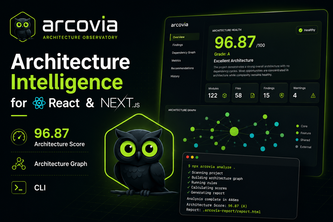
Arcovia is a self-reported architecture intelligence CLI for React and Next.js applications, built as a deterministic static analysis tool. The author states it scans projects, builds dependency models, evaluates rules, calculates scores, and generates offline HTML reports. It uses TypeScript, Node.js, ts-morph, and React, with GPT-5.6 assisting in development via Codex.
The description indicates the project is a solo effort by Ghazi Khan, built for the OpenAI 2026 hackathon. No revenue, customers, or traction data are provided. The tool claims to offer objective architectural insights through deterministic analysis rather than subjective opinions or AI-generated guesses.
Key commercial due-diligence read
The author states Arcovia aims to solve a specific engineering problem—giving frontend teams an objective way to understand and improve React/Next.js architecture—but there is no evidence of market traction, adoption, or commercial viability. The tool's positioning as a deterministic static analysis engine is self-reported; its actual utility in real-world use cases remains unproven.
Most important open question
Is there any evidence that Arcovia has been adopted by teams beyond the author’s own development environment? If not, what would be required to demonstrate product-market fit?
What The Product Actually Is
The description states that Arcovia is an architecture intelligence CLI for React and Next.js applications. It performs static analysis of codebases using deterministic methods to assess architectural health.
It builds a dependency model from project files, evaluates architecture rules, calculates an explainable score, and generates an interactive offline HTML report.
The tool uses:
- TypeScript
- Node.js
- ts-morph
- React
- Vite
- Tailwind CSS
It is described as a modular analysis pipeline with components including filesystem scanning, AST parsing, dependency graph construction, rule evaluation, architecture scoring, and report generation.
Not evidenced: The actual functionality or performance of the tool beyond its self-reported design.
Positioning & Claim Evolution
The author states that Arcovia was inspired by the lack of objective tools for measuring codebase architecture in frontend teams. It aims to answer questions like:
- Is our architecture getting healthier over time?
- Which modules contribute most to architectural debt?
- Where should we start refactoring?
These are framed as being answered through "deterministic static analysis" instead of subjective opinions or AI-generated guesses.
The tool positions itself as a replacement for code reviews and experience-based assessments, offering measurable data backed by evidence extracted directly from the source code.
Inferred: The positioning reflects an attempt to address a gap in developer tooling around architecture health, but this is not validated through usage or feedback.
Target Customer & ICP
The description states that Arcovia targets frontend teams building large React applications. It is specifically designed for React and Next.js projects.
It is implied that the primary users are developers working on complex frontend codebases who want to understand architectural debt and prioritize refactoring.
Not evidenced: No specific customer segments, personas, or use cases beyond general "frontend teams" are provided.
Business Model & Pricing Evidence
The description does not contain any information about pricing, monetization strategy, or business model. It is self-reported that Arcovia is a CLI tool built for the OpenAI 2026 hackathon and has no commercial revenue or customer data.
Not evidenced: No indication of how the product would be sold, licensed, or priced.
Technical & Delivery Signals
The project is described as a modular analysis pipeline with the following stages:
- Filesystem
- Scanner
- AST Parser
- Dependency Graph
- Rule Engine
- Architecture Scoring
- Analysis Report
- Offline HTML Report
It uses:
- TypeScript
- Node.js
- ts-morph
- React
- Vite
- Tailwind CSS
The author notes that Codex with GPT-5.6 was used during development for design, implementation, refactoring, and documentation.
Inferred: The tool is built to be deterministic and explainable rather than relying on opaque heuristics or AI-generated outputs.
Not evidenced: No details about scalability, performance, or integration capabilities beyond the described pipeline.
Traction & Maturity Signals
The description states that Arcovia was built for a hackathon (OpenAI 2026) and is currently a solo project led by Ghazi Khan. There is no mention of:
- Customers
- Revenue
- Adoption
- Usage metrics
- Product-market fit
Not evidenced: No evidence of traction or maturity beyond the initial development phase.
Competitive Context
The description does not provide any information about competitors or existing tools in the architecture intelligence space for React/Next.js applications. It is self-reported that Arcovia fills a gap in tools for measuring codebase architecture, but no comparison to other solutions is made.
Not evidenced: No competitive landscape or differentiation analysis.
Open Questions & Risks
- Solo development: The project is built by one person (Ghazi Khan), which raises concerns about scalability and long-term maintenance.
- No traction or adoption: There is no evidence of real-world usage, customers, or product-market fit.
- Unproven utility: While the tool claims to offer deterministic analysis, there is no demonstration of its effectiveness in practice.
- Limited scope: The tool is focused only on React and Next.js applications, which may limit its appeal.
- Dependency on AI for development: Although the core engine is deterministic, the author used AI extensively during development. This raises questions about whether the final product truly avoids reliance on non-deterministic elements.
Questions the description leaves open
- What specific architectural problems have you observed in your own or others' React/Next.js projects that led to building this tool?
- Have any teams outside of yourself used Arcovia? If so, what feedback did they provide?
- How does Arcovia handle edge cases or complex architectures not covered by its current rule engine?
- What are the expected performance implications for large-scale applications (e.g., time to scan a 100K+ line codebase)?
- Are there plans to expand support beyond React and Next.js, or is this intentionally limited?
- How do you plan to monetize Arcovia if it becomes a viable product?
Overall Assessment
The description states that Arcovia is a solo project built for a hackathon and lacks any evidence of traction, revenue, or customer adoption.
Inferred: Given the lack of commercial data, user feedback, or market validation, there is insufficient basis to recommend investment or partnership at this stage. The tool’s positioning as a deterministic architecture analysis engine is compelling in concept, but its real-world utility remains unproven.
Not evidenced: No financials, customer base, or strategic value proposition beyond the author's own claims.
User Stories BotA demo video on every pull request
Get a demo video on every new feature
GitHub App that watches your pull requests and records a narrated, captioned demo.
Save time on demo prep and make informed decisions faster with a video walkthrough of every new feature.
Source
Submitted to the OpenAI 2026 hackathon on Devpost. Project home on Devpost. Back to the full gallery on Devpost.
This competitive analysis was produced by top-founders.com (opens in a new tab)
Generated by a language model from this project's public Devpost page — its tagline, the author's own write-up and any built-with tags listed there — as captured in August 2026. Short quotations are the author's words. It is an opinion on the idea as a business, not on the people behind it, and it reflects the description as published then. If the project has moved on, request a correction below. The analysis is not independent research and contains no verified traction, revenue or customer data.
An independent guide by KFG International LLC — not affiliated with, endorsed by, or connected to Devpost or OpenAI.