

Archive position — measured, not model output
0 likes on Devpost
2,263 of the 7,850 archived projects have more likes, and 5,587 share exactly 0 — so this project's #4,017 place in the like-ranked listing is a tie-break inside that group, not a ranking.
Projects (log scale)
Likes on Devpost. ▲ marks this project's group.
Show the figures
| Likes | Projects | Share of archive |
|---|---|---|
| 0 | 5,587 | 71.2% |
| 1 | 1,758 | 22.4% |
| 2 | 284 | 3.6% |
| 3–4 | 132 | 1.7% |
| 5–9 | 75 | 1.0% |
| 10+ | 14 | 0.2% |
 User Stories BotA demo video on every pull request
Get a demo video on every new feature
GitHub App that watches your pull requests and records a narrated, captioned demo.
Save time on demo prep and make informed decisions faster with a video walkthrough of every new feature.
Executive Summary
What the company appears to be
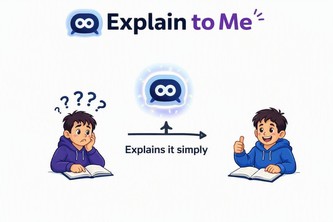
Explain-to-me is a self-reported educational tool for students with language challenges, built as a hackathon project using AI technologies (Azure, GPT 5.6, Codex). It aims to simplify textbook content and provide adaptive quiz practice through an AI assistant.
What changed
The project was submitted to the OpenAI 2026 hackathon on Devpost by one founder, Prashant Choudhari. No prior version or evolution is described; it is a single self-contained prototype.
Single most important open question
Is there evidence of real student usage or feedback that validates the effectiveness of the AI simplification and adaptive quiz features?
What The Product Actually Is
The description states that Explain-to-me is an application designed to help students with language and comprehension challenges. It allows users to upload textbook pages via image, which are then processed using Azure Document Intelligence and rewritten by GPT 5.6 into simpler language. The system also includes a quiz feature aligned with the Grade 9 CBSE curriculum, where GPT 5.6 adapts questions based on student performance.
- Core functionality: Textbook content simplification and adaptive quiz practice.
- Technology stack: React frontend, FastAPI backend, Azure Document Intelligence, GPT 5.6, Codex.
- Not evidenced Any production deployment, user base, or real-world usage beyond the developer's own testing and feedback loops.
Positioning & Claim Evolution
The author positions Explain-to-me as a study companion for students who need additional language support outside the classroom. The goal is not to replace teachers but to offer accessible tutoring assistance.
- Claim: The tool provides an adaptive, tutor-like experience using AI.
- Evolution: No prior versions or iterations are described; this is a single prototype submitted to a hackathon.
- Inference (not evidenced): The positioning implies a niche market for students with language difficulties, but no data supports demand or adoption.
Target Customer & ICP
The author describes the target user as "students with language and comprehension challenges" — specifically those who struggle with complex textbook vocabulary and explanations. The tool is tailored for Grade 9 CBSE Science and Social Science curriculum.
- ICP: Students in India (CBSE curriculum), particularly those needing extra support due to language barriers.
- Not evidenced No demographic breakdown, no data on how many students this affects, or whether the tool has been tested with actual users beyond the developer.
Business Model & Pricing Evidence
The description does not mention any pricing model, monetization strategy, or business model. It is presented as a prototype for a hackathon submission.
- Not evidenced No indication of how the product would be sold, licensed, or funded.
- Inference (not evidenced): If this were to scale, it might involve subscription models or partnerships with schools or edtech platforms, but no such plans are stated.
Technical & Delivery Signals
The project uses a combination of AI and web technologies including React, FastAPI, Azure Document Intelligence, GPT 5.6, and Codex.
- Technical stack: Clearly defined in the write-up.
- Delivery approach: Built as a prototype using iterative development with Codex for implementation.
- Not evidenced No mention of scalability, infrastructure, or deployment details beyond the hackathon context.
Traction & Maturity Signals
There is no evidence of traction, revenue, or customer adoption. The project is described as a single-person hackathon submission.
- Not evidenced No user base, usage metrics, or feedback from students.
- Inference (not evidenced): The developer mentions gathering feedback from students, but no data or results are shared.
Competitive Context
The description does not reference competitors or similar tools in the edtech space. It focuses solely on its own approach to simplifying content and providing adaptive quizzes.
- Not evidenced No competitive analysis or awareness of existing solutions.
- Inference (not evidenced): Given the focus on AI-based tutoring for language learners, there may be overlap with other edtech tools, but no evidence is provided.
Open Questions & Risks
Several risks and open questions emerge from the lack of evidence:
- No real-world validation: The tool has not been tested with actual students or educators.
- Single founder: Only one person built it; no team or external support is mentioned.
- Prototype only: Submitted to a hackathon, not yet a product in production.
- Unverified claims: The effectiveness of GPT 5.6 in adapting learning experiences is self-reported without data.
Questions the description leaves open
- Have you tested the tool with real students? What feedback did they give?
- How do you plan to validate that the AI-generated simplifications are accurate and pedagogically sound?
- Are there any partnerships or institutional trials planned for the next phase?
- What is your roadmap for scaling beyond a single prototype?
- Do you have any data on how students interact with the adaptive quiz system?
Overall Assessment
This is a self-reported hackathon project by one individual, with no evidence of traction, revenue, or customer validation. The idea appears to be grounded in a real need (supporting students with language challenges), but there is no proof that it works at scale or meets market demand.
- Confidence level: Low.
- Assessment: Not ready for investment or partnership without further development, testing, and evidence of impact.
- Next steps (inferred): Prototype must be validated with real users, tested in educational settings, and iterated upon before considering commercialization.
User Stories BotA demo video on every pull request
Get a demo video on every new feature
GitHub App that watches your pull requests and records a narrated, captioned demo.
Save time on demo prep and make informed decisions faster with a video walkthrough of every new feature.
Source
Submitted to the OpenAI 2026 hackathon on Devpost. Project home on Devpost. Back to the full gallery on Devpost.
This competitive analysis was produced by top-founders.com (opens in a new tab)
Generated by a language model from this project's public Devpost page — its tagline, the author's own write-up and any built-with tags listed there — as captured in August 2026. Short quotations are the author's words. It is an opinion on the idea as a business, not on the people behind it, and it reflects the description as published then. If the project has moved on, request a correction below. The analysis is not independent research and contains no verified traction, revenue or customer data.
An independent guide by KFG International LLC — not affiliated with, endorsed by, or connected to Devpost or OpenAI.