

Archive position — measured, not model output
1 like on Devpost
505 of the 7,850 archived projects have more likes, and 1,758 share exactly 1 — so this project's #2,055 place in the like-ranked listing is a tie-break inside that group, not a ranking.
Projects (log scale)
Likes on Devpost. ▲ marks this project's group.
Show the figures
| Likes | Projects | Share of archive |
|---|---|---|
| 0 | 5,587 | 71.2% |
| 1 | 1,758 | 22.4% |
| 2 | 284 | 3.6% |
| 3–4 | 132 | 1.7% |
| 5–9 | 75 | 1.0% |
| 10+ | 14 | 0.2% |
 User Stories BotA demo video on every pull request
Get a demo video on every new feature
GitHub App that watches your pull requests and records a narrated, captioned demo.
Save time on demo prep and make informed decisions faster with a video walkthrough of every new feature.
Executive Summary
What the company appears to be
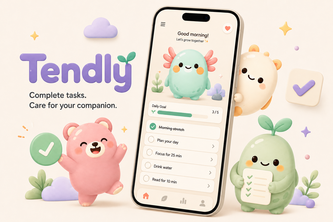
Tendly is a self-reported personal productivity app that combines task management with a digital pet companion. The author states it uses AI (Codex + GPT-5.6) for implementation and is built using modern web technologies like React, Next.js, and Tailwind CSS.
What changed
The project was developed as part of the OpenAI 2026 hackathon over a short timeframe, with no prior development history or external validation.
Single most important open question
Is there any evidence that users engage with Tendly beyond its initial demo mode? The description does not indicate whether the app has been used by anyone other than the developer, nor if it has any monetization or user retention mechanisms.
What The Product Actually Is
The description states:
- Tendly is a to-do app that incorporates virtual pets.
- Users create tasks and complete them to feed and grow one of five virtual pets.
- Each pet has different emotions and growth stages.
- A demo mode allows users to explore the features without creating an account.
Inference The product appears to be a single-user, personal productivity tool with gamification elements. It is not described as a platform or marketplace, nor does it suggest multi-user functionality beyond the demo.
Confidence Low — based only on self-reported description.
Positioning & Claim Evolution
The author states:
- The app was inspired by the discipline required to care for a Tamagotchi.
- It aims to turn everyday progress into "care" for a virtual companion.
- The goal is to make task completion feel meaningful and fun through pet interaction.
Inference Positioning appears to be centered on personal productivity, gamification, and emotional engagement with digital companions. There is no indication of broader market positioning or intent to scale beyond a single-user experience.
Confidence Low — claims are self-reported and lack external validation.
Target Customer & ICP
The description states:
- The app is designed for individuals who want to stay disciplined with task completion.
- It targets people interested in digital pets or gamified productivity tools.
Inference The target customer seems to be a single individual, likely a tech-savvy person or hobbyist looking for an engaging way to manage tasks. No segmentation beyond this is evident.
Confidence Low — no evidence of actual users or market research.
Business Model & Pricing Evidence
The description states:
- The app is publicly deployed and available for use.
- There is no mention of pricing, subscriptions, or monetization strategies.
- The author mentions future features like account syncing and deeper progression but does not describe how these might be monetized.
Inference There is no evidence of a business model or pricing structure. The app appears to be free-to-use with no indication of paid features or revenue streams.
Confidence Very low — no commercial data provided.
Technical & Delivery Signals
The description states:
- Built using React, Next.js, TypeScript, Tailwind CSS, and Vercel.
- AI tools (Codex + GPT-5.6) were used for implementation and debugging.
- The app is responsive and uses local storage for data persistence.
- Deployment was completed within a hackathon timeframe.
Inference The technical stack suggests a modern web application with a focus on simplicity and responsiveness. The use of AI tools indicates a developer-driven approach to rapid prototyping.
Confidence Medium — the author describes the tech stack, but no evidence of scalability or production-grade infrastructure.
Traction & Maturity Signals
The description states:
- This is the first full app the developer has ever built.
- It was completed within a two-day hackathon window.
- A demo mode exists for judges to explore the app.
- No mention of user base, usage metrics, or adoption.
Inference There is no evidence of traction or user engagement beyond the developer’s own use and the demo mode. The project shows early-stage maturity but lacks any indication of real-world usage or product-market fit.
Confidence Very low — no data on users or adoption.
Competitive Context
The description states:
- No direct competitors are mentioned.
- The inspiration comes from Tamagotchi and to-do apps, suggesting a niche overlap with gamified productivity tools.
Inference There is no evidence of competitive analysis or awareness of existing solutions in this space. The app appears to be an original concept within the developer’s own framework.
Confidence Low — no external market context provided.
Open Questions & Risks
- No users or adoption: The app is described as a personal project with no evidence of real-world usage.
- No monetization strategy: No pricing, subscriptions, or revenue model are evident.
- Single developer: Only one person was involved in building the product, which raises concerns about scalability and long-term maintenance.
- Hackathon origin: The app was built in a short timeframe, suggesting limited testing and polish beyond the demo.
- No external validation: No third-party feedback, reviews, or user data are available.
Confidence Medium — risks are inferred from lack of evidence rather than explicit claims.
Questions the description leaves open
- What is your plan for monetization or scaling Tendly beyond the demo mode?
- Have you tested the app with real users, and what feedback have you received?
- How do you intend to maintain and iterate on the product given that it was built by a single developer?
- Are there any plans to integrate with existing task management tools or platforms?
- What are your long-term goals for Tendly — is this intended as a side project or a commercial venture?
Overall Assessment
Assessment Not evidenced.
The description provides no information on traction, revenue, customers, or business model. It is unclear whether Tendly has moved beyond the prototype stage or if it has any commercial viability. The app appears to be a personal project built in a hackathon setting with no indication of market validation or user engagement.
Confidence Very low — this is an early-stage idea with no evidence of product-market fit, adoption, or monetization.
User Stories BotA demo video on every pull request
Get a demo video on every new feature
GitHub App that watches your pull requests and records a narrated, captioned demo.
Save time on demo prep and make informed decisions faster with a video walkthrough of every new feature.
Source
Submitted to the OpenAI 2026 hackathon on Devpost. Project home on Devpost. Back to the full gallery on Devpost.
This competitive analysis was produced by top-founders.com (opens in a new tab)
Generated by a language model from this project's public Devpost page — its tagline, the author's own write-up and any built-with tags listed there — as captured in August 2026. Short quotations are the author's words. It is an opinion on the idea as a business, not on the people behind it, and it reflects the description as published then. If the project has moved on, request a correction below. The analysis is not independent research and contains no verified traction, revenue or customer data.
An independent guide by KFG International LLC — not affiliated with, endorsed by, or connected to Devpost or OpenAI.