

Archive position — measured, not model output
1 like on Devpost
505 of the 7,850 archived projects have more likes, and 1,758 share exactly 1 — so this project's #2,141 place in the like-ranked listing is a tie-break inside that group, not a ranking.
Projects (log scale)
Likes on Devpost. ▲ marks this project's group.
Show the figures
| Likes | Projects | Share of archive |
|---|---|---|
| 0 | 5,587 | 71.2% |
| 1 | 1,758 | 22.4% |
| 2 | 284 | 3.6% |
| 3–4 | 132 | 1.7% |
| 5–9 | 75 | 1.0% |
| 10+ | 14 | 0.2% |
 User Stories BotA demo video on every pull request
Get a demo video on every new feature
GitHub App that watches your pull requests and records a narrated, captioned demo.
Save time on demo prep and make informed decisions faster with a video walkthrough of every new feature.
Executive Summary
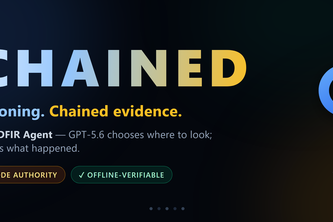
What the company appears to be: Unchained is a self-reported DFIR (Digital Forensics & Incident Response) agent that uses GPT-5.6 to choose where to look in forensic investigations, but separates the model's narrative from the evidentiary record through deterministic code that controls what may run and verifies exactly what was executed and cited.
What changed: The project description states that Unchained was built for the OpenAI 2026 hackathon. It is described as a proof-of-concept with a focus on auditability and determinism in AI-driven forensic investigations, using GPT-5.6 with typed actions and deterministic execution boundaries.
Single most important open question: Is there any evidence of real-world adoption or traction beyond the hackathon submission?
Note: This analysis is based entirely on the self-reported project description provided by the caller. No external verification, revenue data, customer names, or independent sources are available. All claims in this report are attributed to the author's own description.
What The Product Actually Is
The description states that Unchained is:
- A DFIR agent using GPT-5.6 to choose where to look
- Controlled by deterministic code that verifies exactly what was executed and cited
- Designed to separate the model’s narrative from the evidentiary record
- Capable of running on both Linux and Windows with byte-exact offline verification
- Built with bash, codex, docker, gpt-5.6, openai, powershell, pytest, python, ruff, sleuthkit, volatility
Inference: The product appears to be a prototype or proof-of-concept for an AI-driven forensic investigation tool that emphasizes auditability and determinism.
Positioning & Claim Evolution
The description states:
- Unchained is positioned as "the fully autonomous Digital Forensics & Incident Response (DFIR) agent"
- It claims to solve the structural gap in agentic AI where the model's narrative and the evidentiary record are the same object
- The thesis is that agentic AI in high-consequence domains is only sellable when every action can be checked by someone who trusts neither the agent, the vendor, nor the transcript
Inference: The positioning evolved from a hackathon project to a conceptual framework for trustworthy AI in forensic contexts.
Target Customer & ICP
The description states:
- The target domain is DFIR (Digital Forensics & Incident Response)
- It is intended for use by incident-response consultancies facing regulators or opposing counsel
- It is also relevant for expert witnesses under oath
Inference: The primary customer segment appears to be forensic professionals and legal practitioners who require verifiable AI outputs in high-stakes environments.
Business Model & Pricing Evidence
The description states:
- No pricing information is provided
- There is no mention of revenue, customers, or monetization strategy
- The project includes a $0 judge lane with explicit launch cards and key spend gates
- Spend on runs was measured at $2.92, $1.16, and $0.39
Inference: No commercial business model or pricing structure is evident from the description.
Technical & Delivery Signals
The description states:
- Uses GPT-5.6 with typed actions
- Implements deterministic code to control execution and verify outputs
- Includes a CLI setup script (
setup.ps1) - Supports cross-OS verification (Linux and Windows)
- Employs exact byte spans, renders reports, and creates inert no-JS viewers
- Uses SHA-256 custody sealing before GPT-5.6 sees evidence
- Implements hard caps on tool calls and token usage
- Includes offline re-verification of real GPT-5.6 runs
Inference: The technical implementation shows a strong focus on determinism, auditability, and reproducibility.
Traction & Maturity Signals
The description states:
- No revenue or customer data is provided
- The project was submitted to the OpenAI 2026 hackathon
- Includes three authentic retained GPT-5.6 runs (COMPLETE, PARTIAL, INVALID)
- All runs are labeled and kept rather than cherry-picked
- 378/378 tests pass in 22.5 seconds
- The project includes a public repository with example runs
Inference: There is no evidence of commercial traction or adoption beyond the hackathon submission.
Competitive Context
The description states:
- No mention of competitors or competitive landscape
- The project is described as solving a structural gap in agentic AI for DFIR
- It is positioned to generalize beyond DFIR to other domains like compliance review and financial operations
Inference: No competitive context is provided, but the project may be addressing a niche market with limited prior solutions.
Open Questions & Risks
The description states:
- The project is self-reported and unverified
- No revenue, customers, or traction data are available
- The project was built for a hackathon
- It does not include any measured competitive benchmark
- The team size is two (Adil Eskintan, Zehra Eskintan)
- External anchoring is noted as future work
Inference: Key risks include lack of commercial traction, unverified claims, and limited team size for a complex technical project.
Questions the description leaves open
- What are the actual use cases or domains where Unchained has been deployed beyond the hackathon?
- How does Unchained plan to scale its token budgeting approach across larger forensic investigations?
- Are there any partnerships or pilot programs with DFIR consultancies or legal firms?
- What is the roadmap for external anchoring and integration into existing forensic tools?
- How does the team plan to monetize this technology in a commercial setting?
Overall Assessment
The description states:
- No financial data, funding rounds, or valuation are provided
- The project was submitted to a hackathon
- There is no evidence of revenue, customers, or traction beyond the self-reported example runs
Inference: Based on the self-reported description alone, there is insufficient evidence to support an investment or partnership decision. The project appears to be a proof-of-concept with strong technical design but no demonstrated commercial viability or market traction.
User Stories BotA demo video on every pull request
Get a demo video on every new feature
GitHub App that watches your pull requests and records a narrated, captioned demo.
Save time on demo prep and make informed decisions faster with a video walkthrough of every new feature.
Source
Submitted to the OpenAI 2026 hackathon on Devpost. Project home on Devpost. Back to the full gallery on Devpost.
This competitive analysis was produced by top-founders.com (opens in a new tab)
Generated by a language model from this project's public Devpost page — its tagline, the author's own write-up and any built-with tags listed there — as captured in August 2026. Short quotations are the author's words. It is an opinion on the idea as a business, not on the people behind it, and it reflects the description as published then. If the project has moved on, request a correction below. The analysis is not independent research and contains no verified traction, revenue or customer data.
An independent guide by KFG International LLC — not affiliated with, endorsed by, or connected to Devpost or OpenAI.