

Archive position — measured, not model output
0 likes on Devpost
2,263 of the 7,850 archived projects have more likes, and 5,587 share exactly 0 — so this project's #4,104 place in the like-ranked listing is a tie-break inside that group, not a ranking.
Projects (log scale)
Likes on Devpost. ▲ marks this project's group.
Show the figures
| Likes | Projects | Share of archive |
|---|---|---|
| 0 | 5,587 | 71.2% |
| 1 | 1,758 | 22.4% |
| 2 | 284 | 3.6% |
| 3–4 | 132 | 1.7% |
| 5–9 | 75 | 1.0% |
| 10+ | 14 | 0.2% |
 User Stories BotA demo video on every pull request
Get a demo video on every new feature
GitHub App that watches your pull requests and records a narrated, captioned demo.
Save time on demo prep and make informed decisions faster with a video walkthrough of every new feature.
Executive Summary
What the company appears to be
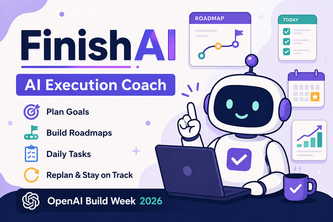
FinishAI is an AI-powered execution coach that helps users turn goals into actionable plans. The author states it allows users to describe a goal in natural language, and the system creates a personalized roadmap, milestones, daily tasks, and adapts the plan if the user falls behind.
What changed
The project was developed during OpenAI Build Week as a hackathon submission. It is described as a first step toward building a SaaS platform for students, developers, freelancers, and lifelong learners.
Single most important open question
Is there any evidence of traction, revenue, or user adoption beyond the author’s personal experience and self-reported development process?
What The Product Actually Is
The description states that FinishAI is an AI execution coach. It allows users to describe a goal in natural language and generates personalized roadmaps, milestones, daily tasks, and adapts plans if users fall behind.
- Claimed function: Turn goals into action.
- AI role: Creates roadmaps, breaks goals into tasks, re-plans dynamically.
- Technology stack (self-reported): Built with codex, css3, flask, git, gpt-5.6, groq, html5, javascript, python, sqlite.
The author states that the system uses GPT-5.6 for development and Groq's LLaMA models for runtime inference in the demo version.
Not evidenced: actual product functionality beyond the developer’s account of its use during the hackathon.
Positioning & Claim Evolution
The author positions FinishAI as an AI execution coach, not just a chatbot or planner. It is described as helping people “actually finish what they start.”
- Original claim: “I wanted to build something I personally needed.”
- Evolution of positioning: From a hackathon demo to a potential SaaS platform for students, developers, freelancers, and lifelong learners.
The author states that the vision extends beyond this hackathon version into a real-world SaaS product.
Not evidenced: any market validation or feedback from users beyond the developer’s own experience.
Target Customer & ICP
The author describes potential users as:
- Students
- Developers
- Freelancers
- Lifelong learners
The author states that the tool is intended for people who struggle to turn ideas into consistent action, especially those learning programming or preparing for exams.
Not evidenced: specific customer segments, personas, or user data.
Business Model & Pricing Evidence
The description does not provide any information about pricing, monetization, or business model.
The author mentions a vision of building a SaaS platform but gives no details on how it would be sold or priced.
Not evidenced: revenue model, pricing tiers, or monetization strategy.
Technical & Delivery Signals
The project was built during OpenAI Build Week using:
- Tools: Codex, GPT-5.6, Groq
- Stack: Flask, Python, JavaScript, HTML5, CSS3, SQLite
The author states that Codex was used for brainstorming, architecture design, code generation, and debugging.
The runtime inference uses Groq's LLaMA models to reduce costs.
Not evidenced: production deployment, scalability, or infrastructure beyond the demo version.
Traction & Maturity Signals
There is no evidence of traction, revenue, or user adoption beyond the author’s own development experience.
The project is described as a hackathon submission and not yet a deployed product.
Not evidenced: customers, usage metrics, or product-market fit.
Competitive Context
The description does not mention any competitors or market context.
Not evidenced: competitive landscape, existing solutions, or differentiation strategy.
Open Questions & Risks
- No traction: The project is described as a hackathon demo with no evidence of real-world usage.
- Single founder: The team size is listed as 1.
- Unverified claims: All descriptions are self-reported and unverified.
- No monetization strategy: No indication of how the product would be sold or funded.
Inference: Without traction, revenue, or user feedback, it's difficult to assess viability or scalability.
Questions the description leaves open
- What specific problems do users face that FinishAI aims to solve?
- How did you validate the need for this tool before building it?
- What is your plan for transitioning from a hackathon demo to a scalable SaaS product?
- Have you tested the AI planning capabilities with real users or in controlled environments?
- What are the key assumptions about user behavior and adoption?
Overall Assessment
The project is described as a hackathon submission with no evidence of traction, revenue, or customer validation.
The author states that this is only the first step toward building a SaaS platform, but there is no indication of progress beyond the demo.
Not evidenced: any commercial activity, user base, or financials.
Inference: The project lacks the signals typically required for investment or partnership consideration at this stage.
User Stories BotA demo video on every pull request
Get a demo video on every new feature
GitHub App that watches your pull requests and records a narrated, captioned demo.
Save time on demo prep and make informed decisions faster with a video walkthrough of every new feature.
Source
Submitted to the OpenAI 2026 hackathon on Devpost. Project home on Devpost. Back to the full gallery on Devpost.
This competitive analysis was produced by top-founders.com (opens in a new tab)
Generated by a language model from this project's public Devpost page — its tagline, the author's own write-up and any built-with tags listed there — as captured in August 2026. Short quotations are the author's words. It is an opinion on the idea as a business, not on the people behind it, and it reflects the description as published then. If the project has moved on, request a correction below. The analysis is not independent research and contains no verified traction, revenue or customer data.
An independent guide by KFG International LLC — not affiliated with, endorsed by, or connected to Devpost or OpenAI.