

Archive position — measured, not model output
0 likes on Devpost
2,263 of the 7,850 archived projects have more likes, and 5,587 share exactly 0 — so this project's #6,067 place in the like-ranked listing is a tie-break inside that group, not a ranking.
Projects (log scale)
Likes on Devpost. ▲ marks this project's group.
Show the figures
| Likes | Projects | Share of archive |
|---|---|---|
| 0 | 5,587 | 71.2% |
| 1 | 1,758 | 22.4% |
| 2 | 284 | 3.6% |
| 3–4 | 132 | 1.7% |
| 5–9 | 75 | 1.0% |
| 10+ | 14 | 0.2% |
 User Stories BotA demo video on every pull request
Get a demo video on every new feature
GitHub App that watches your pull requests and records a narrated, captioned demo.
Save time on demo prep and make informed decisions faster with a video walkthrough of every new feature.
Executive Summary
What the company appears to be: A self-reported educational tool built with GPT-5.6 and Codex that allows learners to create and test their own misconceptions in a simulated physics universe, designed to help them confront and correct faulty mental models.
What changed: The project description indicates an evolution from a general observation about persistent misconceptions in learning to a specific technical solution using AI and simulation.
Single most important open question: Does the described approach actually lead to meaningful learning or cognitive change, or is it merely an interesting demonstration without proven educational impact?
What The Product Actually Is
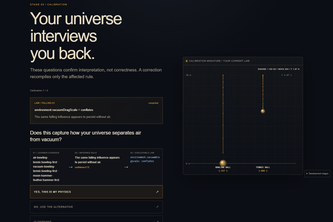
The description states that Private Universe "compiles a learner's own misconception into an executable universe they run, break, and repair themselves." It uses GPT-5.6 for language processing and Codex for development, with React, TypeScript, and Playwright for the frontend.
The product allows users to input their beliefs about falling objects, which are then converted into a physics simulation based on those beliefs. Users can then observe how their universe diverges from reality, leading to a moment of cognitive dissonance where they must repair their model.
Evidence: The author describes the process as: "You tell it what you believe about falling. It takes that belief and turns it into a small universe that actually runs, six real physics laws compiled from your own answers."
Inference: The system appears to be a simulation-based learning tool that uses AI to interpret user input and generate a testable model.
Positioning & Claim Evolution
The author states the inspiration came from observing that "smart people... still walk around with completely broken ideas about how the world works" and that traditional teaching methods fail because they only check answers, not underlying models.
The project evolved from this observation into a tool that "built the opposite of a tutor." Instead of explaining correct answers, it lets learners experience the consequences of their incorrect beliefs directly.
Evidence: The author writes: "I stopped trying to build a better explanation and built the opposite of a tutor."
Inference: This represents a shift from traditional pedagogy toward experiential learning through simulation.
Target Customer & ICP
The description does not clearly identify target customers or an ideal customer profile (ICP). The author mentions "kids" in the context of a teacher view, but no specific demographic or use case is defined.
Evidence: The author says: "A teacher view that shows which universe a kid is actually living in instead of which answer they memorized."
Inference: The tool may be aimed at educators and students, particularly those dealing with conceptual learning challenges in science education.
Business Model & Pricing Evidence
There is no evidence provided about pricing, monetization strategy, or business model. The project description focuses entirely on the technical implementation and educational goals.
Evidence: Not evidenced.
Technical & Delivery Signals
The system uses GPT-5.6 for language interpretation and Codex for development. It includes six phases of development with strict testing requirements (typecheck, lint, tests). The frontend is built with React, TypeScript, Vite, Zod, and Zustand.
Evidence:
- "Built with codex, gpt-5.6, playwright, react, typescript, vite, zod, zustand"
- "Codex was where it got built, in six phases. Nothing moved to the next phase until typecheck, lint, and every test passed on the current one."
- "52 unit tests and 36 browser tests, all green"
Inference: The development process emphasizes code quality and testing rigor.
Traction & Maturity Signals
There is no evidence of revenue, customers, or adoption. The project was submitted to a hackathon and has no indication of market traction beyond its demonstration.
Evidence: Not evidenced.
Competitive Context
The description does not mention any competitors or existing solutions in the space. No reference is made to similar tools or platforms for conceptual learning or simulation-based education.
Evidence: Not evidenced.
Open Questions & Risks
- Lack of educational validation: The project claims to help with cognitive change but provides no evidence of effectiveness.
- Unproven pedagogical approach: The method relies on user-generated simulations, which may not translate into real learning outcomes.
- Limited scope: Only one subject (falling) is mentioned, and the tool seems experimental rather than scalable.
- Self-reported nature: All claims are unverified; no third-party data or user feedback exists.
Evidence: The author states: "Letting someone run their wrong idea beats explaining it away, every time. When you debug your own universe, the fix belongs to you, and it sticks."
Inference: While this sounds promising, there is no empirical support for these claims.
Questions the description leaves open
- What evidence do you have that users actually change their understanding after using the tool?
- How do you plan to scale beyond a single physics concept (falling)?
- Have you tested this with real students or educators?
- What are the limitations of the current simulation in terms of accuracy and realism?
- Is there any research backing up the effectiveness of this type of experiential learning?
Overall Assessment
The project is a self-reported educational prototype submitted to a hackathon. It demonstrates technical capability but lacks evidence of traction, revenue, or proven impact.
Confidence level: Low — based on limited self-reported information and no external validation.
Assessment: Not ready for investment or partnership consideration without further demonstration of effectiveness, scalability, and market demand.
User Stories BotA demo video on every pull request
Get a demo video on every new feature
GitHub App that watches your pull requests and records a narrated, captioned demo.
Save time on demo prep and make informed decisions faster with a video walkthrough of every new feature.
Source
Submitted to the OpenAI 2026 hackathon on Devpost. Project home on Devpost. Back to the full gallery on Devpost.
This competitive analysis was produced by top-founders.com (opens in a new tab)
Generated by a language model from this project's public Devpost page — its tagline, the author's own write-up and any built-with tags listed there — as captured in August 2026. Short quotations are the author's words. It is an opinion on the idea as a business, not on the people behind it, and it reflects the description as published then. If the project has moved on, request a correction below. The analysis is not independent research and contains no verified traction, revenue or customer data.
An independent guide by KFG International LLC — not affiliated with, endorsed by, or connected to Devpost or OpenAI.