

Archive position — measured, not model output
3 likes on Devpost
128 of the 7,850 archived projects have more likes, and 93 share exactly 3 — so this project's #213 place in the like-ranked listing is a tie-break inside that group, not a ranking.
Projects (log scale)
Likes on Devpost. ▲ marks this project's group.
Show the figures
| Likes | Projects | Share of archive |
|---|---|---|
| 0 | 5,587 | 71.2% |
| 1 | 1,758 | 22.4% |
| 2 | 284 | 3.6% |
| 3–4 | 132 | 1.7% |
| 5–9 | 75 | 1.0% |
| 10+ | 14 | 0.2% |
 User Stories BotA demo video on every pull request
Get a demo video on every new feature
GitHub App that watches your pull requests and records a narrated, captioned demo.
Save time on demo prep and make informed decisions faster with a video walkthrough of every new feature.
Executive Summary
What the company appears to be
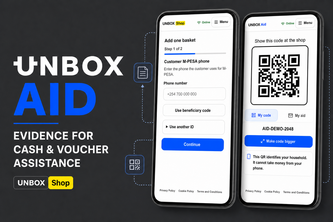
Unbox Aid: Evidence for Cash & Voucher Assistance is a self-reported evidence layer for cash and voucher assistance programs. It connects three lightweight user experiences — merchant, beneficiary, and programme team — to capture offline transactional evidence, without handling funds or payments directly.
What changed
The project was built as part of the OpenAI 2026 hackathon using GPT-5.6 and Codex for engineering automation. It includes a sandboxed judge mode for evaluation purposes and is described as a prototype with field feedback incorporated into its design.
Single most important open question
Is there evidence of real-world use or validation beyond the hackathon sandbox, particularly with actual regulated providers and merchants in Kenya?
Note: This analysis is based entirely on the self-reported description provided by the authors. No independent verification or historical data exists for this project.
What The Product Actually Is
The description states that Unbox Aid is an "evidence and transparency layer" between merchants, beneficiaries, and programme teams in cash and voucher assistance programs. It does not function as a wallet or payment rail.
- Merchants identify customers via phone or QR code, capture basket totals with item details or photos, save evidence locally, and sync when connectivity allows.
- Beneficiaries approve payments using existing mobile money prompts or present signed QR codes; Unbox Aid does not see or store PINs.
- Programme teams review transactional records across programme, household, merchant, and evidence levels in an operational view.
The product distinguishes between:
- Merchant-captured evidence
- Payment requests
- Provider outcomes
- Settlement evidence
It is described as not a wallet or payment rail, with regulated providers retaining custody of funds and responsibility for KYC, authorization, payment execution, and settlement.
Inference: The product appears to be designed to support programmatic oversight rather than financial control.
Claim vs Fact: The description claims it is an evidence layer but does not state whether this has been validated in practice or adopted by any stakeholders beyond the hackathon team.
Positioning & Claim Evolution
The authors position Unbox Aid as a practical, lightweight solution for capturing offline evidence in aid programs. They emphasize:
- Simplicity for merchants working on older phones and unreliable connections.
- Clarity for beneficiaries and programme teams.
- Operational visibility without overclaiming verification or custody.
They also state that the product is not a wallet or payment rail, and that regulated providers retain responsibility for all financial aspects.
Inference: The positioning reflects an intent to serve operational transparency rather than replace existing systems.
Claim vs Fact: These are claims about design intent, not proof of traction or adoption.
Target Customer & ICP
The description identifies three main user groups:
- Merchants – who capture evidence during sales.
- Beneficiaries – who use aid and approve transactions.
- Programme teams – who gain visibility into transactions and evidence.
It also mentions that the system is intended for use in environments with older Android phones and unreliable connectivity, suggesting a focus on low-resource settings like parts of Kenya.
Inference: The ICP likely includes humanitarian organizations, government agencies, or NGOs operating cash/voucher programs in developing regions.
Claim vs Fact: No stated customer base or real-world deployment is mentioned beyond the hackathon sandbox.
Business Model & Pricing Evidence
There is no mention of pricing, revenue models, or monetization strategies in the description.
The authors state that Unbox Aid is an evidence layer and not a payment rail. Regulated providers retain custody and responsibility for financial operations.
Not evidenced: No indication of how the product would be monetized or whether it has any commercial model beyond its hackathon prototype.
Technical & Delivery Signals
The project was built using:
- Frontend: JavaScript, Vite, Cloudflare Workers, Progressive Web App (PWA), QR codes
- Backend: Node.js API, Supabase/PostgreSQL, REST API, service workers, IndexedDB
- Tools: GPT-5.6, OpenAI Codex, Playwright, Sentry, PostHog
Key technical features include:
- Offline capture and synchronization
- Browser-based sandbox for judge mode
- Support for English and Kiswahili
- Mobile-first design with responsive layouts
- Integration with M-PESA Daraja
Inference: The tech stack suggests a modern, lightweight, mobile-oriented solution built for offline usability.
Claim vs Fact: These are self-reported technical choices; no evidence of production performance or scalability.
Traction & Maturity Signals
The description states that the project was developed during the OpenAI 2026 hackathon and includes a sandboxed judge mode for evaluation.
It mentions:
- A fictional Kenyan scenario used in the demo
- Field feedback incorporated into workflow design
- Prototype use with a small set of low-value transactions planned for validation
Not evidenced: No real-world usage, customer data, or adoption metrics are provided.
Inference: The project is at a prototype stage and has not yet been validated in live operations.
Competitive Context
There is no mention of competitors or existing solutions in the description.
The authors describe Unbox Aid as an evidence layer for cash and voucher assistance, distinct from wallets or payment rails.
Not evidenced: No competitive landscape or market positioning beyond its own claims.
Open Questions & Risks
- Prototype-only status: The product is described only as a hackathon prototype with no known real-world deployment.
- No commercial traction: No revenue, customers, or adoption data are reported.
- Unverified validation: Plans for testing with real merchants and providers are outlined but not executed.
- Dependency on GPT/Codex: Heavy reliance on AI tools may indicate lack of mature engineering practices or scalability concerns.
- Limited evidence of trust boundaries: While the authors claim to preserve clear distinctions between types of evidence, this is unverified in practice.
Inference: The product lacks commercial maturity and real-world validation.
Claim vs Fact: All claims about functionality, adoption, and performance are self-reported.
Questions the description leaves open
- Has the system been tested with actual merchants or beneficiaries in Kenya?
- What specific feedback did you receive from field users during development?
- How do you plan to ensure data integrity and security in real-world use cases?
- Are there any partnerships or pilot programs already underway with regulated providers?
- What are the key assumptions about offline behavior, connectivity, and device capabilities that underpin your design?
- Can you walk us through how the sandboxed judge mode works and what it reveals about the system’s functionality?
Overall Assessment
Not evidenced: There is no evidence of revenue, customers, or traction to support an investment or partnership decision.
The project is described as a hackathon prototype with a fictional sandbox environment. The authors have not demonstrated any real-world use, validated workflows, or commercial viability beyond their own claims.
Confidence Level: Low
Assessment: Not ready for investment or partnership consideration without further validation and evidence of traction or pilot deployment.
User Stories BotA demo video on every pull request
Get a demo video on every new feature
GitHub App that watches your pull requests and records a narrated, captioned demo.
Save time on demo prep and make informed decisions faster with a video walkthrough of every new feature.
Source
Submitted to the OpenAI 2026 hackathon on Devpost. Project home on Devpost. Back to the full gallery on Devpost.
This competitive analysis was produced by top-founders.com (opens in a new tab)
Generated by a language model from this project's public Devpost page — its tagline, the author's own write-up and any built-with tags listed there — as captured in August 2026. Short quotations are the author's words. It is an opinion on the idea as a business, not on the people behind it, and it reflects the description as published then. If the project has moved on, request a correction below. The analysis is not independent research and contains no verified traction, revenue or customer data.
An independent guide by KFG International LLC — not affiliated with, endorsed by, or connected to Devpost or OpenAI.