

Archive position — measured, not model output
0 likes on Devpost
2,263 of the 7,850 archived projects have more likes, and 5,587 share exactly 0 — so this project's #7,418 place in the like-ranked listing is a tie-break inside that group, not a ranking.
Projects (log scale)
Likes on Devpost. ▲ marks this project's group.
Show the figures
| Likes | Projects | Share of archive |
|---|---|---|
| 0 | 5,587 | 71.2% |
| 1 | 1,758 | 22.4% |
| 2 | 284 | 3.6% |
| 3–4 | 132 | 1.7% |
| 5–9 | 75 | 1.0% |
| 10+ | 14 | 0.2% |
 User Stories BotA demo video on every pull request
Get a demo video on every new feature
GitHub App that watches your pull requests and records a narrated, captioned demo.
Save time on demo prep and make informed decisions faster with a video walkthrough of every new feature.
Executive Summary
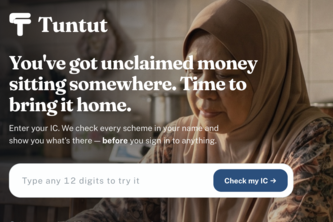
Tuntut is a self-reported AI-powered web application designed to help Malaysians locate and claim unclaimed government money by guiding users through official schemes using their national ID (IC). The product claims to check eligibility across multiple aid programs, provide step-by-step guidance via text or voice (via ElevenLabs), and avoid impersonation to comply with legal restrictions. It is presented as a no-download web app built with CSS, HTML, JavaScript, and ElevenLabs.
The project was submitted by three individuals to the OpenAI 2026 hackathon. The description states that it demonstrates real eligibility checks for several schemes but simulates one-click auto-claim functionality due to lack of a unified national payment rail. It also notes that current live claims still require individual portal logins, and future development includes integrating Malaysia’s MyDigital ID system.
The single most important open question
Is there evidence of any traction, revenue, or user adoption beyond the demo and hackathon submission?
What The Product Actually Is
- The description states that Tuntut is an AI agent that finds unclaimed money for Malaysians.
- It checks eligibility across government schemes (e.g., SARA, BUDI95, PeKa B40, eKasih, eGUMIS) using only a national ID (IC).
- It provides on-screen guidance and voice assistance (via ElevenLabs) to help users navigate official claim portals.
- The tool is described as a no-download web app built with CSS, HTML, JavaScript, and ElevenLabs.
- It does not impersonate users or act as an appointed agent; instead, it guides them through official processes.
Inference Based on the author’s own write-up, Tuntut appears to be a proof-of-concept prototype for a social impact tool aimed at low-literacy or digitally excluded populations in Malaysia. It is not yet operational for full end-to-end claims.
Positioning & Claim Evolution
- The description positions Tuntut as an AI assistant that helps people claim unclaimed money, emphasizing ease of use and accessibility.
- It frames the problem as "friction" rather than lack of funds — focusing on how difficult it is to access benefits due to complex systems.
- The tagline: “An AI agent that finds unclaimed money for Malaysians: MY$3B remains unclaimed as of 2026 and guides them step by step to actually claim it. It doesn't just check; it gets you paid.” — reflects a strong focus on solving user friction in accessing government benefits.
Inference The positioning has evolved from a hackathon prototype into a potential scalable social impact tool, with plans for multilingual support and integration with national digital ID infrastructure.
Target Customer & ICP
- The description identifies the primary users as Malaysia’s B40 (bottom 40% of earners), including hawkers, ride-share drivers, cleaners, and elderly parents.
- These users are described as least equipped to navigate government portals.
- The tool is built for people who have never filled a form online — implying low digital literacy or limited experience with bureaucratic systems.
Inference The ICP is likely defined by socio-economic status and digital exclusion rather than specific job roles or income levels. However, no explicit segmentation beyond B40 is provided.
Business Model & Pricing Evidence
- No evidence of a business model or pricing structure is presented.
- The description mentions that the tool will be free for citizens, funded through foundations aiming for social impact goals.
- There is no indication of monetization strategy, subscription plans, or paid features.
Inference If this evolves into a commercial product, it may rely on grants or partnerships with NGOs or government entities. But there is no evidence of such arrangements in the description.
Technical & Delivery Signals
- Built as a no-download web app using CSS, HTML, JavaScript.
- Voice guidance powered by ElevenLabs via Vercel serverless signed URL exchange.
- Device-speech fallback ensures usability even without voice support.
- Eligibility checks are real and based on public scheme rules.
- One-click auto-claim is simulated due to lack of a unified national payment rail.
- Future integration planned with MyDigital ID for single sign-on.
Inference The technical stack suggests a lightweight, web-based prototype. The use of ElevenLabs indicates early-stage AI voice capabilities, but no evidence of scalability or production-grade infrastructure.
Traction & Maturity Signals
- Not evidenced. No mention of users, customers, revenue, or adoption metrics.
- The project is described as a hackathon submission with a demo version.
- The authors note that real end-to-end auto-claim functionality is not yet available due to lack of payment rails.
Inference There is no evidence of traction beyond the demo and hackathon context. No data on usage, retention, or user feedback exists in the description.
Competitive Context
- Not evidenced. No mention of competitors, market size, or competitive landscape.
- The description does not reference similar tools or platforms offering comparable services in Malaysia or elsewhere.
Inference Without external references, it is unclear whether Tuntut operates in a niche or faces competition from existing government portals or third-party benefit-finding tools.
Open Questions & Risks
- Legal Risk: The description explicitly states that no third party may act as an appointed claim-agent under Malaysian law — which raises compliance concerns if the tool were to evolve into something more automated.
- Scalability Concerns: The current solution relies on individual portal logins and lacks a unified payment rail, limiting full automation.
- Dependency on Public Data: Real eligibility checks depend on public scheme rules being accessible and up-to-date — risk of outdated or incomplete data.
- No Evidence of User Adoption: No traction, revenue, or customer base is reported beyond the demo.
Inference The tool may face legal, technical, and scalability hurdles if it attempts to scale beyond its current prototype form.
Questions the description leaves open
- What specific legal restrictions prevent Tuntut from acting as an appointed claim-agent, and how does the current design comply with those?
- How is eligibility data updated? Is there a mechanism for real-time updates or manual refreshes?
- Are there any partnerships or pilot programs with government agencies or NGOs already in place?
- What are the technical limitations preventing full end-to-end auto-claim functionality, and what timeline do you expect for resolving them?
- How do you plan to ensure long-term sustainability beyond grant funding or hackathon support?
Overall Assessment
Not evidenced.
The description does not provide any information on financials, traction, or commercial viability beyond the prototype stage. It is unclear whether Tuntut has moved past a proof-of-concept phase or has any established partnerships, users, or revenue streams.
Confidence Level Low — based entirely on self-reported claims and no independent verification or historical data.
Assessment Summary
Tuntut appears to be a hackathon prototype with strong social intent. It addresses a real problem in Malaysia but lacks evidence of traction, scalability, or commercial readiness. Any investment or partnership decision should be contingent upon further validation of its potential for growth, compliance, and user adoption.
User Stories BotA demo video on every pull request
Get a demo video on every new feature
GitHub App that watches your pull requests and records a narrated, captioned demo.
Save time on demo prep and make informed decisions faster with a video walkthrough of every new feature.
Source
Submitted to the OpenAI 2026 hackathon on Devpost. Project home on Devpost. Back to the full gallery on Devpost.
This competitive analysis was produced by top-founders.com (opens in a new tab)
Generated by a language model from this project's public Devpost page — its tagline, the author's own write-up and any built-with tags listed there — as captured in August 2026. Short quotations are the author's words. It is an opinion on the idea as a business, not on the people behind it, and it reflects the description as published then. If the project has moved on, request a correction below. The analysis is not independent research and contains no verified traction, revenue or customer data.
An independent guide by KFG International LLC — not affiliated with, endorsed by, or connected to Devpost or OpenAI.