

Archive position — measured, not model output
0 likes on Devpost
2,263 of the 7,850 archived projects have more likes, and 5,587 share exactly 0 — so this project's #3,494 place in the like-ranked listing is a tie-break inside that group, not a ranking.
Projects (log scale)
Likes on Devpost. ▲ marks this project's group.
Show the figures
| Likes | Projects | Share of archive |
|---|---|---|
| 0 | 5,587 | 71.2% |
| 1 | 1,758 | 22.4% |
| 2 | 284 | 3.6% |
| 3–4 | 132 | 1.7% |
| 5–9 | 75 | 1.0% |
| 10+ | 14 | 0.2% |
 User Stories BotA demo video on every pull request
Get a demo video on every new feature
GitHub App that watches your pull requests and records a narrated, captioned demo.
Save time on demo prep and make informed decisions faster with a video walkthrough of every new feature.
Executive Summary
What the company appears to be
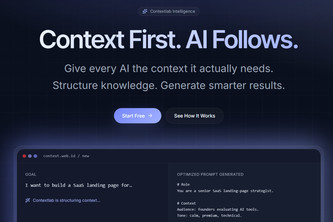
Contextlab is an AI-powered platform described by its author as a "Context Engineering" platform that aims to help users organize, optimize, and reuse knowledge across projects. It is built around the idea of structuring context for AI interactions rather than relying on repeated prompt engineering.
What changed
The project evolved from a simple prompt management tool into a more comprehensive system for managing reusable context using technologies like RAG (Retrieval-Augmented Generation), a Context Graph Engine, and modular components such as Libraries, LearnHub, Documentation, and Showcase. The author emphasizes shifting focus from prompts to structured knowledge.
Single most important open question
Is there evidence of real-world usage or adoption by users beyond the single developer who built it? The description does not indicate any customers, revenue, or traction data — only self-reported claims about functionality and vision.
What The Product Actually Is
The description states that Contextlab is an AI-powered Context Engineering platform. It helps users organize, optimize, and reuse knowledge across projects by connecting prompts with reusable assets such as:
- Context Corpus (internal RAG knowledge)
- Prompt Templates
- Libraries
- Blueprints
- Documentation
- LearnHub courses
- Showcase projects
- Website Snapshot
- Design DNA
- Context Graph
These elements are connected through a relationship engine, allowing AI to receive richer, more relevant context while reducing duplicated work and token usage.
It is built using:
- TypeScript
- Next.js
- React
- PostgreSQL
- AI Gateway (multi-provider & BYOK)
- Context Graph Engine
- Internal RAG (Context Corpus)
- Cloudflare-ready infrastructure
- Markdown-first content system
The platform supports workflows, documentation generation, reusable knowledge packs, and launching AI-ready projects from a single workspace.
Inference The product appears to be a developer-focused tool aimed at improving how context is managed for AI interactions. It is not described as a commercial SaaS offering or having any existing customer base.
Positioning & Claim Evolution
The author positions Contextlab as solving the problem of repeatedly explaining context when working with AI tools. They claim that most users spend too much time repeating explanations about their projects, brand, coding style, documentation, and goals — and that "prompt engineering alone wasn't enough."
They introduce a new concept: Context Engineering, which they define as building reusable context instead of starting from scratch every time.
The evolution described shows:
- From an idea centered on prompt management → to a full-fledged platform integrating multiple knowledge assets.
- From isolated features → to a unified ecosystem built around relationships and modularity.
- Emphasis on reducing token usage, minimizing AI calls, and making context portable across tools.
Claim
The author claims that the missing piece isn't better prompts but better context. This is a positioning statement about what problem they're solving — not proof of traction or adoption.
Target Customer & ICP
The description does not explicitly name target customers or define an ideal customer profile (ICP). However, based on the language used and technical stack, it seems likely that the intended audience includes:
- Developers
- Creators
- Teams working with AI tools
- Businesses looking to improve AI understanding of internal projects
There is no mention of specific personas, use cases, or verticals.
Inference The platform appears to be aimed at individuals and teams who interact frequently with AI systems and want to streamline how they share and manage context. It may appeal more to technical users than general consumers.
Business Model & Pricing Evidence
There is no evidence in the description of a business model or pricing structure. No mention of monetization, subscriptions, licensing, or payment methods.
Not evidenced
Technical & Delivery Signals
The platform is built with:
- TypeScript
- Next.js
- React
- PostgreSQL
- AI Gateway (multi-provider & BYOK)
- Context Graph Engine
- Internal RAG (Context Corpus)
- Cloudflare-ready infrastructure
- Markdown-first content system
It uses a modular architecture designed for scalability and reusability. Components like Libraries, Showcase, LearnHub, Documentation, and Corpus all share the same relationship engine.
Features include:
- Website Snapshot
- Context Optimizer
- DNA Design
- Prompt Studio
- Context Graph
- Reusable context injection
Inference The technical stack suggests a modern, scalable web application with AI integration capabilities. However, there is no indication of production deployment, performance metrics, or delivery history.
Traction & Maturity Signals
The description does not contain any evidence of traction or maturity indicators such as:
- Revenue
- Customers
- User base
- Product usage data
- Market validation
- Product roadmap execution
It mentions a hackathon submission (OpenAI 2026) and the author's own development process, but nothing beyond that.
Not evidenced
Competitive Context
There is no mention of competitors or competitive landscape in the description. The author does not reference other tools or platforms in this space.
Not evidenced
Open Questions & Risks
- Single Developer Team: Only one member listed (Fajar Tri), which raises questions about scalability, support, and long-term maintenance.
- No Traction or Revenue Data: No evidence of customers, users, or monetization — only self-reported claims.
- Unproven Market Demand: The platform is described as a solution to a problem, but there's no indication that this problem has been validated in the market.
- Lack of Independent Verification: Everything is self-reported and unverified; no third-party data or external validation provided.
- Ambiguity Around Commercial Viability: While it’s clear what the platform aims to do, there’s no evidence that it has moved beyond concept or prototype stage.
Questions the description leaves open
- What specific problems are you trying to solve for users? Can you describe a typical user journey?
- Have you tested this with real users? If so, what feedback did you get?
- How do you plan to monetize the platform? Is there any revenue model in place yet?
- Are there any existing partnerships or integrations with AI providers or development tools?
- What is your timeline for moving from prototype to product-market fit?
- How do you intend to scale beyond a single developer team?
- What are the key assumptions behind your approach to context engineering?
Overall Assessment
This project is described as a self-built hackathon submission with no evidence of traction, revenue, or customer adoption. The author claims to have built a platform for "Context Engineering" that connects knowledge assets through relationships and reuses them across AI workflows.
However, the description lacks any indication of:
- Real-world usage
- Revenue streams
- Customer feedback
- Product-market fit
- Scalability beyond one person
Given the lack of external validation and absence of commercial data, this project appears to be in a pre-product-market-fit phase, possibly even pre-launch.
Assessment Not ready for investment or partnership at this time. Requires further validation through user testing, market feedback, and evidence of traction before any serious consideration can be made.
User Stories BotA demo video on every pull request
Get a demo video on every new feature
GitHub App that watches your pull requests and records a narrated, captioned demo.
Save time on demo prep and make informed decisions faster with a video walkthrough of every new feature.
Source
Submitted to the OpenAI 2026 hackathon on Devpost. Project home on Devpost. Back to the full gallery on Devpost.
This competitive analysis was produced by top-founders.com (opens in a new tab)
Generated by a language model from this project's public Devpost page — its tagline, the author's own write-up and any built-with tags listed there — as captured in August 2026. Short quotations are the author's words. It is an opinion on the idea as a business, not on the people behind it, and it reflects the description as published then. If the project has moved on, request a correction below. The analysis is not independent research and contains no verified traction, revenue or customer data.
An independent guide by KFG International LLC — not affiliated with, endorsed by, or connected to Devpost or OpenAI.