

Archive position — measured, not model output
0 likes on Devpost
2,263 of the 7,850 archived projects have more likes, and 5,587 share exactly 0 — so this project's #3,495 place in the like-ranked listing is a tie-break inside that group, not a ranking.
Projects (log scale)
Likes on Devpost. ▲ marks this project's group.
Show the figures
| Likes | Projects | Share of archive |
|---|---|---|
| 0 | 5,587 | 71.2% |
| 1 | 1,758 | 22.4% |
| 2 | 284 | 3.6% |
| 3–4 | 132 | 1.7% |
| 5–9 | 75 | 1.0% |
| 10+ | 14 | 0.2% |
 User Stories BotA demo video on every pull request
Get a demo video on every new feature
GitHub App that watches your pull requests and records a narrated, captioned demo.
Save time on demo prep and make informed decisions faster with a video walkthrough of every new feature.
Executive Summary
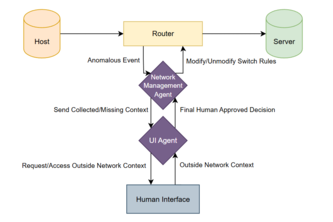
What the company appears to be: ContextScout is a self-reported project that describes an AI-powered network security system designed to integrate human context into automated security decisions. The system uses two cooperating AI agents — one monitoring network events and another communicating with humans in group chat — to validate and temporarily allow blocked connections based on organizational knowledge.
What changed: This is a hackathon submission (submitted to OpenAI 2026). It represents an early-stage concept, not a product or service in production. The description indicates no revenue, customers, or traction beyond the demo.
Single most important open question: Is there any evidence that this system has been tested in real-world environments or integrated into existing security infrastructure?
Note: All findings are based on self-reported information from the author’s own description. No external verification or historical data is available. The project is presented as a concept, not a functioning product.
What The Product Actually Is
The description states that ContextScout combines two AI agents:
- A Network Agent, which monitors blocked network activity, analyzes events, requests context, validates responses, and updates firewalls.
- A Chat Agent, which communicates with authorized users in group chat to retrieve organizational context.
These agents work together to enable a workflow where:
- A connection is blocked.
- The system identifies missing context.
- It sends a structured request to the chat agent.
- An authorized human confirms or denies access.
- If approved, a limited, temporary firewall rule is applied and automatically removed after expiration.
The system is described as being built using:
- API
- Codex
- OpenAI Agents SDK
Inference: The product appears to be an experimental prototype for integrating AI-driven security with human-in-the-loop decision-making. It is not a commercial offering but rather a proof-of-concept.
Positioning & Claim Evolution
The description claims that modern network security tools detect suspicious activity but lack understanding of real-world reasons behind it. The project positions itself as solving this gap by enabling AI agents to seek trusted human input for context.
Key claims include:
- Making missing-context acquisition an integral part of the network defense agent’s reasoning loop.
- Providing a safe way for AI agents to ask humans for organizational context.
- Reducing unnecessary security blocks through contextual validation.
Claim vs Fact: These are stated intentions, not evidence of traction or adoption. The project is described as a hackathon demo with no indication of prior use in production environments.
Target Customer & ICP
The description does not clearly identify specific customer segments or personas. However, it implies that the target users are:
- Network security teams
- System administrators or IT managers who manage firewall rules
- Organizations with complex network access policies and need to balance automation with human oversight
It also suggests a role for:
- Authorized employees or managers who can validate access requests
- Incident response personnel
Inference: The system targets enterprise-level cybersecurity operations where human context is needed to make nuanced decisions about network access. However, no explicit ICP (Ideal Customer Profile) was defined.
Business Model & Pricing Evidence
There is no evidence of pricing or business model in the description. The project is described as a hackathon submission and lacks any indication of monetization strategy, customer acquisition plans, or revenue streams.
Not evidenced: No mention of how the solution would be sold, priced, or deployed commercially.
Technical & Delivery Signals
The system is built using:
- APIs
- Codex
- OpenAI Agents SDK
It includes features like:
- Structured context requests
- Temporary rule enforcement with expiration
- Audit logging
- Group chat integration
- Event grouping to avoid duplicate alerts
Inference: The technical architecture involves AI agents communicating across systems, suggesting a modular and scalable approach. However, no details on scalability, performance, or deployment methods are provided.
Traction & Maturity Signals
The project is described as a hackathon submission (Devpost entry for OpenAI 2026). No evidence of:
- Revenue
- Customers
- Product-market fit
- User adoption
- Market traction
- Post-demo development or iteration
Not evidenced: There is no indication that the system has moved beyond prototype stage or been tested in real-world settings.
Competitive Context
The description does not reference competitors directly. However, it implies a space involving:
- AI-powered network security tools
- Human-in-the-loop security workflows
- Context-aware access control systems
It appears to align with trends in:
- Zero Trust architectures
- AI-assisted incident response
- Automated threat detection with human validation
Inference: While not explicitly named, the system likely competes or overlaps with solutions in the AI-driven cybersecurity and network access management space. No competitive analysis was provided.
Open Questions & Risks
Key risks and open questions based on the description:
- Unproven concept: The project is a hackathon demo with no evidence of real-world testing.
- Limited scope: Only one scenario (VPN access) is demonstrated; no indication of broader applicability.
- Human dependency: Reliance on human approval introduces potential bottlenecks and inconsistency.
- Security assumptions: Assumes that chat-based communication can reliably provide trusted context without additional authentication or verification layers.
- No scalability claims: No evidence of how the system would scale beyond a single demo.
Inference: The project lacks maturity, traction, and commercial viability indicators. It may be more of an idea than a product ready for market.
Questions the description leaves open
- What specific use cases or industries have you considered for this system?
- How would you ensure that only verified users can approve network changes?
- Have you tested the system with actual network security tools or platforms?
- What are the limitations of the current prototype in terms of performance, reliability, and scalability?
- Are there any known edge cases or failure modes in the human-in-the-loop process?
- How do you plan to integrate this into existing enterprise environments?
- What is your roadmap for moving from a demo to a production-ready solution?
Overall Assessment
This project is described as a hackathon submission and represents an early-stage idea or prototype. There is no evidence of:
- Revenue
- Customers
- Traction
- Product-market fit
- Commercial readiness
Assessment: Not suitable for investment or partnership at this stage. It requires further development, testing, and demonstration of real-world utility before any strategic consideration can be made.
User Stories BotA demo video on every pull request
Get a demo video on every new feature
GitHub App that watches your pull requests and records a narrated, captioned demo.
Save time on demo prep and make informed decisions faster with a video walkthrough of every new feature.
Source
Submitted to the OpenAI 2026 hackathon on Devpost. Project home on Devpost. Back to the full gallery on Devpost.
This competitive analysis was produced by top-founders.com (opens in a new tab)
Generated by a language model from this project's public Devpost page — its tagline, the author's own write-up and any built-with tags listed there — as captured in August 2026. Short quotations are the author's words. It is an opinion on the idea as a business, not on the people behind it, and it reflects the description as published then. If the project has moved on, request a correction below. The analysis is not independent research and contains no verified traction, revenue or customer data.
An independent guide by KFG International LLC — not affiliated with, endorsed by, or connected to Devpost or OpenAI.