

Archive position — measured, not model output
0 likes on Devpost
2,263 of the 7,850 archived projects have more likes, and 5,587 share exactly 0 — so this project's #5,458 place in the like-ranked listing is a tie-break inside that group, not a ranking.
Projects (log scale)
Likes on Devpost. ▲ marks this project's group.
Show the figures
| Likes | Projects | Share of archive |
|---|---|---|
| 0 | 5,587 | 71.2% |
| 1 | 1,758 | 22.4% |
| 2 | 284 | 3.6% |
| 3–4 | 132 | 1.7% |
| 5–9 | 75 | 1.0% |
| 10+ | 14 | 0.2% |
 User Stories BotA demo video on every pull request
Get a demo video on every new feature
GitHub App that watches your pull requests and records a narrated, captioned demo.
Save time on demo prep and make informed decisions faster with a video walkthrough of every new feature.
Executive Summary
What the company appears to be
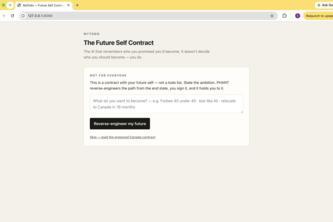
MyTodo is an AI-powered system that enables users to create "Future Self Contracts" — self-imposed commitments to ambitious goals. It reverse-engineers these goals into structured agreements, then monitors progress and intervenes when divergence occurs. The system is designed to strategically reason about user behavior without overriding agency.
What changed
This project was submitted as part of the OpenAI 2026 hackathon. It represents a conceptual prototype for an AI-driven goal alignment tool, not a commercial product or service with users or revenue.
The single most important open question
Is there evidence that MyTodo has moved beyond a hackathon idea into a viable product or business model? The description does not indicate any traction, customers, or monetization strategy.
What The Product Actually Is
- The description states: “MyTodo is an AI Future Self Contract.”
- It reverse-engineers ambitious goals into dated commitments, assumptions, and non-negotiable constraints.
- Once signed, the contract becomes something the AI can strategically reason about over time.
- It follows four steps:
- Reverse-engineer goals into a Future Self Contract.
- Detect divergence between commitments and reality.
- Proactively intervene when users drift from their goals.
- Renegotiate when assumptions materially change.
- The AI is described as not shaming, manipulating, or overriding users; interventions are grounded in voluntary agreements.
Inference The system appears to be a conceptual prototype for an AI-driven goal alignment engine, not a finished product with real-world deployment or user interaction.
Positioning & Claim Evolution
- The description states: “Today's AI assistants help you do what you want right now. MyTodo helps you become who you said you wanted to become.”
- It positions itself as:
- Not a todo list.
- Not an AI coach.
- Not an AI therapist.
- Not an accountability app.
- Not an AI companion.
- Instead, it is described as “an AI system for strategic goal alignment.”
Inference The positioning emphasizes a shift from task-based AI tools to a more philosophical and long-term alignment tool. This is a conceptual evolution from productivity to personal development.
Target Customer & ICP
- The description states: “You declare an ambitious goal—becoming a professional boxer, making the Forbes 40 Under 40 list, relocating to another country, or building a company.”
- It targets users with ambitious, long-term goals.
- The system is designed for people who want to remain aligned with their aspirations over time.
Inference The ICP appears to be self-motivated individuals with high ambitions and a desire for structured support in maintaining goal alignment. No specific demographic or industry data is provided.
Business Model & Pricing Evidence
- Not evidenced.
- The description does not mention pricing, monetization, or any business model.
Inference There is no evidence of a business model or pricing strategy beyond the idea being a hackathon submission.
Technical & Delivery Signals
- Built with:
- OpenAI (GPT-4o)
- FastAPI
- Python
- SQLite
- HTML, CSS, JavaScript
- SQLAlchemy
- GitHub
- The AI is used for:
- Goal decomposition and contract generation.
- Strategic intervention rendering.
- Structured reasoning over user updates.
- Streaming responses during proactive interventions.
Inference The technical stack suggests a prototype built with modern AI and web development tools. No evidence of production deployment or scalability.
Traction & Maturity Signals
- Not evidenced.
- The project is described as a hackathon submission.
- No mention of users, customers, revenue, or adoption.
Inference There are no signs of traction or maturity beyond the initial concept and prototype stage.
Competitive Context
- Not evidenced.
- No mention of competitors or market analysis in the description.
Inference No competitive positioning or market context is provided. The project does not appear to be part of an existing market or ecosystem.
Open Questions & Risks
- The system is described as a hackathon prototype with no evidence of real-world use.
- It is unclear whether the AI can actually detect divergence or intervene in practice.
- The claim that the AI “can recommend, disagree, and renegotiate—but it can never decide who users should become” raises questions about how such a system would function without clear decision-making logic.
- No evidence of user testing, feedback loops, or iterative development.
Inference The project is in an early conceptual phase. Risks include lack of real-world validation, unclear technical execution, and absence of any commercial viability indicators.
Questions the description leaves open
- What specific mechanisms does MyTodo use to detect divergence from a goal?
- How does the system handle cases where users intentionally change their goals?
- Has the AI been tested with real users or only in simulation?
- What is the plan for monetization, if any?
- Are there any existing users or pilot programs?
Overall Assessment
- Not evidenced.
- The project is described as a hackathon submission and lacks evidence of traction, revenue, or business model.
- No indication that it has moved beyond a prototype stage.
Inference At this stage, MyTodo is not a viable investment or partnership opportunity. It is a conceptual idea with no demonstrated commercial potential or user engagement.
User Stories BotA demo video on every pull request
Get a demo video on every new feature
GitHub App that watches your pull requests and records a narrated, captioned demo.
Save time on demo prep and make informed decisions faster with a video walkthrough of every new feature.
Source
Submitted to the OpenAI 2026 hackathon on Devpost. Project home on Devpost. Back to the full gallery on Devpost.
This competitive analysis was produced by top-founders.com (opens in a new tab)
Generated by a language model from this project's public Devpost page — its tagline, the author's own write-up and any built-with tags listed there — as captured in August 2026. Short quotations are the author's words. It is an opinion on the idea as a business, not on the people behind it, and it reflects the description as published then. If the project has moved on, request a correction below. The analysis is not independent research and contains no verified traction, revenue or customer data.
An independent guide by KFG International LLC — not affiliated with, endorsed by, or connected to Devpost or OpenAI.