

Archive position — measured, not model output
0 likes on Devpost
2,263 of the 7,850 archived projects have more likes, and 5,587 share exactly 0 — so this project's #7,421 place in the like-ranked listing is a tie-break inside that group, not a ranking.
Projects (log scale)
Likes on Devpost. ▲ marks this project's group.
Show the figures
| Likes | Projects | Share of archive |
|---|---|---|
| 0 | 5,587 | 71.2% |
| 1 | 1,758 | 22.4% |
| 2 | 284 | 3.6% |
| 3–4 | 132 | 1.7% |
| 5–9 | 75 | 1.0% |
| 10+ | 14 | 0.2% |
 User Stories BotA demo video on every pull request
Get a demo video on every new feature
GitHub App that watches your pull requests and records a narrated, captioned demo.
Save time on demo prep and make informed decisions faster with a video walkthrough of every new feature.
Executive Summary
Project: Tutori
Self-reported basis: The description is entirely from the author’s own write-up, submitted to the OpenAI 2026 hackathon on Devpost. No external verification, revenue, customer or traction data is available beyond what is stated.
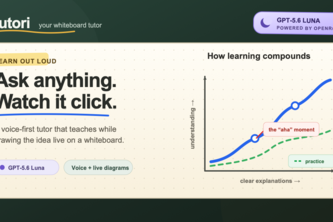
What it appears to be: A browser-based voice tutor that delivers spoken and visual lessons using an agentic AI system. It uses a continuous whiteboard to teach topics by speaking and drawing live in real time.
What changed: The project was built as part of a hackathon, with no evidence of prior development or commercial use beyond the prototype.
Single most important open question: Is there any evidence that this concept has traction, adoption, or a path to monetization — or even a viable product-market fit?
What The Product Actually Is
The description states that Tutori is an agentic voice tutor that teaches topics by speaking and drawing live on a continuous whiteboard. It uses AI to plan lessons, generate narration, and produce structured visual operations (e.g., boxes, arrows, labels) that are rendered in real time.
- The system is built with Python and Gradio.
- It integrates GPT-5.6 Luna via OpenRouter for planning and coaching.
- Whisper Large V3 Turbo handles transcription.
- GPT Audio Mini generates narration.
- A custom HTML Canvas whiteboard renders visual elements.
- Board operations are validated and constrained by a layout layer to avoid collisions or poor placement.
Inference: The product is a prototype, not a commercial offering. It is described as open-source and live, but no evidence of monetization or user base exists.
Positioning & Claim Evolution
The author claims that Tutori brings the “feeling” of real teaching into a browser — where teachers talk, sketch, revise, point, and pace lessons around learners. It contrasts with AI tutors that explain with paragraphs.
- The system supports voice or text input, and allows follow-up questions.
- Lessons are multi-minute, not brief answers.
- It uses a continuous whiteboard that can be reused and cleared selectively.
- It is described as mobile-friendly and fully open source.
Inference: The positioning is that of an interactive, agentic educational tool — not a chatbot or static visual aid. However, the claim of “real teaching” is self-reported and not substantiated by any external data or user feedback.
Target Customer & ICP
The description does not state who the intended users are beyond general learners or students.
- The system supports voice or text input, suggesting a broad audience.
- It is designed to teach any topic.
- It is described as a browser-based tool, implying accessibility across platforms.
Inference: The ICP is likely students, educators, or self-learners who benefit from visual and spoken explanations. However, no specific persona or segment is defined.
Business Model & Pricing Evidence
The description does not mention any business model, pricing, or monetization strategy.
- It is described as open source under Apache 2.0.
- No revenue streams, subscriptions, or licensing are mentioned.
- The project was built for a hackathon and is not presented as a commercial product.
Inference: There is no evidence of a business model or pricing structure. The tool is open-source and likely not monetized at this stage.
Technical & Delivery Signals
The system is built using:
- Python, Gradio, HTML5 Canvas
- GPT-5.6 Luna (via OpenRouter)
- Whisper Large V3 Turbo for transcription
- GPT Audio Mini for narration
- Pitch-preserving audio filter
Key technical features include:
- Streaming of narration and board events
- Structured drawing operations (boxes, arrows, erasures)
- Layout layer to manage spatial constraints and collisions
- Deterministic post-processing for visual clarity
Inference: The system is a prototype with strong engineering effort, but it has not been scaled or deployed in production. It is described as live and mobile-friendly, but no evidence of performance or scalability exists.
Traction & Maturity Signals
The description states:
- The project was built for a hackathon.
- It is live and open source.
- It is mobile-friendly.
- It supports multi-minute lessons with follow-up questions.
However, there is no evidence of:
- User adoption or engagement
- Customer feedback or usage metrics
- Revenue or monetization
- Product-market fit or traction
Inference: The project is at a very early stage, likely a prototype or proof-of-concept. No signs of traction or maturity beyond the hackathon.
Competitive Context
The description does not mention any competitors or market context.
- It is not clear whether similar tools exist in the market.
- No comparison to existing AI tutors, educational platforms, or whiteboard tools is made.
Inference: There is no evidence of competitive analysis or positioning in the market. The author does not describe how Tutori compares to other tools.
Open Questions & Risks
- No traction or revenue: The project is a prototype with no evidence of adoption.
- Unproven business model: No monetization strategy or pricing structure is evident.
- Highly technical prototype: Likely not ready for production or commercial use.
- Self-reported claims: All descriptions are unverified and lack external corroboration.
- No user feedback or data: No evidence of how users interact with the system.
Inference: The project is a conceptual prototype, not a product in the market. It may have potential, but there is no evidence of viability or demand.
Questions the description leaves open
- What is the intended user segment and how did you identify them?
- How do you plan to monetize this tool if at all?
- Have you tested it with real users? What feedback have you received?
- What are the technical limitations of scaling this system?
- Are there any existing educational or tutoring platforms that this might compete with or complement?
Overall Assessment
Not evidenced: There is no evidence of traction, revenue, customers, or a clear path to monetization.
Confidence level: Very low — this is a self-reported hackathon prototype, not a commercial product. The author states the tool is live and open-source, but there is no indication of adoption, user engagement, or business model.
Inference: This project is at an early stage of development and may be a conceptual or experimental idea with potential, but it does not yet meet criteria for investment or partnership.
User Stories BotA demo video on every pull request
Get a demo video on every new feature
GitHub App that watches your pull requests and records a narrated, captioned demo.
Save time on demo prep and make informed decisions faster with a video walkthrough of every new feature.
Source
Submitted to the OpenAI 2026 hackathon on Devpost. Project home on Devpost. Back to the full gallery on Devpost.
This competitive analysis was produced by top-founders.com (opens in a new tab)
Generated by a language model from this project's public Devpost page — its tagline, the author's own write-up and any built-with tags listed there — as captured in August 2026. Short quotations are the author's words. It is an opinion on the idea as a business, not on the people behind it, and it reflects the description as published then. If the project has moved on, request a correction below. The analysis is not independent research and contains no verified traction, revenue or customer data.
An independent guide by KFG International LLC — not affiliated with, endorsed by, or connected to Devpost or OpenAI.