

Archive position — measured, not model output
0 likes on Devpost
2,263 of the 7,850 archived projects have more likes, and 5,587 share exactly 0 — so this project's #5,457 place in the like-ranked listing is a tie-break inside that group, not a ranking.
Projects (log scale)
Likes on Devpost. ▲ marks this project's group.
Show the figures
| Likes | Projects | Share of archive |
|---|---|---|
| 0 | 5,587 | 71.2% |
| 1 | 1,758 | 22.4% |
| 2 | 284 | 3.6% |
| 3–4 | 132 | 1.7% |
| 5–9 | 75 | 1.0% |
| 10+ | 14 | 0.2% |
 User Stories BotA demo video on every pull request
Get a demo video on every new feature
GitHub App that watches your pull requests and records a narrated, captioned demo.
Save time on demo prep and make informed decisions faster with a video walkthrough of every new feature.
Executive Summary
Company: Mytion
Self-reported basis: The description is entirely self-reported by the author and unverified. No archived evidence, third-party sources or independent corroboration are available.
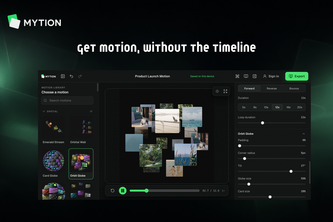
Commercial due-diligence read: Mytion appears to be a browser-based creative tool for generating motion from static visuals, with local-first privacy and deterministic rendering. It is positioned as a no-account, approachable alternative to traditional timeline-based animation tools. The most important open question is whether the product can scale beyond a single creator's workflow into collaborative or production environments.
What The Product Actually Is
The description states that Mytion is a local-first browser motion studio that turns static designs and images into polished motion. It supports:
- 50++ original motion systems
- Media import, reorder, crop, replace, duplicate, remove workflows
- Aspect ratio selection
- Controls for timing, pace, direction, easing, depth, spacing, and motion-specific parameters
- Browser-native export in formats like WebM, MP4, transparent WebM, true-alpha PNG sequence ZIP, CapCut-ready green-screen workflow
- Local autosave and recovery
The product is built with React, TypeScript, Vite, and uses Canvas 2D rendering. It includes a deterministic renderer shared between preview and export.
Inference: The tool appears to be a browser-based creative environment focused on motion design, not a general-purpose animation suite or timeline editor.
Positioning & Claim Evolution
The author states that Mytion was built to close the gap between static work and motion creation. It is positioned as:
- A fast, approachable alternative to traditional timeline-based tools
- A tool that avoids templates but still provides reusable systems
- A local-first privacy-focused product with no account required
- A browser-native experience with deterministic output
It claims to offer creative control, local-first privacy, and export without a timeline.
Inference: The positioning evolved from a simple renderer demo into a complete product experience, emphasizing ease-of-use, creative control, and local-first principles.
Target Customer & ICP
The description does not state the target customer or ideal customer profile (ICP). It implies that creators with static work who want to animate it are the intended users, but no specific segment is named.
Inference: The likely audience includes individual designers, developers, or content creators who want to animate visuals quickly and without complex workflows. No evidence of enterprise, team, or commercial use cases is provided.
Business Model & Pricing Evidence
The description does not provide any information on pricing, monetization, or business model. It states that users can open the Studio without creating an account, but no details are given about:
- Revenue streams
- Subscription tiers
- Freemium offerings
- Paid features
Inference: No evidence of a business model is present in the description.
Technical & Delivery Signals
The product is built with:
- Frontend: React, TypeScript, Vite, Canvas 2D
- Backend/Infrastructure: Supabase (PostgreSQL, authentication), IndexedDB, Dexie
- AI Tools: Codex, GPT-5.6 used for implementation, debugging, testing, and documentation
- Export Formats: WebM, MP4, transparent WebM, PNG sequence ZIP, CapCut-ready green-screen workflow
The system uses a deterministic renderer shared between preview and export to ensure consistency.
Inference: The technical stack suggests a modern, browser-native approach with local-first storage and AI-assisted development. No evidence of cloud-based rendering or complex infrastructure is provided.
Traction & Maturity Signals
The description states:
- Team size: 0
- No mention of users, customers, or adoption
- No revenue or funding data
- No product roadmap beyond the immediate next steps (e.g., AI agents, audio support, collaboration)
Inference: There is no evidence of traction, customer base, or commercial adoption. The project appears to be a prototype or early-stage tool.
Competitive Context
The description does not mention competitors or market positioning relative to existing tools. It implies that Mytion fills a gap in the market between static design and traditional timeline-based animation tools.
Inference: No competitive landscape is described, so no direct comparison to existing tools is possible from this report.
Open Questions & Risks
- No team size or structure: The project has 0 team members, which raises questions about scalability, maintenance, and execution.
- No revenue or traction: No evidence of monetization, users, or adoption.
- Unproven business model: No pricing, monetization, or commercial strategy is described.
- AI dependency: Reliance on Codex and GPT-5.6 for development may indicate a lack of in-house engineering depth or long-term sustainability.
- Limited scope: The tool is described as local-first and single-user, with no mention of collaboration or team features.
Inference: The project lacks commercial viability indicators and appears to be a prototype or personal endeavor rather than a scalable product.
Questions the description leaves open
- What is the long-term vision for Mytion beyond its current single-user, local-first scope?
- How does the team plan to scale beyond 0 members?
- Are there any plans to monetize or generate revenue from the tool?
- What are the technical limitations of browser-native export and how are they being addressed?
- How is the deterministic renderer validated for consistency across preview and export?
- Is there a plan to support team collaboration or shared projects?
- What is the roadmap for expanding the motion library and adding AI features?
Overall Assessment
Not evidenced: No data on revenue, customers, traction, or funding is available. The project appears to be an early-stage prototype with no commercial evidence.
Confidence level: Very low — based entirely on self-reported claims with no external validation or traction indicators.
Assessment: The product is a browser-based creative tool focused on local-first motion design and deterministic output. It is not evidenced as having traction, revenue, or a clear business model. It may be a prototype or personal project rather than a scalable venture.
User Stories BotA demo video on every pull request
Get a demo video on every new feature
GitHub App that watches your pull requests and records a narrated, captioned demo.
Save time on demo prep and make informed decisions faster with a video walkthrough of every new feature.
Source
Submitted to the OpenAI 2026 hackathon on Devpost. Project home on Devpost. Back to the full gallery on Devpost.
This competitive analysis was produced by top-founders.com (opens in a new tab)
Generated by a language model from this project's public Devpost page — its tagline, the author's own write-up and any built-with tags listed there — as captured in August 2026. Short quotations are the author's words. It is an opinion on the idea as a business, not on the people behind it, and it reflects the description as published then. If the project has moved on, request a correction below. The analysis is not independent research and contains no verified traction, revenue or customer data.
An independent guide by KFG International LLC — not affiliated with, endorsed by, or connected to Devpost or OpenAI.