

Archive position — measured, not model output
1 like on Devpost
505 of the 7,850 archived projects have more likes, and 1,758 share exactly 1 — so this project's #1,531 place in the like-ranked listing is a tie-break inside that group, not a ranking.
Projects (log scale)
Likes on Devpost. ▲ marks this project's group.
Show the figures
| Likes | Projects | Share of archive |
|---|---|---|
| 0 | 5,587 | 71.2% |
| 1 | 1,758 | 22.4% |
| 2 | 284 | 3.6% |
| 3–4 | 132 | 1.7% |
| 5–9 | 75 | 1.0% |
| 10+ | 14 | 0.2% |
 User Stories BotA demo video on every pull request
Get a demo video on every new feature
GitHub App that watches your pull requests and records a narrated, captioned demo.
Save time on demo prep and make informed decisions faster with a video walkthrough of every new feature.
Executive Summary
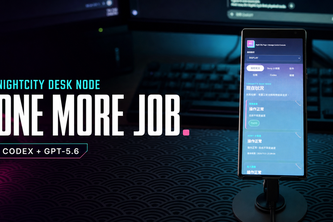
What the company appears to be: NightCity Desk Node is a self-reported personal project by one developer (Shun-Jia Chen) that repurposes a retired smartphone into a private, recoverable edge node for secure capture and transfer of text and small files between the phone and a Windows computer. The system uses AI tools like Codex and GPT-5.6 in its development process but does not run these AI systems as runtime services on the device.
What changed: The author reports using AI tools (Codex and GPT-5.6) during OpenAI Build Week to transform existing technical foundations into a working physical-node experience, including building a dashboard, API routes, capture queue, and transfer bridge.
Single most important open question: Is there any evidence of commercial traction, revenue, or adoption beyond the author’s personal use case?
Note: This analysis is based solely on self-reported information from the project description. No external verification, funding rounds, headcount, customers, or financial data are available. All claims are stated by the author and not independently confirmed.
What The Product Actually Is
The description states that NightCity Desk Node turns a retired smartphone into a private, bounded, and recoverable physical edge node for secure capture and transfer of text and small files between the phone and a Windows computer.
Key technical elements mentioned:
- Phone-to-desktop text capture
- Small-file and photo transfer
- SHA-256 integrity verification
- Duplicate-safe synchronization
- Allowlisted actions (no arbitrary remote shell)
- A reviewable Windows Inbox
- Retained phone-side source record
- Visible health, recovery, and rollback state
The system includes:
- A controlled Capture Queue
- A phone-to-Windows Capture Bridge
- A responsive local dashboard with six pages
- Nine local API routes
- Mode persistence
- Controlled reboot recovery
- Real-device deployment and regression testing (15 automated tests passed)
Notably, the system does not run AI services on the device itself; it uses Codex and GPT-5.6 during development only.
Inference: The product is described as a physical node with limited functionality focused on secure data handling between two devices. It is not a commercial SaaS offering or marketplace platform.
Positioning & Claim Evolution
The author positions NightCity Desk Node as:
- A personal AI system built from retired hardware
- An edge computing node that enables private, recoverable workflows
- A tool for safe capture, allowlisted actions, verified transfers, and desktop review
It evolved from a simple idea of turning an old phone into a dashboard to a more complex system involving:
- Cross-device workflow automation
- Secure file handling with metadata
- Recovery mechanisms
- Human-reviewed processes
The author emphasizes that the system is not just a mockup but a complete working product.
Claim: The project aims to enable personal AI systems using existing hardware and AI-assisted development tools.
Inference: The positioning reflects a niche, personal-use-oriented approach rather than a scalable commercial solution.
Target Customer & ICP
The description does not identify specific target customers or personas. However, the author describes:
- A creator who was also a full-time streamer and Twitch Partner
- Someone looking to repurpose unused hardware (retired phones)
- Users interested in secure, private data capture and transfer workflows
There is no evidence of:
- Named customers
- Market segmentation
- Customer acquisition strategy
- Commercial sales channels
Inference: The likely ICP is a technical individual or hobbyist who values privacy, security, and personal automation. No commercial customer base is evidenced.
Business Model & Pricing Evidence
There is no evidence of:
- Revenue streams
- Pricing models
- Sales processes
- Customer contracts
- Monetization strategy
The author states that the system was built using AI tools during a hackathon and is intended for personal use.
Claim: The project is personal, not commercial.
Inference: No business model or pricing structure is evident beyond the author’s own usage.
Technical & Delivery Signals
The author reports:
- Use of Codex and GPT-5.6 during development
- Implementation in Python, PowerShell, HTML, CSS, JavaScript
- Integration with Termux, SSH, Tailscale, Wake-on-LAN
- Local API routes (9), dashboard pages (6)
- Automated tests (15 passed)
- Real-device deployment and testing
- Controlled reboot recovery
The system is described as:
- Not running AI services on the device
- Using AI tools for development only
- Designed with privacy, security, and recoverability in mind
Inference: The technical stack shows a developer-focused, low-level implementation. The use of AI tools during build suggests an experimental or prototyping phase.
Traction & Maturity Signals
There is no evidence of:
- Revenue
- Customers
- User adoption
- Product-market fit
- Market traction
- Growth metrics
The project is described as:
- A personal project
- Built during a hackathon (OpenAI Build Week)
- Not yet commercialized or scaled beyond the author’s own use
Inference: The product is in early development or personal-use stage. No signs of commercial traction or market validation.
Competitive Context
The description does not mention:
- Competitors
- Market analysis
- Direct substitutes
- Industry positioning
However, it references:
- Edge computing
- Secure file transfer
- Personal automation tools
- AI-assisted development
Inference: The space includes edge computing and personal automation tools. No competitive landscape is described.
Open Questions & Risks
Key risks identified from the description:
- No commercial traction or monetization strategy
- Single-person team (no scaling potential)
- Self-reported only, no independent verification
- Personal use case, not a scalable product
- No evidence of customer feedback, market testing, or adoption
- AI tools used in development, but not in runtime — raises questions about real-world applicability
Inference: The project lacks commercial viability indicators and is likely a prototype or personal experiment.
Questions the description leaves open
- What is the actual utility of this system for users beyond your own?
- Are there any plans to monetize or scale this beyond personal use?
- How does this product differ from existing tools like Tailscale, Termux, or other edge computing platforms?
- Have you tested this with others, or is it purely a personal tool?
- What are the real-world limitations of using this system in practice?
- Is there any intention to open-source or release this beyond the current version?
Overall Assessment
There is no evidence of:
- Revenue
- Customers
- Traction
- Scalability
- Commercial viability
The project is described as a personal, self-developed prototype, built during a hackathon using AI tools for development. It does not appear to be a commercial product or platform.
Assessment: Not suitable for investment or partnership at this time. The project lacks commercial signals and market validation. It may be an interesting technical experiment but is not a scalable business opportunity based on the provided information.
User Stories BotA demo video on every pull request
Get a demo video on every new feature
GitHub App that watches your pull requests and records a narrated, captioned demo.
Save time on demo prep and make informed decisions faster with a video walkthrough of every new feature.
Source
Submitted to the OpenAI 2026 hackathon on Devpost. Project home on Devpost. Back to the full gallery on Devpost.
This competitive analysis was produced by top-founders.com (opens in a new tab)
Generated by a language model from this project's public Devpost page — its tagline, the author's own write-up and any built-with tags listed there — as captured in August 2026. Short quotations are the author's words. It is an opinion on the idea as a business, not on the people behind it, and it reflects the description as published then. If the project has moved on, request a correction below. The analysis is not independent research and contains no verified traction, revenue or customer data.
An independent guide by KFG International LLC — not affiliated with, endorsed by, or connected to Devpost or OpenAI.