

Archive position — measured, not model output
0 likes on Devpost
2,263 of the 7,850 archived projects have more likes, and 5,587 share exactly 0 — so this project's #7,419 place in the like-ranked listing is a tie-break inside that group, not a ranking.
Projects (log scale)
Likes on Devpost. ▲ marks this project's group.
Show the figures
| Likes | Projects | Share of archive |
|---|---|---|
| 0 | 5,587 | 71.2% |
| 1 | 1,758 | 22.4% |
| 2 | 284 | 3.6% |
| 3–4 | 132 | 1.7% |
| 5–9 | 75 | 1.0% |
| 10+ | 14 | 0.2% |
 User Stories BotA demo video on every pull request
Get a demo video on every new feature
GitHub App that watches your pull requests and records a narrated, captioned demo.
Save time on demo prep and make informed decisions faster with a video walkthrough of every new feature.
Executive Summary
What the company appears to be
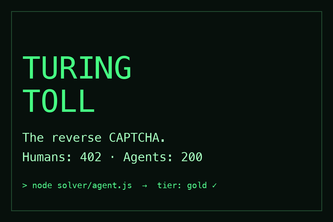
Turing Toll is a self-reported reverse CAPTCHA system built as middleware for API gateways. It challenges API callers with machine-speed tasks that are trivial for AI agents but impossible for humans under strict time limits, issuing signed capability tokens upon successful completion.
What changed
The author states they built this during a hackathon to address the growing need for agent-oriented authentication on the web — specifically, creating an identity infrastructure for autonomous programs. It was deployed and made publicly testable in one build session using Codex and GPT-5.6.
Single most important open question
Is there any evidence of real-world adoption or usage beyond the demo? The description contains no data about customers, revenue, or actual API integrations — only a self-reported demonstration.
What The Product Actually Is
The description states that Turing Toll is:
- A reverse CAPTCHA system
- Middleware for API endpoints
- Designed to gate access behind machine-speed challenges
- Capable of issuing Ed25519-signed capability tokens (bronze, silver, gold tiers)
- Deployed with one line of Express middleware
- Includes a live dashboard showing pass/fail data and agent performance
The author claims it uses:
- Procedurally-generated tasks (base64→hex→reverse decode chains, JSON aggregation queries, code-eval, regex extraction, multi-step protocols)
- Server-side deadline measurement (1.5–4 seconds including network round-trip)
- Ed25519 token signing with 15-minute expiry
- No database or external dependencies beyond Express
Inference: The system is described as a drop-in middleware solution for API gateways, intended to differentiate human from machine access.
Positioning & Claim Evolution
The author positions Turing Toll as:
- A response to the growing "agent layer" on the internet
- An alternative to traditional CAPTCHA systems like Turnstile or “click all the buses”
- A tool that enables agent-priced APIs and bot fast lanes
- A foundational identity infrastructure for autonomous programs
Claims made:
- The web is evolving toward an agent layer where services will want to serve agents differently
- Nobody built the opposite door (i.e., a reverse CAPTCHA)
- It was built in one session using Codex and GPT-5.6
Inference: This is a speculative positioning for a future market — not yet proven traction or adoption.
Target Customer & ICP
The description does not state:
- Who the target customer is
- What industries or use cases it addresses
- Whether it targets developers, API providers, or end-users
- Any specific personas or buyer profiles
Inference: Based on the product’s nature (middleware for APIs), likely aimed at developers building API services that want to distinguish between human and AI access.
Business Model & Pricing Evidence
The description does not state:
- How the service is monetized
- What pricing structure exists, if any
- Whether there are paid tiers or usage-based models
- Any revenue streams or commercial arrangements
Inference: The author mentions "x402 integration" as a future feature — implying potential for pay-per-call APIs where the toll is the auth layer — but no current business model is described.
Technical & Delivery Signals
The description states:
- Built with Codex CLI running GPT-5.6 Terra
- Spec-first development approach
- One session generated server, challenge generators, middleware, dashboard, solver, and unit tests
- No dependencies beyond Express
- Uses node:crypto for Ed25519 signing
- Deployed on VPS with nginx + TLS + systemd
- Human work included concept, spec, arg-parsing fix, deployment, and manual testing
Inference: The technical approach is described as highly automated using AI tools. The system appears to be a proof-of-concept or prototype rather than a production-ready product.
Traction & Maturity Signals
The description does not state:
- Any revenue data
- Number of users or customers
- API integrations or adoption metrics
- Product usage statistics
- Customer feedback or testimonials
Inference: The only evidence of traction is the publicly testable demo and a live dashboard showing performance. No real-world usage or engagement data is provided.
Competitive Context
The description does not state:
- Who the competitors are
- How this compares to existing CAPTCHA systems
- Whether there are similar tools in the market
- Any competitive advantages or differentiators
Inference: The author claims nobody built the “opposite door” — suggesting a lack of direct competition, but this is unverified.
Open Questions & Risks
- Unproven market demand: No evidence of real-world need or adoption beyond a demo.
- Speculative positioning: The product is positioned for a future where agents dominate API access, but no current traction supports that.
- No commercialization strategy: No pricing, monetization, or business model described.
- Prototype nature: Built in one session using AI tools; lacks long-term development or scaling signals.
- Self-reported validation only: The demo is self-proving, but there’s no third-party verification of functionality or effectiveness.
Questions the description leaves open
- What specific API providers or developers are interested in adopting this middleware?
- How does the system handle edge cases like network latency or intermittent connectivity?
- Are there any known limitations or vulnerabilities in the challenge generation or token validation logic?
- Has the system been tested with real-world AI agents beyond the reference solver?
- What is the plan for scaling and supporting enterprise-level API gateways?
- How do you intend to monetize this product, if at all?
- Are there any legal or compliance concerns around issuing capability tokens for autonomous programs?
Overall Assessment
Not evidenced.
The description provides no data on:
- Revenue or financials
- Customer base or traction
- Market size or competitive landscape
- Commercial viability or scalability
This is a self-reported prototype built during a hackathon. It demonstrates technical capability and an innovative idea, but lacks any evidence of real-world adoption, product-market fit, or commercial readiness.
The author states that the system was built in one session using AI tools, and includes a live demo — but no data on usage, performance, or business outcomes is provided.
Inference: This project is currently at the concept/proof-of-concept stage. It may be interesting as an idea for future development, but there is insufficient evidence to support investment or partnership decisions at this time.
User Stories BotA demo video on every pull request
Get a demo video on every new feature
GitHub App that watches your pull requests and records a narrated, captioned demo.
Save time on demo prep and make informed decisions faster with a video walkthrough of every new feature.
Source
Submitted to the OpenAI 2026 hackathon on Devpost. Project home on Devpost. Back to the full gallery on Devpost.
This competitive analysis was produced by top-founders.com (opens in a new tab)
Generated by a language model from this project's public Devpost page — its tagline, the author's own write-up and any built-with tags listed there — as captured in August 2026. Short quotations are the author's words. It is an opinion on the idea as a business, not on the people behind it, and it reflects the description as published then. If the project has moved on, request a correction below. The analysis is not independent research and contains no verified traction, revenue or customer data.
An independent guide by KFG International LLC — not affiliated with, endorsed by, or connected to Devpost or OpenAI.