

Archive position — measured, not model output
0 likes on Devpost
2,263 of the 7,850 archived projects have more likes, and 5,587 share exactly 0 — so this project's #7,399 place in the like-ranked listing is a tie-break inside that group, not a ranking.
Projects (log scale)
Likes on Devpost. ▲ marks this project's group.
Show the figures
| Likes | Projects | Share of archive |
|---|---|---|
| 0 | 5,587 | 71.2% |
| 1 | 1,758 | 22.4% |
| 2 | 284 | 3.6% |
| 3–4 | 132 | 1.7% |
| 5–9 | 75 | 1.0% |
| 10+ | 14 | 0.2% |
 User Stories BotA demo video on every pull request
Get a demo video on every new feature
GitHub App that watches your pull requests and records a narrated, captioned demo.
Save time on demo prep and make informed decisions faster with a video walkthrough of every new feature.
Executive Summary
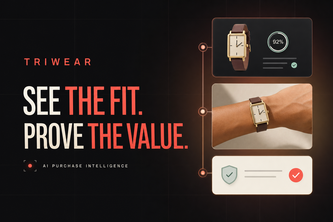
What the company appears to be: TriWear is an AI-powered purchase-intelligence tool for wearable accessories (watches, sunglasses, bags, etc.) that allows users to upload product information from various sources and receive structured, explainable recommendations on whether to buy, negotiate, or walk away. It supports both new and pre-owned purchases and includes a safety workflow for used-item verification.
What changed: The project is presented as a self-contained prototype built during an OpenAI hackathon. No prior version or product history is described; it appears to be a single-person effort with no evidence of prior traction, funding or customers.
Single most important open question: Is there any evidence that users actually upload content and engage with the tool beyond the demo? The description states the author built it for a hackathon — but does not indicate whether this is a product in development or a proof-of-concept with no real-world usage.
Note: This analysis is based entirely on the self-reported, unverified project description provided by the author. No third-party verification, revenue data, customer base, or traction metrics are available beyond what was stated.
What The Product Actually Is
The description states that TriWear is an AI purchase-intelligence workspace for wearable accessories such as watches, sunglasses, bags, bracelets, rings, shoes, jewelry, hats, and selected wearable accessories.
It allows users to upload:
- Product photos
- Listing screenshots
- PDFs
- URLs
- Notes
- Audio
The system then extracts category-specific facts from these inputs, compares products in a traceable result matrix, preserves contradictions and missing information, re-ranks candidates based on user preferences, and provides explanations for its recommendations.
For pre-owned items, it includes an additional workflow:
- Investigates whether the asking price is justified
- Suggests questions for the seller
- Reviews the seller's response
- Identifies what is confirmed or unresolved
- Recommends whether to buy, negotiate, or walk away
Inference: The tool appears to be a multimodal AI assistant that integrates structured reasoning with visual and textual data inputs. It uses GPT-5.6 for reasoning and GPT-4o Transcribe for voice notes.
Positioning & Claim Evolution
The author positions TriWear as an intelligent, evidence-backed decision-making tool for shoppers who are uncertain about purchasing decisions due to fragmented or untrustworthy information.
Key claims:
- It turns scattered research into one clear, evidence-backed purchase decision.
- It supports both new and pre-owned purchases.
- It provides explainable recommendations with confidence levels and traceability.
- It includes a safety workflow for used-item verification.
Inference: The positioning is centered on trust-building through transparency in AI reasoning and structured comparison. The tool aims to reduce buyer uncertainty by aggregating and analyzing multiple data points into actionable insights.
Target Customer & ICP
The description states that TriWear targets shoppers looking to make purchase decisions for wearable accessories, including:
- Watches
- Sunglasses
- Bags
- Bracelets
- Rings
- Shoes
- Jewelry
- Hats
- Selected wearable accessories
It also supports both new and pre-owned purchases.
Inference: The primary customer segment is likely individual consumers who are hesitant to buy online due to lack of information or trust in sellers. The tool may appeal more to those who value detailed product research and safety checks.
Business Model & Pricing Evidence
There is no evidence provided about pricing, monetization strategy, or business model in the description.
Not evidenced: No mention of subscription plans, freemium tiers, transaction fees, or any commercial structure.
Technical & Delivery Signals
The system is built with:
- Frontend: Next.js, React, TypeScript
- Backend: OpenAI API integration (via Vercel server routes)
- AI Models Used:
- GPT-5.6 for structured reasoning
- GPT-4o Transcribe for voice notes
- GPT Image for try-ons
- Tools & Libraries:
- Codex as engineering collaborator
- Three.js, React Three Fiber, Framer Motion for UI/UX
- Remotion for demo video
- Zod for validation
- IndexedDB and browser-local storage for privacy
The application supports:
- Category-specific adapters
- Live and cached AI results
- Private uploads (stored locally)
- Automated testing and verification workflows
Inference: The architecture suggests a lightweight, client-side approach with serverless AI processing. It appears designed to be demoable without requiring user accounts or API keys.
Traction & Maturity Signals
There is no evidence of traction, revenue, users, or adoption beyond the author’s own account.
Not evidenced: No data on:
- Number of active users
- Conversion rates
- Customer feedback or engagement
- Product usage metrics
- Market testing or pilot programs
The project was submitted to a hackathon and described as a prototype built in a short timeframe.
Competitive Context
No competitive landscape is described. The author does not reference existing tools or platforms that offer similar functionality.
Not evidenced: No mention of:
- Competitors
- Market gaps
- Differentiation from other AI purchase assistants or marketplace tools
Open Questions & Risks
- Unproven Market Demand: The tool is described as a hackathon project with no evidence of real-world usage or demand.
- AI Dependency Risk: Heavy reliance on OpenAI APIs and GPT models without clear plans for scalability, cost control, or fallbacks.
- Privacy Concerns: While local storage is used for uploads, the system still processes sensitive data through third-party AI services.
- Limited Scope: Only supports 9 categories; no indication of expansion plans or broader applicability.
- Single Developer Risk: The team size is listed as one person (Aaron Nathaniel), which raises concerns about long-term development and maintenance.
Questions the description leaves open
- What specific use cases drove the creation of this tool? Was there any market research or user feedback?
- How does the system handle conflicting data from different sources?
- Are there plans to monetize the product, and if so, what is the business model?
- Has the prototype been tested with real users beyond the demo?
- What are the technical limitations of using GPT-5.6 for structured reasoning at scale?
- How does the tool ensure accuracy when dealing with subjective or ambiguous inputs like visual try-ons?
Overall Assessment
Not evidenced: No information is provided regarding valuation, funding history, or investment interest.
This project appears to be a prototype built during a hackathon with no demonstrated traction or commercial viability. It lacks evidence of market demand, revenue, or user engagement.
Confidence Level: Low — based on self-reported description only, with no external validation or performance data.
Assessment: Not ready for investment or partnership at this stage. The tool shows potential but requires further development, testing, and proof of concept before any strategic move can be considered.
User Stories BotA demo video on every pull request
Get a demo video on every new feature
GitHub App that watches your pull requests and records a narrated, captioned demo.
Save time on demo prep and make informed decisions faster with a video walkthrough of every new feature.
Source
Submitted to the OpenAI 2026 hackathon on Devpost. Project home on Devpost. Back to the full gallery on Devpost.
This competitive analysis was produced by top-founders.com (opens in a new tab)
Generated by a language model from this project's public Devpost page — its tagline, the author's own write-up and any built-with tags listed there — as captured in August 2026. Short quotations are the author's words. It is an opinion on the idea as a business, not on the people behind it, and it reflects the description as published then. If the project has moved on, request a correction below. The analysis is not independent research and contains no verified traction, revenue or customer data.
An independent guide by KFG International LLC — not affiliated with, endorsed by, or connected to Devpost or OpenAI.