

Archive position — measured, not model output
0 likes on Devpost
2,263 of the 7,850 archived projects have more likes, and 5,587 share exactly 0 — so this project's #7,400 place in the like-ranked listing is a tie-break inside that group, not a ranking.
Projects (log scale)
Likes on Devpost. ▲ marks this project's group.
Show the figures
| Likes | Projects | Share of archive |
|---|---|---|
| 0 | 5,587 | 71.2% |
| 1 | 1,758 | 22.4% |
| 2 | 284 | 3.6% |
| 3–4 | 132 | 1.7% |
| 5–9 | 75 | 1.0% |
| 10+ | 14 | 0.2% |
 User Stories BotA demo video on every pull request
Get a demo video on every new feature
GitHub App that watches your pull requests and records a narrated, captioned demo.
Save time on demo prep and make informed decisions faster with a video walkthrough of every new feature.
Executive Summary
What the company appears to be
TROUT FUTURE MAP is a self-reported citizen-science tool designed to enable anglers to contribute observational data about fish and river conditions without revealing exact fishing locations. The product is described as an end-to-end workflow for structuring, reviewing, and publishing observation records through a browser-based interface.
What changed
The project evolved from a pre-existing concept into a functional prototype during OpenAI Build Week. It includes a controlled GPT-5.6 integration, human review steps, privacy-preserving transformations, and a public demo mode that does not store or expose real data.
Single most important open question
Is there any evidence of traction, revenue, or adoption beyond the hackathon prototype? The description provides no indication of actual users, customers, or product-market fit outside of its demonstration state.
What The Product Actually Is
The description states that TROUT FUTURE MAP is a browser-based application designed to turn angler observations into research-ready records while preserving location privacy. It uses synthetic data in demo mode and implements a structured workflow involving:
- Observation entry
- Structured fact extraction via GPT-5.6 (in controlled Live Mode)
- Human review and approval
- Browser-local storage of records using IndexedDB
- Public aggregate map with k ≥ 3 suppression
- CSV/JSON export capabilities
The system is built with React, TypeScript, Next.js, and integrates OpenAI's API in a limited way. It does not store real GPS data or use real observers' information in public mode.
Evidence
- The description states the product has a “Golden Path” workflow.
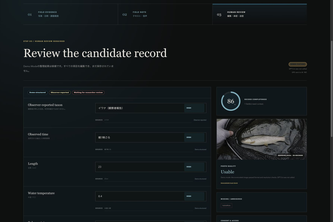
- It includes UI components for record entry, map display, and research demo.
- Browser-local persistence is implemented using IndexedDB.
- Public output excludes exact coordinates and observer identifiers.
- GPT-5.6 is used only in a controlled Live Mode; Demo Mode disables it.
Inference The product functions as a proof-of-concept rather than a production-ready system.
Positioning & Claim Evolution
The project positions itself around two core principles:
- Keep the spot secret. Make the river visible.
- Connecting anglers, researchers, fisheries cooperatives, and public institutions through responsible data sharing.
It claims to be a citizen-science tool that enables non-experts to contribute useful environmental data without compromising sensitive locations.
Evidence
- The tagline and inspiration section articulate these principles.
- The write-up describes how the idea originated before Build Week but was extended into a working prototype.
- It emphasizes privacy by design, including suppression rules and metadata removal.
Inference The positioning reflects an intent to bridge citizen science with environmental research while maintaining ethical data practices. However, no evidence suggests this has moved beyond a hackathon-level prototype.
Target Customer & ICP
The description identifies the primary user as "anglers" who are also citizen scientists contributing observational data about fish and river conditions. These users are described as needing to avoid exposing fragile habitats or rare species locations.
Secondary stakeholders include:
- Researchers
- Fisheries cooperatives
- Public institutions
Evidence
- The inspiration section mentions anglers, researchers, fisheries cooperatives, and public institutions.
- The product is framed as a way for anglers to contribute data without compromising sensitive spots.
Inference The ICP appears to be environmentally conscious individuals or groups involved in recreational fishing and environmental monitoring. No evidence of actual customer segments or personas beyond this general description.
Business Model & Pricing Evidence
There is no evidence of any business model, pricing structure, monetization strategy, or revenue streams in the project description.
Evidence
- The public deployment runs in Demo Mode.
- No mention of accounts, subscriptions, API keys, or paid services.
- The system does not require authentication or payment for use.
Inference The product is currently a demonstration-only tool with no indication of commercial viability or monetization plans.
Technical & Delivery Signals
The technical stack includes:
- Frontend: React, TypeScript, Next.js
- Backend: Vercel, OpenAI JavaScript SDK
- Data handling: IndexedDB, Canvas APIs, Zod validation
- AI integration: GPT-5.6 in controlled Live Mode only
Key delivery signals include:
- Browser-local storage (IndexedDB)
- Image processing and metadata stripping
- Controlled prompt boundaries for GPT-5.6
- Public data allowlisting and suppression rules
- Export functionality (CSV/JSON)
Evidence
- The write-up details the architecture and implementation.
- Tests are mentioned for validation, prompt boundaries, and privacy controls.
Inference The system is built with a focus on privacy and controlled AI use. However, it lacks production-grade infrastructure or scalability features.
Traction & Maturity Signals
There is no evidence of traction, adoption, or maturity beyond the hackathon prototype.
Evidence
- The product is described as a “browser-local hackathon demonstration.”
- No real users, customers, or usage metrics are provided.
- Public demo mode does not store or share data across devices or users.
- No mention of user feedback, retention, or growth indicators.
Inference This is an early-stage prototype with no demonstrated market traction or product-market fit.
Competitive Context
The description does not provide any information about competitors or the broader marketplace for citizen-science tools or environmental data collection platforms.
Evidence
- No mention of existing solutions, market size, or competitive landscape.
- The project is positioned as a novel approach to combining citizen science with AI and privacy controls.
Inference Without context, it's impossible to assess how this product compares to others in the space. It may be unique in its specific combination of features, but no evidence supports that claim.
Open Questions & Risks
- No commercial traction or revenue model: The project is described only as a demo with no indication of monetization.
- Limited scope and maturity: Built for a hackathon, not production-ready.
- Privacy implementation is conceptual: While described as “privacy by design,” the actual system uses browser-local storage and synthetic data — not real-world protections.
- AI integration is restricted: Live GPT-5.6 mode is disabled in public demo; no evidence of live AI usage or scaling.
- No institutional partnerships or field testing: No mention of engagement with fisheries, researchers, or environmental organizations.
Evidence
- The description explicitly states the product is a “browser-local hackathon demonstration.”
- No real-world deployment or user base is referenced.
- All data in public mode is synthetic and not shared beyond browser.
Inference This project lacks commercial viability, scalability, and institutional credibility at this stage.
Questions the description leaves open
- What is the intended path from this prototype to a production-ready product?
- Are there any plans for user onboarding or authentication in future versions?
- Has the team conducted any field testing with actual anglers or researchers?
- How does the team plan to handle real-world data validation and quality control?
- What are the long-term goals for integrating DNA analysis or lab workflows?
- Is there a roadmap for expanding beyond the current synthetic demo mode?
- What would be required to move from browser-local storage to durable, authenticated systems?
Overall Assessment
Not evidenced.
The description provides no information about:
- Revenue
- Customers
- Market traction
- Financials
- Team experience or track record
- Strategic fit for potential investors or partners
This is a self-reported hackathon prototype with no evidence of commercial readiness, adoption, or institutional validation.
Confidence Level Low. The project is described as a working demo but not as a viable business or product. Any investment or partnership decision would require further due diligence beyond this description.
User Stories BotA demo video on every pull request
Get a demo video on every new feature
GitHub App that watches your pull requests and records a narrated, captioned demo.
Save time on demo prep and make informed decisions faster with a video walkthrough of every new feature.
Source
Submitted to the OpenAI 2026 hackathon on Devpost. Project home on Devpost. Back to the full gallery on Devpost.
This competitive analysis was produced by top-founders.com (opens in a new tab)
Generated by a language model from this project's public Devpost page — its tagline, the author's own write-up and any built-with tags listed there — as captured in August 2026. Short quotations are the author's words. It is an opinion on the idea as a business, not on the people behind it, and it reflects the description as published then. If the project has moved on, request a correction below. The analysis is not independent research and contains no verified traction, revenue or customer data.
An independent guide by KFG International LLC — not affiliated with, endorsed by, or connected to Devpost or OpenAI.