

Archive position — measured, not model output
0 likes on Devpost
2,263 of the 7,850 archived projects have more likes, and 5,587 share exactly 0 — so this project's #7,402 place in the like-ranked listing is a tie-break inside that group, not a ranking.
Projects (log scale)
Likes on Devpost. ▲ marks this project's group.
Show the figures
| Likes | Projects | Share of archive |
|---|---|---|
| 0 | 5,587 | 71.2% |
| 1 | 1,758 | 22.4% |
| 2 | 284 | 3.6% |
| 3–4 | 132 | 1.7% |
| 5–9 | 75 | 1.0% |
| 10+ | 14 | 0.2% |
 User Stories BotA demo video on every pull request
Get a demo video on every new feature
GitHub App that watches your pull requests and records a narrated, captioned demo.
Save time on demo prep and make informed decisions faster with a video walkthrough of every new feature.
Executive Summary
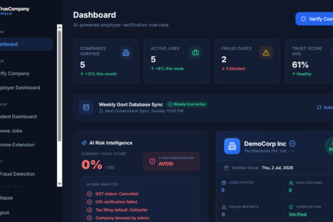
The company appears to be a solo-developer project named TrueCompany Shield, an AI-powered cybersecurity platform focused on verifying corporate credentials and detecting recruitment scams in real-time to protect job seekers. The author states that it was built for the OpenAI 2026 hackathon, using GPT-5.6 and Codex, with a Chrome extension and dashboard components.
What changed: The project is presented as a proof-of-concept or prototype, not yet live in production. It has no evidence of revenue, customers, or traction beyond the author's own claims.
Single most important open question: Is there any evidence that the platform will be able to scale from a hackathon prototype to a real-world product with actual integrations and adoption?
What The Product Actually Is
The description states that TrueCompany Shield is:
- An AI-powered cybersecurity platform
- Designed for safe and verified hiring
- It validates corporate credentials through government APIs (GST/CIN status)
- Analyzes recruiter messages for scam patterns using an advanced NLP engine
- Flags hidden risks
- Features a student safety dashboard, a mock employer dashboard, and a Chrome extension for real-time safety scores while browsing job sites like LinkedIn
Inference: The platform is described as having multiple components (dashboards, extension) and integrating with government verification systems and NLP engines. However, no evidence of actual functionality or integration exists beyond the author's claims.
Positioning & Claim Evolution
The author states:
- The product addresses fake job scams and fraudulent employers
- It aims to create a secure ecosystem for job seekers
- It verifies employer legitimacy before applicants hit apply
- It uses AI to detect recruitment fraud in real-time
Inference: The positioning is that of a cybersecurity tool aimed at protecting job seekers from fraud, using AI and government verification. The claim evolution suggests an intent to build a platform that bridges trust gaps between job seekers and employers.
Target Customer & ICP
The description states:
- Job seekers (especially students)
- Recruiters or employers (via mock employer dashboard)
- Cyber enforcement teams (via hub state)
Inference: The primary customer is the job seeker, with secondary users being recruiters and enforcement bodies. However, no evidence of actual user segmentation or targeting strategy beyond the author’s description.
Business Model & Pricing Evidence
The description does not provide any information about:
- Revenue streams
- Pricing model
- Monetization strategy
- Customer acquisition costs
Not evidenced: There is no indication of how the platform intends to make money or what its business model looks like beyond the author’s self-description.
Technical & Delivery Signals
The description states:
- Built with GPT-5.6 and Codex
- Uses OpenAI's tools for backend logic, data architecture, and database sync protocols
- UI built for distinct user experiences across student, employer, and enforcement hub states
- Chrome extension for real-time safety scores
- NLP engine to detect scam patterns
Inference: The technical stack includes AI tools like Codex and GPT-5.6, with a focus on automation and real-time processing. However, no evidence of actual deployment or performance metrics is provided.
Traction & Maturity Signals
The description states:
- It was built for a hackathon
- It has a working multi-layered defense system
- It includes a Chrome extension preview and workflow simulator
- Plans to transition to live production integrations with government registries
Not evidenced: There is no evidence of actual users, revenue, or adoption. The project is described as a prototype, not a product in use.
Competitive Context
The description does not mention:
- Competitors
- Market size
- Competitive advantages
- Differentiation from existing solutions
Not evidenced: No competitive analysis or positioning relative to other cybersecurity or recruitment fraud platforms is provided.
Open Questions & Risks
Key risks and open questions based on the description:
- Solo team (1 member) may limit execution capability
- Prototype nature implies no real-world testing or user feedback
- Use of GPT/Codex for backend logic raises questions about scalability, control, and reliability
- No evidence of integration with actual government APIs or verification systems
- No mention of data privacy or compliance considerations
Inference: The project is at a very early stage and lacks the maturity to be considered a viable product. Risks include technical feasibility, scalability, and execution.
Questions the description leaves open
- What specific government APIs are you planning to integrate with, and how will you ensure access?
- How do you plan to scale from a hackathon prototype to a production-ready system?
- What is your roadmap for monetization and customer acquisition?
- Have you conducted any user testing or feedback collection?
- What are the technical limitations of using GPT/Codex for backend logic, and how do you plan to address them?
Overall Assessment
Not evidenced: There is no evidence of revenue, customers, traction, or a clear path to monetization. The project is described as a hackathon prototype with no indication of real-world adoption or business viability.
Confidence level: Low — the description is self-reported and unverified, with no external validation or data points to support its claims.
User Stories BotA demo video on every pull request
Get a demo video on every new feature
GitHub App that watches your pull requests and records a narrated, captioned demo.
Save time on demo prep and make informed decisions faster with a video walkthrough of every new feature.
Source
Submitted to the OpenAI 2026 hackathon on Devpost. Project home on Devpost. Back to the full gallery on Devpost.
This competitive analysis was produced by top-founders.com (opens in a new tab)
Generated by a language model from this project's public Devpost page — its tagline, the author's own write-up and any built-with tags listed there — as captured in August 2026. Short quotations are the author's words. It is an opinion on the idea as a business, not on the people behind it, and it reflects the description as published then. If the project has moved on, request a correction below. The analysis is not independent research and contains no verified traction, revenue or customer data.
An independent guide by KFG International LLC — not affiliated with, endorsed by, or connected to Devpost or OpenAI.