

Archive position — measured, not model output
0 likes on Devpost
2,263 of the 7,850 archived projects have more likes, and 5,587 share exactly 0 — so this project's #3,478 place in the like-ranked listing is a tie-break inside that group, not a ranking.
Projects (log scale)
Likes on Devpost. ▲ marks this project's group.
Show the figures
| Likes | Projects | Share of archive |
|---|---|---|
| 0 | 5,587 | 71.2% |
| 1 | 1,758 | 22.4% |
| 2 | 284 | 3.6% |
| 3–4 | 132 | 1.7% |
| 5–9 | 75 | 1.0% |
| 10+ | 14 | 0.2% |
 User Stories BotA demo video on every pull request
Get a demo video on every new feature
GitHub App that watches your pull requests and records a narrated, captioned demo.
Save time on demo prep and make informed decisions faster with a video walkthrough of every new feature.
Executive Summary
What the company appears to be
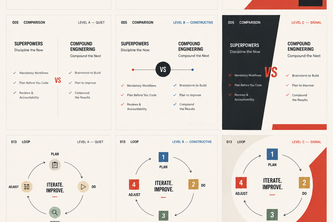
The project described by the caller is Constructive Signal Design Language (CSDL), a self-reported versioned visual language for explaining complex ideas with humans and generative models. It is presented as a machine-readable system of components, recipes, and constraints that enables consistent yet flexible presentation design.
What changed
The author states that CSDL evolved from an experimental seven-slide presentation into a structured system with 15 semantic components, 23 recipes, a Prompt DSL v0.5, and a 32-page Cookbook and Design Book. It was built using Python tooling for validation and codex/markdown for specification.
Single most important open question — the commercial due-diligence read
Is there evidence of traction or adoption beyond the author’s own development? The description contains no data on revenue, customers, usage, or market feedback.
What The Product Actually Is
The description states that CSDL is a versioned, machine-readable visual language for explaining complex ideas in AI, software engineering, and economics. It uses:
- Semantic components (e.g., Signal, Vector, Frame, Loop)
- Recipes such as Comparison, Workflow, Formula, Dashboard
- A Prompt DSL v0.5 for declarative generation packages
- YAML contracts to make the language machine-readable
- Markdown as the source of truth
It also includes:
- 20 Visual DNA families
- Accessibility profiles (light, night, monochrome, projector)
- Analytical Mode v0.1 for data fidelity and uncertainty
- A 32-page Cookbook and Design Book
- Deterministic Python tooling to validate manifests, contracts, indexes, dimensions, color modes, scores, analytical data, accessibility behavior, and accepted asset hashes
Inference The system appears to be a hybrid of design specification and generative AI workflow. It is not a product that directly sells to end-users but rather a framework or methodology for creating consistent visual explanations.
Positioning & Claim Evolution
The description states that CSDL aims to solve two problems in technical presentations:
- Templates produce consistency but make every story look the same.
- Open-ended style prompts offer freedom but result in drift or visual noise.
CSDL proposes a third approach: define the meaning of visual elements instead of fixing their coordinates.
The author claims that CSDL turns presentation design into a shared, machine-readable system of components, enabling both humans and generative models to work from the same specifications.
It also references historical art principles (e.g., El Lissitzky’s “Topography of Typography”) but explicitly avoids imitating 1920s aesthetics or propaganda symbolism. The result is a contemporary visual direction called Constructive Signal, with a restrained default style called Quiet Modular.
Inference CSDL positions itself as a design system for generative AI, not a standalone tool or SaaS product. It seeks to make AI-generated presentations more reproducible, coherent, and understandable through structured semantics.
Target Customer & ICP
The description does not name specific customers or target personas. However, it implies that CSDL is intended for:
- Technical presenters working in AI, software engineering, and economics
- Human-AI collaboration teams who want to use generative models in design workflows
- Designers or developers who seek consistency and reproducibility in visual output
It also mentions that the system was piloted on agentic development discipline — suggesting a focus on AI agents, process-driven teams, or reproducible design systems.
Inference The ICP likely includes technical professionals involved in AI, software engineering, and data visualization who are interested in reproducible, semantic-based visual communication. No evidence of actual customer segments or personas is provided.
Business Model & Pricing Evidence
The description does not contain any information about pricing, monetization, or business model.
It states that CSDL includes:
- A complete foundation
- Visual DNA catalog
- Component and Recipe libraries
- Prompt DSL
- Analytical Mode
- Accessibility profiles
- Two applied presentation pilots
- A 32-page Cookbook and Design Book
However, there is no mention of:
- Revenue streams
- Customers or users
- Licensing or subscription models
- Paid features or tiers
Inference No business model or pricing evidence is presented. The project appears to be an open-source or experimental framework with no stated commercial intent.
Technical & Delivery Signals
The description states that CSDL was built using:
- Codex, Markdown, Python
- A deterministic Python tooling system for validation
- YAML contracts for machine readability
- 167 passing automated tests
- Hash-based protection for canonical assets (60 accepted raster assets)
- Provenance records and negative test fixtures
It also mentions:
- Prompt DSL v0.5
- Analytical Mode v0.1
- Accessibility profiles for multiple conditions
- A 32-page Cookbook and Design Book generated from Markdown
Inference The technical stack is well-defined, with a focus on reproducibility, validation, and semantic clarity. It suggests a tooling-first approach, not a product-first one.
Traction & Maturity Signals
The description states that CSDL:
- Started as a seven-slide pilot
- Evolved into a system with 15 components, 23 recipes, and 20 Visual DNA families
- Has 167 automated tests
- Preserves hashes for 60 accepted raster assets
- Includes two applied presentation pilots
However, there is no evidence of:
- Customer adoption or usage
- Revenue or monetization
- Market traction or user feedback
- Product-market fit indicators
- Any external validation or third-party use
Inference The project shows development maturity, but no evidence of market traction or user engagement.
Competitive Context
The description does not mention any competitors. It references historical art principles (e.g., El Lissitzky) and the MoMA presentation, but does not name other tools or frameworks in the space of generative design or visual communication systems.
It also does not describe how CSDL compares to existing tools such as:
- Design systems (e.g., Figma, Storybook)
- Generative AI platforms (e.g., Midjourney, DALL·E, Leonardo)
- Presentation tools (e.g., PowerPoint, Notion, Canva)
Inference No competitive landscape is described. The project appears to be independent of known market players, but this cannot be confirmed without further context.
Open Questions & Risks
- No evidence of traction or adoption: The system has not been tested in real-world environments beyond the author’s own development.
- Unproven commercial viability: There is no indication that CSDL is being used by others, monetized, or integrated into workflows.
- Highly experimental nature: It is described as a framework for generative AI, but not yet a product or service.
- Limited scalability: The project is built around one developer (Vladyslav Ohirenko) and lacks evidence of team expansion or community involvement.
- No pricing or monetization model: No indication of how the system would be sold or used commercially.
Inference CSDL is a conceptual framework, not a product. Its risk lies in whether it can evolve into a viable, scalable offering — which is not evidenced.
Questions the description leaves open
- What real-world use cases have you tested CSDL with?
- Have any teams or organizations adopted or integrated CSDL into their workflows?
- How do you plan to monetize or commercialize this system?
- Are there any early adopters, partners, or customers who can speak to its utility?
- What are the key challenges in scaling this from a developer tool to a broader design system?
- How does CSDL integrate with existing AI tools or platforms (e.g., Midjourney, Notion)?
- What is your roadmap for expanding beyond the current 15 components and 23 recipes?
Overall Assessment
The description states that this project was submitted to the OpenAI 2026 hackathon, suggesting it is an experimental or early-stage initiative.
There is no evidence of:
- Revenue
- Customers
- Market traction
- Product-market fit
- Commercial viability
Inference CSDL is a conceptual and technical framework, not a product or business. It may be a seed-stage idea with potential, but it lacks the commercial signals required for investment or partnership consideration.
It is not evident whether this project will evolve into a viable product or service — that remains an open question.
User Stories BotA demo video on every pull request
Get a demo video on every new feature
GitHub App that watches your pull requests and records a narrated, captioned demo.
Save time on demo prep and make informed decisions faster with a video walkthrough of every new feature.
Source
Submitted to the OpenAI 2026 hackathon on Devpost. Project home on Devpost. Back to the full gallery on Devpost.
This competitive analysis was produced by top-founders.com (opens in a new tab)
Generated by a language model from this project's public Devpost page — its tagline, the author's own write-up and any built-with tags listed there — as captured in August 2026. Short quotations are the author's words. It is an opinion on the idea as a business, not on the people behind it, and it reflects the description as published then. If the project has moved on, request a correction below. The analysis is not independent research and contains no verified traction, revenue or customer data.
An independent guide by KFG International LLC — not affiliated with, endorsed by, or connected to Devpost or OpenAI.