

Archive position — measured, not model output
0 likes on Devpost
2,263 of the 7,850 archived projects have more likes, and 5,587 share exactly 0 — so this project's #3,480 place in the like-ranked listing is a tie-break inside that group, not a ranking.
Projects (log scale)
Likes on Devpost. ▲ marks this project's group.
Show the figures
| Likes | Projects | Share of archive |
|---|---|---|
| 0 | 5,587 | 71.2% |
| 1 | 1,758 | 22.4% |
| 2 | 284 | 3.6% |
| 3–4 | 132 | 1.7% |
| 5–9 | 75 | 1.0% |
| 10+ | 14 | 0.2% |
 User Stories BotA demo video on every pull request
Get a demo video on every new feature
GitHub App that watches your pull requests and records a narrated, captioned demo.
Save time on demo prep and make informed decisions faster with a video walkthrough of every new feature.
Executive Summary
What the company appears to be
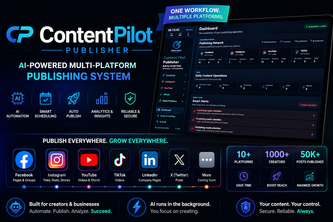
ContentPilot Publisher is an AI-powered multi-platform publishing platform that allows creators to manage content distribution across Facebook, Instagram, YouTube, and other platforms from a single interface. It supports secure OAuth-based connections, independent publishing queues per platform, and is built with extensibility in mind.
What changed
The author states this was developed as part of the OpenAI 2026 hackathon submission. No prior version or evolution is described; it appears to be a new product concept.
Single most important open question
Is there any evidence of user adoption, revenue, or customer traction beyond the author's own description? The project has no demonstrated market presence or commercial activity.
What The Product Actually Is
The description states that ContentPilot Publisher is an AI-powered multi-platform publishing platform. It supports:
- Facebook Publishing
- Instagram Publishing
- YouTube Uploads
- Multi-Platform Campaigns
It enables users to connect their own developer applications, authorize accounts securely, and publish content without sharing credentials.
The system includes:
- A web dashboard
- A desktop companion
- Secure OAuth authentication
- Official Meta APIs and YouTube Data API
- Background publishing workers
- Multi-platform campaign engine
- Queue management
- Publishing analytics
- AI-ready architecture
It is designed so that new platforms can be added without changing the existing workflow.
Evidence
- The author's own write-up describes these features.
- Technology tags include: Facebook Graph API, YouTube Data API, OAuth 2.0, React, Node.js, Express.js, Docker, etc.
Inference The product is described as a tool for content creators managing multiple social media accounts, but no actual usage data or customer feedback is provided.
Positioning & Claim Evolution
The author positions ContentPilot Publisher as a solution to the fragmentation of content management across platforms. The stated goal is to provide a unified workspace where creators can manage and publish content across multiple platforms from one interface while maintaining platform independence.
Key claims:
- "Creators often switch between different dashboards, upload the same content multiple times, and manually adjust captions and schedules for every platform."
- "I wanted to build a single publishing workspace where creators can connect their own developer apps, manage multiple accounts, and publish content across different platforms from one interface while keeping each platform independent."
The author also mentions that the system is AI-ready and supports future expansion with LinkedIn, X (Twitter), Pinterest, Threads, and AI-driven features like content generation, caption rewriting, image optimization, smart scheduling, and performance recommendations.
Evidence
- The author's own write-up.
- Technology tags suggest integration with AI tools (e.g., GPT-5, OpenAI).
Inference The positioning implies a shift from fragmented publishing to centralized control. However, no evidence of prior product iteration or market validation is provided.
Target Customer & ICP
The author states that the platform targets creators who manage content across multiple social media platforms and want to streamline their workflow.
It is implied that these are individuals or small teams who:
- Use Facebook, Instagram, YouTube
- Want to avoid manual uploads and scheduling
- Prefer secure methods of account access (no credential sharing)
- May benefit from AI enhancements
There is no explicit segmentation beyond "creators", nor any indication of whether the target includes businesses, agencies, or influencers.
Evidence
- The author's own write-up.
- Tagline: “automates content distribution across Facebook, Instagram, YouTube, TikTok, Multi-Platform and more.”
Inference The ICP is likely early-stage creators or small content teams. No evidence of specific personas, buyer journeys, or customer segments.
Business Model & Pricing Evidence
There is no mention of pricing models, monetization strategies, or business model in the description.
The author does not state whether the platform will be free-to-use, subscription-based, pay-per-use, or supported through advertising or partnerships.
Evidence
- Not evidenced.
Inference Given that this is a hackathon project, it’s possible the business model has not yet been defined or tested. No evidence of revenue streams or pricing plans exists.
Technical & Delivery Signals
The platform uses:
- OAuth 2.0 for secure authentication
- Official APIs from Meta (Facebook/Instagram) and Google (YouTube)
- A web dashboard and desktop companion application
- Background publishing workers
- Queue management systems
- Multi-platform campaign engine
- AI-ready architecture
It is built using technologies such as:
- React, Node.js, Express.js, TypeScript, Tailwind CSS, Vite, Electron, Docker, SQLite, REST API, GitHub, OpenAI, GPT-5
The system supports adding new platforms without altering the existing publishing workflow.
Evidence
- The author’s own write-up.
- Technology tags list various backend and frontend tools.
Inference The technical stack suggests a modern, scalable architecture. However, no evidence of production deployment or performance metrics is provided.
Traction & Maturity Signals
There is no evidence of traction, revenue, customer base, or adoption beyond the author’s own description.
The project was submitted to a hackathon and has no known users, customers, or market presence.
Evidence
- Not evidenced.
Inference This is a new concept with no demonstrated maturity or user engagement. It lacks any signs of traction or commercial viability.
Competitive Context
No competitive landscape or comparison to existing tools is mentioned in the description.
The author does not reference competitors such as Hootsuite, Buffer, Later, or other social media management platforms.
Evidence
- Not evidenced.
Inference Without context on how ContentPilot Publisher compares to current offerings, it's unclear whether it addresses a real gap or duplicates existing solutions.
Open Questions & Risks
- No traction or revenue: The project is described as a hackathon submission with no evidence of users, customers, or monetization.
- Unproven market fit: No indication that creators actually need this solution or are willing to pay for it.
- Security assumptions: Reliance on users connecting their own developer apps may raise concerns about ease-of-use and scalability.
- AI integration claims without execution: The platform is described as AI-ready, but no actual AI functionality is demonstrated or implemented in the current version.
- Limited team size: Only one member (Owais Ghani) is listed, which raises questions about development capacity and scalability.
Evidence
- Author's own write-up.
- Project description lacks any data on usage, revenue, or customer feedback.
Questions the description leaves open
- What specific problem are creators facing today that this tool solves?
- How many users have you tested the platform with? What was their feedback?
- Are there any existing competitors in this space? How does your solution differ?
- What is your plan for monetization and scaling beyond the hackathon?
- Can you demonstrate how the AI features will be integrated into the workflow?
- How do you plan to handle platform-specific API limitations and changes?
- What are the technical challenges you anticipate in expanding to LinkedIn, X (Twitter), Pinterest, and Threads?
Overall Assessment
Not evidenced.
There is no evidence of revenue, customers, or traction to support any investment or partnership decision.
The project is described as a hackathon submission with no commercial activity, user base, or financial data.
This appears to be an early-stage idea or prototype with potential for development but currently lacks the indicators of viability required for due-diligence evaluation.
Confidence level Very low. The entire analysis rests on self-reported information without external corroboration.
User Stories BotA demo video on every pull request
Get a demo video on every new feature
GitHub App that watches your pull requests and records a narrated, captioned demo.
Save time on demo prep and make informed decisions faster with a video walkthrough of every new feature.
Source
Submitted to the OpenAI 2026 hackathon on Devpost. Project home on Devpost. Back to the full gallery on Devpost.
This competitive analysis was produced by top-founders.com (opens in a new tab)
Generated by a language model from this project's public Devpost page — its tagline, the author's own write-up and any built-with tags listed there — as captured in August 2026. Short quotations are the author's words. It is an opinion on the idea as a business, not on the people behind it, and it reflects the description as published then. If the project has moved on, request a correction below. The analysis is not independent research and contains no verified traction, revenue or customer data.
An independent guide by KFG International LLC — not affiliated with, endorsed by, or connected to Devpost or OpenAI.