

Archive position — measured, not model output
0 likes on Devpost
2,263 of the 7,850 archived projects have more likes, and 5,587 share exactly 0 — so this project's #7,406 place in the like-ranked listing is a tie-break inside that group, not a ranking.
Projects (log scale)
Likes on Devpost. ▲ marks this project's group.
Show the figures
| Likes | Projects | Share of archive |
|---|---|---|
| 0 | 5,587 | 71.2% |
| 1 | 1,758 | 22.4% |
| 2 | 284 | 3.6% |
| 3–4 | 132 | 1.7% |
| 5–9 | 75 | 1.0% |
| 10+ | 14 | 0.2% |
 User Stories BotA demo video on every pull request
Get a demo video on every new feature
GitHub App that watches your pull requests and records a narrated, captioned demo.
Save time on demo prep and make informed decisions faster with a video walkthrough of every new feature.
Executive Summary
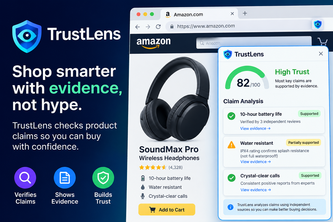
TrustLens is a browser-based shopping assistant that evaluates product claims for credibility using structured evidence and deterministic scoring. The author describes it as an "evidence-driven product credibility platform" that analyzes individual claims on product pages, connects them to supporting or contradicting evidence, and calculates a Trust Score.
The system is built as a Chrome extension with a Fastify backend, PostgreSQL database, and a deterministic Rating Engine. It uses AI for information extraction and interpretation but separates AI's role from final scoring decisions.
Key features include claim-level reasoning, evidence provenance tracking, directional contradiction analysis, and product/variant identity matching. The project was submitted as a hackathon entry with a focus on proving core functionality rather than broad production coverage.
The most important open question is: What is the actual commercial viability of this approach at scale? The description shows a strong technical foundation but lacks evidence of market traction, customer validation, or revenue models beyond the author's own use case.
What The Product Actually Is
The description states that TrustLens is:
- A browser-based shopping assistant
- Designed to help shoppers identify misleading, exaggerated, or unsupported product claims
- An evidence-driven product credibility platform
- A system that evaluates individual claims rather than relying on star ratings or review counts
- A tool that calculates a deterministic Trust Score based on structured inputs
The author describes it as:
- Not a recommendation engine but a trust protection tool
- Built as a Chrome extension with TypeScript, React, and WXT
- Using a Fastify backend API
- Incorporating a deterministic Rating Engine separate from AI decision-making
- Focused on claim-level analysis rather than general product assessment
Positioning & Claim Evolution
The description states that TrustLens evolved from:
- An initial idea to analyze product pages with AI prompts
- A concept focused on protecting shoppers from scams and misleading listings
- A shift from simple AI opinion generation to a structured, evidence-based system
The author notes the principle: "The score summarizes; the evidence persuades."
Positioning evolution described:
- Started as a tool that might recommend products
- Evolved into a trust protection platform focused on claim verification
- Moved from unexplained AI assessments to deterministic scoring with evidence explanation
- Became an evidence-first system rather than general AI opinion generator
Target Customer & ICP
The description states:
- Primary users are shoppers looking to make informed purchase decisions
- The tool is designed for consumers researching products online, particularly in e-commerce contexts
- It targets people who want protection from misleading product claims
- The specific use case mentioned is "designing a projection setup" with projector research
No explicit customer segments or personas are described beyond general shoppers. The author's own experience as a consumer researcher is cited as the original motivation.
Business Model & Pricing Evidence
The description states:
- No explicit business model or pricing information is provided
- The system is presented as a browser extension for consumers
- The author mentions it could be "hosted" but doesn't describe commercialization approaches
- No revenue streams, subscription models, or monetization strategies are described
- The focus appears to be on the technical demonstration rather than business viability
Technical & Delivery Signals
The description states:
- Built as a Chrome extension with TypeScript, React, WXT, and Manifest V3
- Uses Fastify backend API
- Implements PostgreSQL persistence
- Features a deterministic Rating Engine using structured inputs
- Includes asynchronous investigation worker
- Uses shared runtime-validated contracts
- Incorporates fixture-backed investigators for testing
- Utilizes AI tools (Codex, GPT-5.6) for engineering collaboration
The author emphasizes:
- Deterministic scoring rather than AI-generated opinions
- Separation of AI investigation from final score calculation
- Structured approach to evidence handling and claim analysis
- Modular architecture without microservices or graph databases
- Focus on reproducibility and explainability from the start
Traction & Maturity Signals
The description states:
- This is a hackathon submission (OpenAI 2026)
- Built by one person (Daniel Garcia)
- Uses fixture-backed demonstrations rather than live data
- No evidence of customer adoption, revenue, or usage metrics
- The MVP focuses on proving core functionality over broad coverage
- No mention of user testing, market validation, or product-market fit
Competitive Context
The description states:
- No explicit competitive analysis is provided
- The author mentions the problem of misleading product claims in e-commerce
- The system is positioned as different from general recommendation engines
- No specific competitors are named or described
- The approach appears to be unique in its claim-level evidence evaluation and deterministic scoring
Open Questions & Risks
The description states:
- No revenue, customer, or traction data available beyond the author's own use case
- The system is presented as a hackathon MVP with limited production coverage
- Reliance on AI for information extraction but not final scoring creates potential inconsistency
- The focus on claim-level analysis may be difficult to scale across all product categories
- No evidence of market validation or customer feedback
- The single-person team size raises questions about scalability and execution capability
- The system's effectiveness depends on availability and quality of external evidence sources
Questions the description leaves open
- What specific evidence sources does TrustLens rely on for claim verification?
- How does the system handle cases where evidence is completely unavailable or contradictory?
- What are the actual technical challenges in scaling this approach across multiple retailers and product categories?
- How would you monetize this platform if it were to become a commercial product?
- What customer validation or market research has been conducted beyond the author's own experience?
- How does the system handle edge cases like products with no claims, or claims that are inherently subjective?
- What is the plan for building and maintaining the evidence database over time?
- How do you ensure the quality and reliability of the AI tools used in information extraction?
Overall Assessment
The description states:
- This is a hackathon submission with no verified traction or revenue
- The technical approach shows promise but lacks commercial validation
- The single-person team size raises execution concerns
- No evidence of market demand, customer adoption, or competitive positioning beyond self-description
- The concept appears innovative in its claim-level evidence evaluation approach
- The deterministic scoring and explainability features are well-articulated
- No financial data, customer metrics, or business model details are provided
The author's own account indicates strong technical design but no commercial evidence. The project demonstrates a clear understanding of the problem space and technical architecture, but lacks validation that would be required for investment or partnership consideration.
User Stories BotA demo video on every pull request
Get a demo video on every new feature
GitHub App that watches your pull requests and records a narrated, captioned demo.
Save time on demo prep and make informed decisions faster with a video walkthrough of every new feature.
Source
Submitted to the OpenAI 2026 hackathon on Devpost. Project home on Devpost. Back to the full gallery on Devpost.
This competitive analysis was produced by top-founders.com (opens in a new tab)
Generated by a language model from this project's public Devpost page — its tagline, the author's own write-up and any built-with tags listed there — as captured in August 2026. Short quotations are the author's words. It is an opinion on the idea as a business, not on the people behind it, and it reflects the description as published then. If the project has moved on, request a correction below. The analysis is not independent research and contains no verified traction, revenue or customer data.
An independent guide by KFG International LLC — not affiliated with, endorsed by, or connected to Devpost or OpenAI.