

Archive position — measured, not model output
0 likes on Devpost
2,263 of the 7,850 archived projects have more likes, and 5,587 share exactly 0 — so this project's #7,408 place in the like-ranked listing is a tie-break inside that group, not a ranking.
Projects (log scale)
Likes on Devpost. ▲ marks this project's group.
Show the figures
| Likes | Projects | Share of archive |
|---|---|---|
| 0 | 5,587 | 71.2% |
| 1 | 1,758 | 22.4% |
| 2 | 284 | 3.6% |
| 3–4 | 132 | 1.7% |
| 5–9 | 75 | 1.0% |
| 10+ | 14 | 0.2% |
 User Stories BotA demo video on every pull request
Get a demo video on every new feature
GitHub App that watches your pull requests and records a narrated, captioned demo.
Save time on demo prep and make informed decisions faster with a video walkthrough of every new feature.
Executive Summary
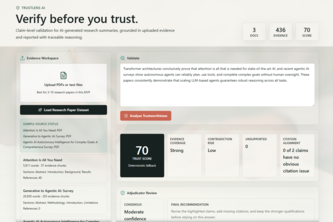
TrustLens AI is a self-reported web application designed to validate AI-generated academic and research writing against source documents. The author states it performs claim decomposition, evidence retrieval, and trust scoring, producing auditable reports that flag overclaiming, citation issues, and missing qualifications. It uses a multi-agent architecture built with Next.js, TypeScript, and GPT-based tools.
The product appears to be a proof-of-concept or prototype submitted for the OpenAI 2026 hackathon. There is no evidence of revenue, customers, or commercial traction. The author describes it as a research assistant that makes AI reasoning inspectable by showing evidence for judgments, but does not claim any operational deployment or user adoption.
The single most important open question is: What is the actual commercial viability of this product, and how does it differ from existing tools in the research verification space?
What The Product Actually Is
The description states that TrustLens AI is a web app that validates AI-generated research claims against uploaded papers and evidence. It breaks answers into individual claims, retrieves relevant passages from documents, checks whether each claim is supported, partially supported, unsupported, contradicted, or has insufficient evidence, and generates a trust report.
It also flags overclaiming, citation alignment issues, originality risk, and missing qualifications, and produces an evidence-grounded rewritten answer. The system uses a multi-agent workflow with specialized agents for different verification tasks.
The author reports building it using Next.js, TypeScript, Tailwind CSS, and what they describe as "codex, gpt-5.6" — though this is not verified or confirmed to be a real product version.
Positioning & Claim Evolution
The author states that TrustLens AI was inspired by the need for transparency in AI-generated academic writing, where tools can make unsupported claims but lack verification mechanisms. It positions itself as a way to "verify before you trust" — suggesting a focus on trustworthiness and auditability of AI outputs.
It claims to go beyond basic chatbots by producing auditable reports with claim-level evidence, trust scoring, originality checks, citation alignment, and rewritten answers grounded in source material. The author also notes that it was designed to be inspectable, showing uncertainty and making human review easier.
This is a self-reported positioning statement — no external validation or market research is provided.
Target Customer & ICP
The author states that TrustLens AI is intended for students, academics, and professionals who work with research writing. It aims to become a "dependable research companion" for these users.
It also mentions future plans to integrate with tools like Zotero, Google Drive, and institutional repositories — suggesting an institutional or academic user base.
No specific customer segments, personas, or usage patterns are detailed beyond the general academic/professional category.
Business Model & Pricing Evidence
Not evidenced. The description does not contain any information about pricing models, monetization strategies, or business model assumptions.
Technical & Delivery Signals
The author reports building TrustLens AI with Next.js, TypeScript, and Tailwind CSS. They describe a multi-agent architecture with specialized agents for claim decomposition, evidence retrieval, citation alignment, originality checking, validation, scoring, research guidance, and rewriting.
They also mention adding Demo Mode with bundled sample data to make the system testable without external setup. The author notes challenges in making the process explainable and handling nuanced academic language, long documents, partial support, citation mismatches, and overclaiming.
The system is described as using "codex, gpt-5.6" — though this is not independently verified or confirmed to be a real product version.
Traction & Maturity Signals
Not evidenced. There is no mention of revenue, customers, user adoption, or any commercial traction beyond the fact that it was submitted to a hackathon.
The project appears to be a prototype or proof-of-concept. The author describes it as a demo for judges and does not claim operational deployment or real-world usage.
Competitive Context
Not evidenced. No information is provided about existing competitive products, market size, or competitive positioning beyond the general idea of AI research verification.
Open Questions & Risks
- Unverified technology stack: The author references "codex, gpt-5.6" — which may not be a real product version or may not be accurately described.
- Prototype nature: The project is described as a hackathon submission and demo, with no evidence of commercial deployment or traction.
- No commercial viability claimed: There is no indication that the author has considered how this would scale or monetize in a real-world setting.
- Limited scope: The product is focused on academic research writing, which may limit its broader market appeal.
Questions the description leaves open
- What specific use cases are you targeting beyond academic writing?
- How do you plan to differentiate TrustLens AI from existing tools in the research verification or AI ethics space?
- Are there any partnerships or integrations already in place with institutions, libraries, or research platforms?
- What is your roadmap for moving from a demo to a scalable product?
- Have you conducted any user testing or feedback sessions with potential customers?
- How do you intend to monetize TrustLens AI if it becomes a commercial product?
Overall Assessment
Not evidenced. There is no information provided about funding, valuation, or investment interest in the project beyond its submission to a hackathon.
The author does not claim any current business operations, revenue, or customer base. The project appears to be a prototype submitted for competition purposes with no indication of commercial intent or traction.
User Stories BotA demo video on every pull request
Get a demo video on every new feature
GitHub App that watches your pull requests and records a narrated, captioned demo.
Save time on demo prep and make informed decisions faster with a video walkthrough of every new feature.
Source
Submitted to the OpenAI 2026 hackathon on Devpost. Project home on Devpost. Back to the full gallery on Devpost.
This competitive analysis was produced by top-founders.com (opens in a new tab)
Generated by a language model from this project's public Devpost page — its tagline, the author's own write-up and any built-with tags listed there — as captured in August 2026. Short quotations are the author's words. It is an opinion on the idea as a business, not on the people behind it, and it reflects the description as published then. If the project has moved on, request a correction below. The analysis is not independent research and contains no verified traction, revenue or customer data.
An independent guide by KFG International LLC — not affiliated with, endorsed by, or connected to Devpost or OpenAI.