

Archive position — measured, not model output
1 like on Devpost
505 of the 7,850 archived projects have more likes, and 1,758 share exactly 1 — so this project's #1,519 place in the like-ranked listing is a tie-break inside that group, not a ranking.
Projects (log scale)
Likes on Devpost. ▲ marks this project's group.
Show the figures
| Likes | Projects | Share of archive |
|---|---|---|
| 0 | 5,587 | 71.2% |
| 1 | 1,758 | 22.4% |
| 2 | 284 | 3.6% |
| 3–4 | 132 | 1.7% |
| 5–9 | 75 | 1.0% |
| 10+ | 14 | 0.2% |
 User Stories BotA demo video on every pull request
Get a demo video on every new feature
GitHub App that watches your pull requests and records a narrated, captioned demo.
Save time on demo prep and make informed decisions faster with a video walkthrough of every new feature.
Executive Summary
What the company appears to be
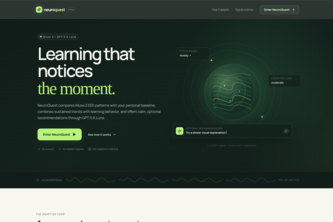
NeuroQuest: Mind Adaptive Study Tuitor is a self-reported study tool that uses EEG signals from a Muse 2 headset (or a simulator) to adapt explanations, pacing, challenge level, and breaks during learning sessions. It claims to adjust its approach in real time based on user’s mental state and performance.
What changed
The project description indicates an evolution from general thinking about study tools to a specific implementation using EEG data and GPT-5.6 for adaptive learning guidance. It evolved into a prototype with React/TypeScript frontend, Muse-JS integration, and local processing of EEG signals.
Single most important open question
Does NeuroQuest actually improve learning outcomes or reduce frustration in real-world use cases, and how does it scale beyond the hackathon context?
Note: This analysis is based entirely on the self-reported project description provided by the author. No external verification, revenue data, customer feedback, or traction metrics are available.
What The Product Actually Is
- The description states that NeuroQuest is a study tool using EEG signals from a Muse 2 headset (or a simulator).
- It claims to use GPT-5.6 for adjusting explanations, pacing, challenge level, and suggesting breaks.
- The system processes EEG data locally on the user’s device; raw EEG signals are not sent to servers.
- It allows users to upload notes, set goals, and receive adaptive suggestions during study sessions.
- At the end of a session, it provides a report showing correct/incorrect answers and suggested changes.
Inference: The product is described as an adaptive learning system that integrates brain-computer interface (BCI) data with AI-generated feedback. However, no evidence exists regarding actual functionality beyond prototype-level claims.
Positioning & Claim Evolution
- The author states the inspiration was to create a study tool that adapts when users get frustrated or confused — contrasting with traditional tools that maintain fixed pacing.
- It positions itself as an adaptive learning platform using EEG and AI (GPT-5.6).
- The claim has evolved from conceptual thinking about adaptive systems to building a working prototype with Muse 2 integration.
- There is no mention of prior versions, competitors, or market positioning beyond the hackathon submission.
Inference: The positioning reflects a niche focus on personalized learning through neurofeedback, but there is no evidence of prior product iteration or competitive differentiation.
Target Customer & ICP
- The description does not name specific target customers.
- It implies use by students studying with notes and goals.
- The tool supports both real EEG headsets (Muse 2) and a simulator for accessibility.
- No segmentation or persona details are given.
Not evidenced: No clear indication of who the primary users are, their needs, or how they would be reached.
Business Model & Pricing Evidence
- There is no evidence of pricing structure, monetization strategy, or business model.
- The project is described as a hackathon submission with no mention of commercial viability or revenue streams.
- No details on licensing, subscriptions, or enterprise features are provided.
Not evidenced: No indication of how the product would generate value or income.
Technical & Delivery Signals
- Built using React, TypeScript, Node.js, Express.js, Muse-JS, and OpenAI GPT-5.6.
- Uses local processing of EEG data to avoid sending raw signals to servers.
- Includes a simulator for testing without hardware.
- The tool uses structured data inputs like question accuracy and response time alongside EEG.
Inference: Technical architecture suggests a lightweight, privacy-conscious solution with potential for scalability, but no evidence of production deployment or performance metrics.
Traction & Maturity Signals
- No revenue, customer base, or adoption data is reported.
- The project was submitted to the OpenAI 2026 hackathon — indicating early-stage development.
- There is no mention of user testing, feedback loops, or iterative improvements beyond the hackathon phase.
Not evidenced: No signs of traction, growth, or maturity beyond prototype stage.
Competitive Context
- The description does not reference existing competitors in adaptive learning or BCI-based education tools.
- It does not compare NeuroQuest to other platforms like Khan Academy, Duolingo, or Anki.
- No mention of similar technologies or markets (e.g., neurofeedback apps, AI tutoring systems).
Not evidenced: No competitive landscape or differentiation analysis available.
Open Questions & Risks
- The tool relies on GPT-5.6 which is not publicly confirmed to exist; this may be a placeholder or speculative reference.
- EEG signal processing is complex and noisy — the description acknowledges challenges in filtering noise, suggesting technical risk.
- No evidence of real-world testing or validation of effectiveness.
- The product is described as a hackathon project with no indication of long-term viability or scalability.
Inference: High technical uncertainty due to reliance on unverified AI models and limited real-world validation.
Questions the description leaves open
- What specific learning outcomes have you observed in early testing?
- How does the tool distinguish between different types of cognitive load (e.g., confusion vs. fatigue)?
- Can you demonstrate how the system adjusts explanations or pacing based on EEG data?
- Have you tested the simulator’s accuracy compared to real EEG readings?
- What are your plans for user privacy and data handling beyond local processing?
- Are there any known limitations of Muse 2 in educational settings?
- How do you plan to validate that the adaptive suggestions actually improve learning?
Overall Assessment
- Not evidenced: No basis for evaluating investment or partnership potential.
- The project is described as a hackathon submission with no traction, revenue, or scalable business model.
- It shows promise in concept but lacks evidence of execution, validation, or commercial readiness.
Confidence level: Low. This is a speculative idea with no demonstrated product-market fit or financial viability.
User Stories BotA demo video on every pull request
Get a demo video on every new feature
GitHub App that watches your pull requests and records a narrated, captioned demo.
Save time on demo prep and make informed decisions faster with a video walkthrough of every new feature.
Source
Submitted to the OpenAI 2026 hackathon on Devpost. Project home on Devpost. Back to the full gallery on Devpost.
This competitive analysis was produced by top-founders.com (opens in a new tab)
Generated by a language model from this project's public Devpost page — its tagline, the author's own write-up and any built-with tags listed there — as captured in August 2026. Short quotations are the author's words. It is an opinion on the idea as a business, not on the people behind it, and it reflects the description as published then. If the project has moved on, request a correction below. The analysis is not independent research and contains no verified traction, revenue or customer data.
An independent guide by KFG International LLC — not affiliated with, endorsed by, or connected to Devpost or OpenAI.