

Archive position — measured, not model output
0 likes on Devpost
2,263 of the 7,850 archived projects have more likes, and 5,587 share exactly 0 — so this project's #3,479 place in the like-ranked listing is a tie-break inside that group, not a ranking.
Projects (log scale)
Likes on Devpost. ▲ marks this project's group.
Show the figures
| Likes | Projects | Share of archive |
|---|---|---|
| 0 | 5,587 | 71.2% |
| 1 | 1,758 | 22.4% |
| 2 | 284 | 3.6% |
| 3–4 | 132 | 1.7% |
| 5–9 | 75 | 1.0% |
| 10+ | 14 | 0.2% |
 User Stories BotA demo video on every pull request
Get a demo video on every new feature
GitHub App that watches your pull requests and records a narrated, captioned demo.
Save time on demo prep and make informed decisions faster with a video walkthrough of every new feature.
Executive Summary
What the company appears to be
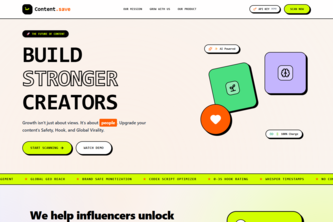
Content.Save is an AI-powered pre-publish review platform for creators, designed to flag harmful content and suggest alternative phrasing before publication. It claims to help creators distinguish between edgy and harmful ideas, with a focus on preventing real harm while preserving creative voice.
What changed
This project was submitted as part of the OpenAI 2026 hackathon. The description indicates it is a prototype or early-stage product, built using GPT-4o and related technologies, with no evidence of revenue, customers, or traction beyond its own self-reporting.
Single most important open question
Is there any evidence that creators are actively using this tool in real-world workflows, or that the AI models used are reliable enough to be trusted for content moderation at scale?
What The Product Actually Is
The description states that Content.Save is an AI-powered pre-publish review platform for creators. It allows users to upload various forms of media (captions, scripts, images, videos, audio) and performs:
- Content scanning for harmful or offensive material including body shaming, hate speech, racism, anti-feminist language, and brand-safety risks.
- Risk scoring with a 0–100 scale and specific line/point identification.
- Virality potential evaluation, including first 0–3 second hook scoring, retention prediction, and demographic/country-level reach forecasting.
- Script rewriting into three variations: Viral Safe, Punchy Edgy, Corporate Clean.
- Interactive media timeline sync, showing flagged or viral moments directly on video/audio playback.
The tool is built using GPT-4o mini for fast multimodal scanning and GPT-4o for rewriting. It uses structured JSON mode to validate outputs and includes a fallback heuristic engine for when no API key is provided.
Evidence
- The author states the platform flags offensive content.
- It evaluates virality potential.
- It offers script rewrites.
- It integrates with media timelines.
- Built using GPT-4o, Next.js, React, Tailwind, TypeScript.
Inference The tool appears to be a prototype or MVP, not yet integrated into mainstream publishing workflows.
Positioning & Claim Evolution
Content.Save positions itself as a pre-publish safety net for creators, aiming to prevent real harm without stifling creativity. It claims to help users “tell right from wrong in their own content honestly,” distinguishing between edgy and harmful content.
The platform is described as not a censorship tool, but rather a way to make the internet safer for free expression and accountability.
Evidence
- The tagline: “AI that catches what could get you cancelled, before you hit publish.”
- The inspiration section emphasizes trust loss from poorly worded posts.
- The goal is framed as helping creators avoid harm while preserving voice.
Inference The positioning reflects a niche market need for responsible content creation tools, but lacks evidence of adoption or traction.
Target Customer & ICP
The description states that Content.Save targets creators, particularly those who publish content online (e.g., social media posts, videos, scripts). These are individuals or teams who may be at risk of reputational damage due to offensive language or unintended harm in their content.
Evidence
- The platform is built for creators.
- It addresses issues like body shaming, hate speech, and racism.
- It aims to help creators avoid losing trust or facing backlash.
Inference The ICP likely includes social media influencers, content creators, video editors, scriptwriters — but no evidence of actual customer segmentation or targeting strategy is provided.
Business Model & Pricing Evidence
There is no evidence in the description of a business model or pricing structure. The project is presented as a hackathon submission and does not mention monetization, subscriptions, or paid features.
Evidence
- No mention of pricing.
- No indication of revenue streams.
- No reference to enterprise or consumer pricing tiers.
Inference The tool may be in early development, possibly free-to-use or intended for internal use only.
Technical & Delivery Signals
Content.Save is built using:
- AI models: GPT-4o mini and GPT-4o.
- Framework: Next.js 16 (App Router), React 19, TypeScript.
- Design system: Custom Neo-Brutalist UI with Tailwind CSS v4.
- Data visualization: Recharts for heatmaps and forecasts.
- Media sync: HTML5 video/audio playback tied to timestamps.
- Fallback mechanism: Heuristic engine runs without API key.
Evidence
- Structured JSON mode used across all model responses.
- Client-side storage of API keys via localStorage.
- Media player with interactive scrubber and flag markers.
- Custom components like ApiKeyModal.tsx, clsx, tailwind-merge.
Inference The technical stack suggests a modern, scalable architecture, but no evidence of production deployment or performance metrics is given.
Traction & Maturity Signals
There is no evidence of traction, revenue, or customer adoption. The project is described as a hackathon submission and does not reference any users, customers, or usage data.
Evidence
- Team size: 4.
- Submitted to OpenAI 2026 hackathon.
- No mention of product launches, user base, or performance KPIs.
Inference This is likely an early-stage prototype or proof-of-concept, not yet mature for commercial use.
Competitive Context
The description does not provide any information about competitors. It does not name similar tools or platforms that offer content moderation or AI-powered pre-publish review services.
Evidence
- No competitor references.
- No mention of existing solutions in the market.
Inference It is unclear whether Content.Save addresses a gap in the market or competes with existing tools, as no competitive landscape is described.
Open Questions & Risks
Several key risks and open questions are present:
- No traction or revenue: The project is presented as a hackathon submission with no evidence of real-world usage.
- AI reliability concerns: While it uses structured JSON mode, there’s no indication that the models have been tested at scale or validated for accuracy in real-world content.
- Ethical ambiguity: The line between “edgy” and “harmful” is subjective; the tool may misclassify content or fail to account for context.
- Lack of monetization strategy: No business model or pricing structure is evident, raising questions about long-term viability.
- Limited team size: A 4-person team may not be sufficient to build a scalable product or enter competitive markets.
Evidence
- No revenue or customer data.
- No mention of testing or validation beyond the hackathon.
- No business model described.
Inference This is a high-risk, early-stage idea with no clear path to commercialization or market traction.
Questions the description leaves open
- Has this tool been tested in real-world scenarios by actual creators?
- How does the AI handle nuanced or context-dependent language that might be misclassified?
- What are the plans for monetization and scaling beyond the hackathon prototype?
- Are there any partnerships or integrations with content platforms already in place?
- How is the risk scoring validated — through human review, benchmark datasets, or other methods?
Overall Assessment
Not evidenced.
There is no evidence of revenue, customers, traction, or a clear path to monetization. The project is described as a hackathon submission with no indication of commercial viability or product-market fit.
The tool appears to be an early-stage idea focused on content safety for creators, but lacks the foundational signals needed to assess its potential for investment or partnership.
Confidence level Low — based entirely on self-reported claims and no external validation.
User Stories BotA demo video on every pull request
Get a demo video on every new feature
GitHub App that watches your pull requests and records a narrated, captioned demo.
Save time on demo prep and make informed decisions faster with a video walkthrough of every new feature.
Source
Submitted to the OpenAI 2026 hackathon on Devpost. Project home on Devpost. Back to the full gallery on Devpost.
This competitive analysis was produced by top-founders.com (opens in a new tab)
Generated by a language model from this project's public Devpost page — its tagline, the author's own write-up and any built-with tags listed there — as captured in August 2026. Short quotations are the author's words. It is an opinion on the idea as a business, not on the people behind it, and it reflects the description as published then. If the project has moved on, request a correction below. The analysis is not independent research and contains no verified traction, revenue or customer data.
An independent guide by KFG International LLC — not affiliated with, endorsed by, or connected to Devpost or OpenAI.