

Archive position — measured, not model output
0 likes on Devpost
2,263 of the 7,850 archived projects have more likes, and 5,587 share exactly 0 — so this project's #7,401 place in the like-ranked listing is a tie-break inside that group, not a ranking.
Projects (log scale)
Likes on Devpost. ▲ marks this project's group.
Show the figures
| Likes | Projects | Share of archive |
|---|---|---|
| 0 | 5,587 | 71.2% |
| 1 | 1,758 | 22.4% |
| 2 | 284 | 3.6% |
| 3–4 | 132 | 1.7% |
| 5–9 | 75 | 1.0% |
| 10+ | 14 | 0.2% |
 User Stories BotA demo video on every pull request
Get a demo video on every new feature
GitHub App that watches your pull requests and records a narrated, captioned demo.
Save time on demo prep and make informed decisions faster with a video walkthrough of every new feature.
Executive Summary
Project: TrueCalling
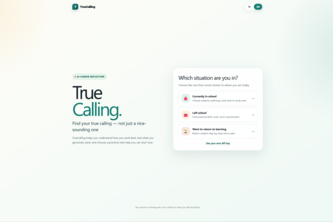
Author's self-description: A bilingual AI career guide that separates genuine interest in the work from attraction to a career's image — then builds an evidence-based direction map.
Analysis basis: Self-reported, unverified project description from Devpost submission. No archived data, funding, customers or revenue available.
What it is: A browser-based, bilingual (Vietnamese/English) AI-powered career reflection tool that uses a 16-question quiz and reverse questioning to assess user interest in potential careers. It generates an evidence-based direction map with cited answers, assessments on directions, and career path recommendations.
What changed: The project was built end-to-end using OpenAI Codex and GPT-5.6, with no external database or account required — all data stays in browser memory.
Key open question: Does the reverse-questioning method actually improve career decision-making, or is it a novel but unproven approach?
What The Product Actually Is
The description states that TrueCalling is:
- A bilingual (Vietnamese/English) AI career-reflection app
- Designed for three life paths: currently in school, left school, and returning to learning
- Uses a 16-question discovery quiz with a "write your own" option on every question
- Includes a short streamed conversation using reverse questioning
- Outputs an evidence-based direction map, including:
- Portrait with cited evidence
- Honest assessments (proven / promising / passing)
- 3–4 broad career groups with one best fit to test first
- Branch-aware 30-day / 6-month / 1–2-year path
- Results can be saved as PDF or copied as text
- No account, no database — everything stays in browser memory
Inference: The app is built for young people, especially in Vietnam, who are unsure about their career paths and want a reality-tested alternative to traditional quizzes.
Positioning & Claim Evolution
The description states:
- It separates genuine interest in the work from attraction to a career's image
- It gently reality-tests a stated dream instead of flattering it
- It builds an evidence-based direction map
Inference: The positioning is that of a career reflection tool, not a career guidance platform or marketplace. It emphasizes self-awareness and evidence over flattery.
Claim evolution: The project evolved from a problem identification (young people choosing careers without real evidence) to a solution (AI-powered reverse questioning with evidence-based output). The solution is framed as a privacy-first, no-account tool, not a scalable SaaS product.
Target Customer & ICP
The description states:
- It targets young people, especially in Vietnam
- Specifically for three life paths: currently in school, left school, and returning to learning
Inference: The ICP is likely adolescents or young adults aged 14–25, with a focus on those in or transitioning from formal education.
Absence of evidence: No explicit mention of:
- Age ranges beyond the general “young people”
- Geographic targeting beyond Vietnam
- Demographics (gender, socioeconomic status)
- Specific pain points beyond career confusion
Business Model & Pricing Evidence
The description states:
- No account, no database — everything stays in browser memory
- Results can be saved as PDF or copied as text
- No mention of monetization or pricing
Inference: The product is not monetized, and likely a non-commercial prototype or hackathon submission.
Absence of evidence: No information on:
- Revenue model
- Pricing strategy
- Paid features or tiers
- Subscription or transactional models
Technical & Delivery Signals
The description states:
- Built end-to-end with OpenAI Codex
- Uses GPT-5.6 via the Responses API
- Frontend: React/TypeScript
- Deployment to OpenAI Sites
- Prompt caching, bounded token budgets, and Structured Outputs with JSON Schema
- Includes automated test suite
- Privacy by default, safety design (crisis handoff, scope limits)
- Accessibility features (reduced motion, ARIA, 390px mobile)
Inference: The product is a technical prototype, likely built in a short timeframe for a hackathon. It uses AI tools extensively but does not appear to be production-ready or scalable.
Traction & Maturity Signals
The description states:
- It’s a working, polished, bilingual product
- It's not a proof of concept
- Includes real safety design, privacy by default, accessibility
- Has an automated test suite
Absence of evidence: No data on:
- User adoption or usage metrics
- Customer feedback or retention
- Product iteration history
- Market testing or validation
Competitive Context
The description does not mention any competitors.
Absence of evidence: No information on:
- Existing career guidance tools
- AI-powered career platforms
- Competitors in the Vietnamese market or among young people
Open Questions & Risks
- Unproven methodology: The reverse-questioning approach is novel but untested for real-world impact.
- No commercialization strategy: No evidence of monetization, scaling plans, or long-term business model.
- Limited scope: Built for a specific demographic (Vietnamese youth) and use case (career reflection), not scalable to broader markets.
- Self-reported only: The entire product is described by the author without external validation.
Questions the description leaves open
- What evidence supports the effectiveness of reverse questioning in career decision-making?
- How would you validate that users are actually using the tool for its intended purpose (self-reflection) and not just as a novelty?
- Are there any plans to expand beyond Vietnamese/English or to include more diverse career paths?
- What is the long-term vision for this product — is it meant to be a standalone tool, or part of a larger platform?
- How do you plan to scale beyond a hackathon prototype?
Overall Assessment
Not evidenced: No data on:
- Revenue, ARR, or funding
- Customer traction or adoption
- Market size or competitive positioning
- Scalability or commercial viability
Inference: This is likely a prototype or proof-of-concept, not a product ready for investment or partnership. It may be a valuable idea with a strong execution, but it lacks evidence of traction, monetization, or market validation.
The project is self-reported and unverified, built as a hackathon submission, and does not show signs of commercial maturity or scalability.
User Stories BotA demo video on every pull request
Get a demo video on every new feature
GitHub App that watches your pull requests and records a narrated, captioned demo.
Save time on demo prep and make informed decisions faster with a video walkthrough of every new feature.
Source
Submitted to the OpenAI 2026 hackathon on Devpost. Project home on Devpost. Back to the full gallery on Devpost.
This competitive analysis was produced by top-founders.com (opens in a new tab)
Generated by a language model from this project's public Devpost page — its tagline, the author's own write-up and any built-with tags listed there — as captured in August 2026. Short quotations are the author's words. It is an opinion on the idea as a business, not on the people behind it, and it reflects the description as published then. If the project has moved on, request a correction below. The analysis is not independent research and contains no verified traction, revenue or customer data.
An independent guide by KFG International LLC — not affiliated with, endorsed by, or connected to Devpost or OpenAI.