

Archive position — measured, not model output
0 likes on Devpost
2,263 of the 7,850 archived projects have more likes, and 5,587 share exactly 0 — so this project's #3,476 place in the like-ranked listing is a tie-break inside that group, not a ranking.
Projects (log scale)
Likes on Devpost. ▲ marks this project's group.
Show the figures
| Likes | Projects | Share of archive |
|---|---|---|
| 0 | 5,587 | 71.2% |
| 1 | 1,758 | 22.4% |
| 2 | 284 | 3.6% |
| 3–4 | 132 | 1.7% |
| 5–9 | 75 | 1.0% |
| 10+ | 14 | 0.2% |
 User Stories BotA demo video on every pull request
Get a demo video on every new feature
GitHub App that watches your pull requests and records a narrated, captioned demo.
Save time on demo prep and make informed decisions faster with a video walkthrough of every new feature.
Executive Summary
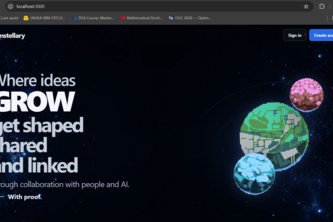
Constellary is a self-reported research workspace that aims to preserve the full journey of ideas—human and AI contributions, branches, failed paths, and connections—within one visible system. The author states it was built by a single individual (khushboo Rani) with help from GPT-5.6 and Codex, using Next.js, Supabase, PostgreSQL, and OpenAI APIs.
The product is described as a "provenance-first workspace" where users can create, connect, and grow ideas across their full journey, including AI-assisted work that must be reviewed before approval. It includes features like branch views, workspace editing, comments, collaborators, summaries, notes, sources, privacy controls, and researcher profiles.
The description makes no claims about revenue, customers, or traction. The author's own write-up is the only evidence available; there is no independent verification of any commercial activity or adoption.
Key open question
What is the actual demand for such a system? The self-reported product description does not include any evidence of real-world usage, customer feedback, or market validation.
What The Product Actually Is
The description states that Constellary is a "provenance-first workspace" where people and AI can create, connect, and grow ideas across their full journey. It allows users to:
- Start with an original idea
- Develop it through branches and subbranches
- Link references and related work without changing ancestry
- Collaborate through comments and shared contributions
- Record AI-supported work with review/approval steps
- Preserve failed or redirected paths
- View the entire journey as a visible map
The author describes it as a system that shows how work began, evolved, who shaped it, and what connects it together—rather than just showing final output.
It is built using:
- Next.js App Router, React, TypeScript
- Supabase Auth, PostgreSQL, Storage, functions, triggers, Row-Level Security
- OpenAI Responses API with GPT-5.6
- Vitest and pgTAP
- Vercel deployment
The system uses server-side OpenAI integration where users explicitly choose which branch content is sent as context, and all generated contributions must be reviewed before approval.
Positioning & Claim Evolution
The author states that Constellary was created to solve the problem of scattered research across documents, AI conversations, code repositories, diagrams, notes, references, and separate projects. The core claim is that existing tools handle only parts of the journey, forcing users to repeatedly rebuild connections.
The positioning evolved from:
- A personal solution for PhD profile preparation
- To a general-purpose workspace for connecting, mapping, sharing, discussing, and growing ideas across their complete journey
- To a "provenance-first" system that preserves how work became possible
The author emphasizes that Constellary helps users show how an idea began, changed, connected to other work, or grew through human and AI contributions.
Target Customer & ICP
The description states that Constellary's first audience is researchers, students, professors, and academic labs. It helps them:
- Develop ideas through connected branches
- Link prior research and related work
- Organize notes, summaries, code, results, and decisions
- Collaborate with people and AI
- Share one clear, trustworthy research journey
The author also mentions that while Work and Productivity is part of the product, the primary goal is academic research and learning. Later expansion to product teams, engineering, game development, and other professional workflows is mentioned as a future vision.
Business Model & Pricing Evidence
Not evidenced. The description does not contain any information about pricing, monetization strategy, or business model.
Technical & Delivery Signals
The system was built with:
- Next.js App Router, React, TypeScript
- Supabase Auth, PostgreSQL, Storage, functions, triggers, Row-Level Security
- OpenAI Responses API with GPT-5.6
- Vitest and pgTAP
- Vercel deployment
Key technical decisions include:
- Server-side OpenAI integration
- Explicit user control over which branch content is sent as context
- All generated contributions must be reviewed before approval
- Use of Row-Level Security for permissions
- Implementation using Codex with focused tasks, precise rules, and clear acceptance criteria
The development process involved a loop of:
- Product decision
- GPT-5.6 refinement
- Focused Codex task
- Implementation
- Automated validation
- Browser review
- Correction
Traction & Maturity Signals
Not evidenced. The description contains no information about revenue, customers, user adoption, or market traction.
Competitive Context
Not evidenced. The description does not mention any competitors or competitive landscape.
Open Questions & Risks
- Single-person development: The entire project was built by one person (khushboo Rani), which raises questions about scalability and long-term maintenance.
- Unverified claims: All information is self-reported without independent verification of product usage, customer feedback, or market demand.
- Limited evidence of traction: No data on users, customers, revenue, or adoption metrics.
- AI dependency: Heavy reliance on GPT-5.6 and Codex for development raises questions about the sustainability of this approach if these tools change or become unavailable.
- Unclear commercial viability: The description does not indicate any monetization strategy or business model beyond the initial concept.
Questions the description leaves open
- What specific research workflows are you trying to solve, and how do you know these problems exist?
- Have you validated your solution with actual researchers or students?
- How will you scale beyond a single developer?
- What is your plan for monetization and customer acquisition?
- How do you intend to handle data privacy and security concerns in research environments?
- What are the technical limitations of relying on GPT-5.6 and Codex for product development?
- How do you plan to differentiate from existing tools like Notion, Obsidian, or academic platforms?
Overall Assessment
Not evidenced. The description provides no information about funding rounds, valuations, or investment status. No commercial due-diligence signals are present beyond the self-reported product description.
The project is presented as a hackathon submission with no evidence of commercial traction, revenue, or customer validation. The author's own account is the only source of information, and it does not contain any data about market demand, user adoption, or financial performance.
User Stories BotA demo video on every pull request
Get a demo video on every new feature
GitHub App that watches your pull requests and records a narrated, captioned demo.
Save time on demo prep and make informed decisions faster with a video walkthrough of every new feature.
Source
Submitted to the OpenAI 2026 hackathon on Devpost. Project home on Devpost. Back to the full gallery on Devpost.
This competitive analysis was produced by top-founders.com (opens in a new tab)
Generated by a language model from this project's public Devpost page — its tagline, the author's own write-up and any built-with tags listed there — as captured in August 2026. Short quotations are the author's words. It is an opinion on the idea as a business, not on the people behind it, and it reflects the description as published then. If the project has moved on, request a correction below. The analysis is not independent research and contains no verified traction, revenue or customer data.
An independent guide by KFG International LLC — not affiliated with, endorsed by, or connected to Devpost or OpenAI.