

Archive position — measured, not model output
0 likes on Devpost
2,263 of the 7,850 archived projects have more likes, and 5,587 share exactly 0 — so this project's #5,439 place in the like-ranked listing is a tie-break inside that group, not a ranking.
Projects (log scale)
Likes on Devpost. ▲ marks this project's group.
Show the figures
| Likes | Projects | Share of archive |
|---|---|---|
| 0 | 5,587 | 71.2% |
| 1 | 1,758 | 22.4% |
| 2 | 284 | 3.6% |
| 3–4 | 132 | 1.7% |
| 5–9 | 75 | 1.0% |
| 10+ | 14 | 0.2% |
 User Stories BotA demo video on every pull request
Get a demo video on every new feature
GitHub App that watches your pull requests and records a narrated, captioned demo.
Save time on demo prep and make informed decisions faster with a video walkthrough of every new feature.
Executive Summary
What the company appears to be
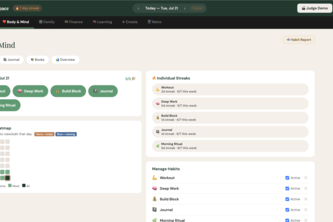
My Workspace is a self-reported personal operating system for life beyond work, built as a single HTML file with local-first storage. The author describes it as a private, AI-powered tool that integrates calendar, health, family, finances, learning, and creative projects into one adaptable daily view.
What changed
The project was originally developed during a micro-retirement period as a personal solution to the challenge of structuring time outside of work. It evolved from a prototype into a tool used daily by its creator, with additional features added for demonstration purposes (e.g., Balance Compass, Judge Demo).
Single most important open question
Is there evidence that My Workspace has traction or adoption beyond the author’s personal use? The description does not provide any data on users, revenue, or customer engagement.
What The Product Actually Is
The description states:
- My Workspace is a private, local-first personal operating system for life beyond work.
- It brings schedule, health, family, money, learning, and projects into one adaptable daily view.
- It includes features like a morning briefing based on calendar/email, daily focus/habits/reflections, family schedules, budgets, learning goals, creative projects, and portable snapshots/reports.
- It uses localStorage and IndexedDB for data storage, with export options to JSON, CSV, and PDF.
- It was built without backend or account requirements.
- The author collaborated with AI (e.g., GPT-5.6) during development.
Inference The product is a browser-based, single-user application designed to help individuals manage their non-work lives in an integrated way. It does not appear to be a commercial product or platform for others to use directly.
Positioning & Claim Evolution
The description states:
- The tool was built to replace productivity tools like Outlook and Notion, which are designed for work-life but not for paused life.
- It aims to provide structure without turning rest into another job.
- It measures life by what matters, not how busy someone is.
- It offers a “current pulse” across five life domains with one small next step recommended.
- It provides context-aware guidance (health coach, financial thought partner, etc.) depending on the part of the app being used.
Inference The positioning appears to be that My Workspace is a personal productivity tool for individuals navigating life outside traditional work structures — particularly those in transition or seeking autonomy over their time. The claim has evolved from a personal prototype to a daily-use tool with potential for broader application, though no evidence of adoption beyond the creator exists.
Target Customer & ICP
The description states:
- The target is someone who has paused working life (e.g., micro-retirement).
- It is intended for people looking to maintain structure without turning rest into a job.
- It supports individuals who want to measure their lives by what matters, not just activity levels.
Inference The ICP seems to be early-career professionals or retirees seeking autonomy over time and life planning, particularly those interested in local-first, private tools that do not rely on cloud infrastructure or third-party integrations.
Business Model & Pricing Evidence
The description states:
- There is no mention of a business model.
- The app runs without installation, account, or subscription.
- It stores data locally and allows for export.
- No pricing information is provided.
Inference There is no evidence of any commercial offering or monetization strategy. The tool appears to be self-hosted and personal in nature.
Technical & Delivery Signals
The description states:
- Built as a single HTML file with embedded logic, CSS, and JavaScript.
- Uses localStorage and IndexedDB for data persistence.
- Data can be exported as JSON, CSV, or PDF.
- The author used AI (including GPT-5.6) to assist in development.
- No backend, account, or installation required.
Inference The technical architecture is minimalistic and local-first, suggesting a low-barrier entry for users. However, this also implies limited scalability or integration capabilities.
Traction & Maturity Signals
The description states:
- The author uses it daily.
- It was built during a hackathon (OpenAI 2026).
- A fictional demo is included to allow exploration without real data.
- No mention of external users, feedback loops, or adoption metrics.
Inference There is no evidence of traction beyond the author’s personal use. The project appears to be in an early stage of development with no signs of user growth or commercial viability.
Competitive Context
The description states:
- It was inspired by the lack of tools for managing life outside work, especially compared to productivity tools like Outlook and Notion.
- It aims to offer a more holistic view than existing platforms.
Inference It competes with personal productivity tools (e.g., Notion, Todoist) but focuses on non-work life domains. However, no direct competitors are named or described in the submission.
Open Questions & Risks
The description states:
- The tool is built by a single person and lacks any team or external support.
- It stores data locally and does not integrate with third-party services.
- There is no indication of how it might scale or evolve beyond the creator’s needs.
Inference Key risks include lack of team, limited functionality due to local-first design, and absence of commercial traction or user feedback. The tool may not be suitable for broader adoption without significant development or repositioning.
Questions the description leaves open
- What is the actual usage frequency and duration of use by the author?
- Has there been any external testing or feedback from others using the tool?
- Are there plans to monetize or commercialize the product, and if so, how?
- How does the local-first architecture impact long-term data migration or recovery?
- What are the limitations of the AI integration in terms of performance or usability?
Overall Assessment
The description states:
- The tool is currently used daily by its creator.
- It was built for a hackathon and has not yet been released to the public.
- There is no evidence of revenue, customers, or traction beyond personal use.
Inference There is insufficient evidence to support an investment or partnership opportunity at this time. The project remains in a prototype phase with no demonstrated market demand or commercial viability. It may be worth revisiting once there is evidence of user adoption or a clear path to monetization.
User Stories BotA demo video on every pull request
Get a demo video on every new feature
GitHub App that watches your pull requests and records a narrated, captioned demo.
Save time on demo prep and make informed decisions faster with a video walkthrough of every new feature.
Source
Submitted to the OpenAI 2026 hackathon on Devpost. Project home on Devpost. Back to the full gallery on Devpost.
This competitive analysis was produced by top-founders.com (opens in a new tab)
Generated by a language model from this project's public Devpost page — its tagline, the author's own write-up and any built-with tags listed there — as captured in August 2026. Short quotations are the author's words. It is an opinion on the idea as a business, not on the people behind it, and it reflects the description as published then. If the project has moved on, request a correction below. The analysis is not independent research and contains no verified traction, revenue or customer data.
An independent guide by KFG International LLC — not affiliated with, endorsed by, or connected to Devpost or OpenAI.