

Archive position — measured, not model output
0 likes on Devpost
2,263 of the 7,850 archived projects have more likes, and 5,587 share exactly 0 — so this project's #3,475 place in the like-ranked listing is a tie-break inside that group, not a ranking.
Projects (log scale)
Likes on Devpost. ▲ marks this project's group.
Show the figures
| Likes | Projects | Share of archive |
|---|---|---|
| 0 | 5,587 | 71.2% |
| 1 | 1,758 | 22.4% |
| 2 | 284 | 3.6% |
| 3–4 | 132 | 1.7% |
| 5–9 | 75 | 1.0% |
| 10+ | 14 | 0.2% |
 User Stories BotA demo video on every pull request
Get a demo video on every new feature
GitHub App that watches your pull requests and records a narrated, captioned demo.
Save time on demo prep and make informed decisions faster with a video walkthrough of every new feature.
Executive Summary
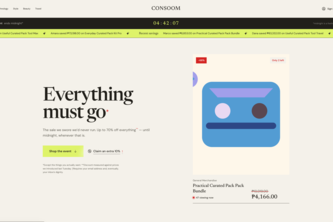
Consoom is a self-described virtual marketplace built as a hackathon project, designed to allow users to browse, add items to cart, and "checkout" without spending real money. The product is presented as a "feel-good" alternative to traditional e-commerce, with an emphasis on safe browsing and simulated shopping experiences. It was developed using React, Node.js, and AI tools like Codex for design and content generation.
The project appears to be a conceptual or experimental prototype, not yet monetized or deployed in production. The team is small (3 members), and the product has no demonstrated traction, revenue, or customer base. The description makes claims about UI/UX quality, interactions, and AI integration but does not substantiate any commercial viability or market demand.
The single most important open question
Is there a real market need for a "safe" virtual marketplace that allows users to simulate shopping without financial risk? Or is this an experimental idea with no clear path to monetization?
What The Product Actually Is
The description states that Consoom is:
- A virtual marketplace where users can browse items, add them to cart, and checkout
- Designed for people who enjoy browsing e-commerce but do not want to spend real money
- Built with React (frontend) and Node.js (backend)
- Uses AI tools like Codex and GPT-5.6 for design and content generation
- Allows users to shop for "exotic" items through generated content
- Includes caching of generated products to improve performance
It is described as a safe haven for consumers who want to engage in the thrill of shopping without financial downsides.
Inference The product appears to be a frontend-heavy prototype, possibly with backend logic for cart management and simulated checkout. It is not clear if it has any real integration with actual e-commerce platforms or payment systems.
Positioning & Claim Evolution
The description states that Consoom:
- Is a "feel-good" virtual marketplace
- Offers a safe environment for browsing and adding items to cart
- Provides the thrill of shopping without the downside of spending money
- Is inspired by window-shopping experiences, like at Ikea
- Is built to replace doom scrolling on social media
The positioning is clearly experimental, focused on user experience and emotional engagement, rather than commercial utility.
Inference The product is positioned as a nostalgic or therapeutic tool, not a serious e-commerce platform. It may be an exploration of how virtual shopping can be emotionally satisfying without financial risk.
Target Customer & ICP
The description states:
- The target audience includes people who enjoy browsing online marketplaces
- People who want to "window shop" but don't want to spend money
- Users who are tired of doom scrolling and want a "safe haven" for shopping
It does not specify:
- Demographics or psychographics beyond general interest in browsing
- Whether the product is aimed at specific age groups, income levels, or behaviors
- If there’s a defined ICP beyond "consumers who like to shop"
Inference The ICP is broadly defined, likely targeting general consumers with an interest in e-commerce or digital shopping experiences. No clear segmentation or persona is described.
Business Model & Pricing Evidence
The description states:
- Users can browse, add items to cart, and checkout without spending real money
- The product is presented as a safe environment for users to engage with shopping without financial risk
- It is not clear if the project has any monetization strategy or pricing model
There is no evidence of:
- Revenue streams
- Pricing tiers
- Monetization plans
- Paid features or subscriptions
Inference The business model is not evidenced, and the product appears to be a conceptual prototype with no clear path to revenue.
Technical & Delivery Signals
The description states:
- Built with React (frontend) and Node.js (backend)
- Uses Codex and GPT-5.6 for design and content generation
- Implemented caching of generated products
- Used SVGs instead of AI image generation due to cost
- Team faced challenges with high output commits and collaboration issues, which were resolved by using Codex
There is no evidence of:
- Production deployment
- Scalability or performance metrics
- Security or data handling practices
- Integration with real e-commerce APIs or payment systems
Inference The project is a hackathon prototype, likely not production-ready. It shows some technical sophistication but lacks real-world delivery signals.
Traction & Maturity Signals
The description states:
- This was built for the OpenAI 2026 hackathon
- Team size: 3 members
- No evidence of:
- Users or customers
- Revenue or monetization
- Product adoption or usage metrics
- Market testing or feedback
- Product iteration beyond the hackathon
Inference The product is at a very early stage, likely not yet in production. There are no signs of traction, user engagement, or commercial maturity.
Competitive Context
The description does not mention:
- Direct competitors
- Similar products or platforms
- Market size or competitive landscape
- Any differentiation from existing virtual shopping or browsing tools
Inference No competitive context is provided. The product appears to be unique in concept, but without evidence of market demand or prior solutions, it's hard to assess its place in the marketplace.
Open Questions & Risks
Key risks and open questions based on the description:
- No revenue model: The project is not monetized or presented with a clear path to monetization
- Prototype only: Built for a hackathon, no evidence of production deployment or scalability
- Unproven market need: No user data or feedback to validate demand
- AI dependency: Heavy reliance on AI tools (Codex, GPT-5.6) may not be sustainable or scalable
- No clear ICP or commercial strategy: The positioning is emotional and conceptual, not strategic
Inference The project is highly speculative, with no evidence of commercial viability or traction.
Questions the description leaves open
- What is the intended user base for Consoom? Is there a specific demographic or behavior you're targeting?
- How do you plan to monetize this product, if at all?
- Have you tested this concept with real users or conducted any market research?
- What are your long-term goals for Consoom beyond the hackathon?
- Are you planning to integrate with real e-commerce platforms or APIs?
- How do you intend to scale this product if it gains traction?
Overall Assessment
The description states that Consoom is a hackathon project and not yet in production. It is presented as an experimental, feel-good virtual marketplace with no evidence of:
- Revenue
- Customers
- Product-market fit
- Commercial strategy
It is not evidenced to be a viable investment or partnership opportunity at this stage.
Inference The project is pre-product, and the description does not support any commercial due-diligence conclusions. It is a conceptual idea, not a product with traction or monetization potential.
User Stories BotA demo video on every pull request
Get a demo video on every new feature
GitHub App that watches your pull requests and records a narrated, captioned demo.
Save time on demo prep and make informed decisions faster with a video walkthrough of every new feature.
Source
Submitted to the OpenAI 2026 hackathon on Devpost. Project home on Devpost. Back to the full gallery on Devpost.
This competitive analysis was produced by top-founders.com (opens in a new tab)
Generated by a language model from this project's public Devpost page — its tagline, the author's own write-up and any built-with tags listed there — as captured in August 2026. Short quotations are the author's words. It is an opinion on the idea as a business, not on the people behind it, and it reflects the description as published then. If the project has moved on, request a correction below. The analysis is not independent research and contains no verified traction, revenue or customer data.
An independent guide by KFG International LLC — not affiliated with, endorsed by, or connected to Devpost or OpenAI.