

Archive position — measured, not model output
0 likes on Devpost
2,263 of the 7,850 archived projects have more likes, and 5,587 share exactly 0 — so this project's #7,381 place in the like-ranked listing is a tie-break inside that group, not a ranking.
Projects (log scale)
Likes on Devpost. ▲ marks this project's group.
Show the figures
| Likes | Projects | Share of archive |
|---|---|---|
| 0 | 5,587 | 71.2% |
| 1 | 1,758 | 22.4% |
| 2 | 284 | 3.6% |
| 3–4 | 132 | 1.7% |
| 5–9 | 75 | 1.0% |
| 10+ | 14 | 0.2% |
 User Stories BotA demo video on every pull request
Get a demo video on every new feature
GitHub App that watches your pull requests and records a narrated, captioned demo.
Save time on demo prep and make informed decisions faster with a video walkthrough of every new feature.
Executive Summary
What the company appears to be
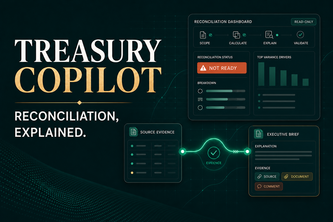
Treasury Copilot is a proof-of-concept AI-powered assistant for treasury reconciliation workflows, built as a hackathon submission. It operates as a read-only layer above an existing Excel/VBA-based treasury management platform, generating executive summaries from reconciliation data using OpenAI APIs.
What changed
The project was developed in a 24-hour hackathon environment and is presented as a vertical slice demonstrating how AI can interpret and communicate treasury reconciliation findings without modifying the underlying system. It does not claim to be production-ready or commercially deployed.
The single most important open question
Is there evidence of traction, revenue, or customer adoption beyond the author's own demonstration? The description provides no data on actual users, usage patterns, or commercial viability.
What The Product Actually Is
The description states that Treasury Copilot is a tool that sits above an existing Excel/VBA Treasury Management Platform. It performs deterministic financial calculations and uses OpenAI Structured Outputs to generate concise Reconciliation Intelligence Briefs. These briefs are grounded in approved evidence IDs, explain why a reconciliation is or isn't ready to progress, and produce management-ready narratives.
It operates on sanitized synthetic data for demonstration purposes and does not modify or interact with the underlying workbook. The system includes a client adapter, intelligence layer, model provider abstraction, validation layer, and responsive presentation client.
Evidence The author's own write-up and project description.
Inference This is a read-only AI assistant designed to interpret treasury data for executive decision-making, not a replacement or modification of the existing platform.
Positioning & Claim Evolution
The author states that Treasury Copilot aims to make a production treasury workflow easier to understand without weakening its controls. It positions itself as an evidence-based intelligence tool that interprets reconciliation status and exceptions for decision-makers.
It claims to be built with AI to interpret data, not to perform arithmetic or authority decisions. The system is described as being designed to avoid modifying the workbook and to maintain strict separation between deterministic financial computation and language interpretation.
Evidence The author's own write-up and project description.
Inference The positioning emphasizes control preservation while adding interpretive value through AI — a niche approach in finance automation where compliance and audit trails are paramount.
Target Customer & ICP
The description states that Treasury Copilot targets finance teams who already have the data and controls they need but spend significant time interpreting reconciliation status, finding exceptions, and translating operational detail for decision-makers.
It is built to work with an existing Excel/VBA Treasury Management Platform, suggesting a specific type of customer: organizations using legacy systems in finance operations.
Evidence The author's own write-up.
Inference The ICP appears to be mid-to-large financial teams working within traditional treasury platforms, likely in regulated or compliance-sensitive environments.
Business Model & Pricing Evidence
There is no evidence provided about a business model or pricing structure. The project is described as a hackathon submission with no mention of monetization, licensing, or customer acquisition strategies.
Evidence Not evidenced.
Inference No commercial model is evident from the description; it remains unclear whether this will be sold as SaaS, embedded in existing platforms, or offered as a service.
Technical & Delivery Signals
The system uses OpenAI APIs (specifically gpt-5.6-terra) for language intelligence tasks such as prioritizing exceptions and drafting narratives. It separates deterministic financial computation from AI interpretation, using structured outputs and JSON schema validation to ensure accuracy.
It includes a platform-neutral client adapter, model provider abstraction, and validation layer. The system is designed to be injection-resistant and supports multiple platforms including Excel, Google Sheets, web, and mobile.
Evidence The author's own write-up and technology tags.
Inference The architecture shows deliberate design for safety, auditability, and extensibility — key traits in financial systems.
Traction & Maturity Signals
The project is described as a hackathon submission with demonstration data created solely for testing. It does not claim to have any real-world usage or customer base. There is no evidence of revenue, ARR, headcount, or adoption metrics.
Evidence Not evidenced.
Inference The product is at the prototype stage and lacks any signal of traction or commercial maturity.
Competitive Context
The description does not mention competitors or market positioning beyond its own claims. It does not reference existing tools in treasury management or AI-assisted finance platforms.
Evidence Not evidenced.
Inference Without competitive data, it's impossible to assess how Treasury Copilot would fit into the broader marketplace.
Open Questions & Risks
- No commercial evidence: The project is a hackathon submission with no indication of real-world use or revenue.
- Limited scope: It only works on a specific platform (Excel/VBA) and does not include write capabilities.
- AI dependency: Reliance on OpenAI APIs introduces risk if those services change or become unavailable.
- Read-only design: While preserving controls, this also limits functionality compared to full automation tools.
Evidence The author's own write-up.
Inference The project may be too narrow in scope and lack commercial viability without further development and market validation.
Questions the description leaves open
- What is the actual adoption rate or usage of this tool beyond the hackathon?
- How does it integrate with existing treasury platforms, and what are the technical requirements for deployment?
- Are there any plans to expand beyond Excel/VBA or add write capabilities?
- Has the team considered how to scale this solution across multiple organizations?
- What is the plan for handling model drift or API changes from OpenAI?
Overall Assessment
The project is a hackathon prototype with no evidence of traction, revenue, or customer adoption. It is presented as a proof-of-concept that demonstrates technical feasibility but lacks commercial viability indicators.
Evidence Not evidenced.
Inference At this stage, the project does not present a compelling investment or partnership opportunity without further development and market validation.
User Stories BotA demo video on every pull request
Get a demo video on every new feature
GitHub App that watches your pull requests and records a narrated, captioned demo.
Save time on demo prep and make informed decisions faster with a video walkthrough of every new feature.
Source
Submitted to the OpenAI 2026 hackathon on Devpost. Project home on Devpost. Back to the full gallery on Devpost.
This competitive analysis was produced by top-founders.com (opens in a new tab)
Generated by a language model from this project's public Devpost page — its tagline, the author's own write-up and any built-with tags listed there — as captured in August 2026. Short quotations are the author's words. It is an opinion on the idea as a business, not on the people behind it, and it reflects the description as published then. If the project has moved on, request a correction below. The analysis is not independent research and contains no verified traction, revenue or customer data.
An independent guide by KFG International LLC — not affiliated with, endorsed by, or connected to Devpost or OpenAI.