

Archive position — measured, not model output
0 likes on Devpost
2,263 of the 7,850 archived projects have more likes, and 5,587 share exactly 0 — so this project's #7,382 place in the like-ranked listing is a tie-break inside that group, not a ranking.
Projects (log scale)
Likes on Devpost. ▲ marks this project's group.
Show the figures
| Likes | Projects | Share of archive |
|---|---|---|
| 0 | 5,587 | 71.2% |
| 1 | 1,758 | 22.4% |
| 2 | 284 | 3.6% |
| 3–4 | 132 | 1.7% |
| 5–9 | 75 | 1.0% |
| 10+ | 14 | 0.2% |
 User Stories BotA demo video on every pull request
Get a demo video on every new feature
GitHub App that watches your pull requests and records a narrated, captioned demo.
Save time on demo prep and make informed decisions faster with a video walkthrough of every new feature.
Executive Summary
What the company appears to be
TrendSync Brand Factory is a self-reported end-to-end AI fashion design platform built for independent designers and brands. The author states it integrates real-time trend intelligence, AI-generated imagery (including models), tech pack generation, and ad video creation into one dashboard. It leverages OpenAI tools (GPT-5.6 SOL, GPT-image-1.5/2, Sora 2) and other technologies like Foxit PDF Services, Supabase, Redis, and Node.js.
What changed
This is a hackathon project submitted to the OpenAI 2026 hackathon. It was not previously known or verified outside of this submission. The author describes an ambitious platform that attempts to automate fashion design workflows from trend detection through manufacturing-ready outputs.
Single most important open question — the commercial due-diligence read
Is there a viable business model or path to monetization beyond a hackathon prototype? There is no evidence of revenue, customers, or product-market fit. The self-reported features are extensive but unproven in any real-world context.
What The Product Actually Is
The description states that TrendSync Brand Factory is an AI-powered platform designed for fashion designers and brands to generate collections from real-time trend data. It includes:
- Trend intelligence engine using OpenAI’s web_search tool
- AI collection generator with two-phase generation (plan + expand)
- GPT-image tools for image generation and surgical editing
- AI models catalog and composites
- Voice design companion microservice
- Tech pack generation via PDF pipeline
- Ad video creation using Sora 2
- Brand compliance engine
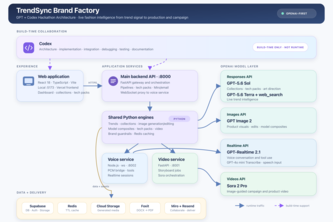
The system is built with React, TypeScript, Vite frontend; Python backend services; Node.js voice agent; Supabase for data storage; Redis for caching; and OpenAI APIs including GPT-5.6 SOL, GPT-image-1.5/2, Sora 2.
Inference The platform appears to be a prototype or proof-of-concept built in a short timeframe (hackathon), not yet validated in production use cases.
Positioning & Claim Evolution
The author positions TrendSync Brand Factory as an “end-to-end AI fashion factory” that addresses the problem of trend misalignment in the fashion industry. It claims to offer:
- Real-time global trend analysis
- Brand-compliant imagery
- AI models wearing designs
- Manufacturing-ready tech packs
- Cinematic ad videos
The tagline says: “An end-to-end AI fashion factory: live trend intelligence, brand-compliant imagery, AI models wearing your designs, manufacturer-ready PDF tech packs, and Sora ad videos - all in one dashboard.”
Inference The positioning is aspirational and implies a high level of automation across the entire design-to-production workflow. However, this is based on self-reporting without evidence of adoption or traction.
Target Customer & ICP
The description states that TrendSync Brand Factory targets:
- Independent designers
- Brands facing trend misalignment issues
- Users who manually scroll Instagram and guess at trends
It also mentions a need for “manufacturer-ready PDF tech packs” and “cinematic ad videos,” suggesting a B2B audience focused on product development and marketing.
Inference The ICP likely includes small to mid-sized fashion brands or individual designers looking to streamline their creative process. However, no specific customer segments or personas are defined.
Business Model & Pricing Evidence
There is no evidence in the description of pricing models, monetization strategies, or business model assumptions.
Not evidenced.
Technical & Delivery Signals
The platform uses:
- OpenAI APIs (GPT-5.6 SOL, GPT-image-1.5/2, Sora 2)
- Python backend services
- Node.js microservice for voice agent
- Supabase for auth/data/storage
- Redis for caching
- Foxit PDF Services for document pipeline
- React + TypeScript + Vite frontend
It includes features like:
- Surgical vs global image editing classifier
- Structured output repair with retries
- Voice agent using raw PCM WebSocket frames
- Deterministic tech pack generation with single-source-of-truth principle
Inference The technical stack shows a hybrid approach combining AI APIs, custom logic, and service orchestration. It suggests some engineering sophistication but lacks evidence of scalability or robustness beyond prototype-level execution.
Traction & Maturity Signals
The project is described as a hackathon submission to the OpenAI 2026 hackathon. The team size is listed as zero (0), and no members are named.
Not evidenced.
There is no mention of:
- Revenue
- Customers
- Product usage metrics
- Market traction
- Beta users or pilot programs
Competitive Context
The description does not reference existing competitors or market positioning beyond general claims about addressing trend misalignment in fashion.
Not evidenced.
Open Questions & Risks
- Unproven commercial viability: The platform is a hackathon project with no evidence of revenue, customers, or product-market fit.
- Over-reliance on AI hallucination risk: Features like tech pack generation and ad video creation depend heavily on AI outputs that may not be reliable for manufacturing or production use.
- No team or execution history: The team size is zero; no prior experience or track record is mentioned.
- Unverified claims: All features are self-reported without external validation or demonstration.
- Limited maturity: No evidence of testing, iteration, or product development beyond initial prototype.
Questions the description leaves open
- What specific use cases have you identified for this platform?
- How do you plan to validate demand and build a customer base?
- Have you conducted any user research or interviews with potential customers?
- What are the key assumptions behind your business model?
- Can you demonstrate how the tech pack generation ensures accuracy for manufacturers?
- Are there any regulatory or compliance concerns around AI-generated content in fashion?
- How do you intend to scale beyond a single-person hackathon effort?
Overall Assessment
Not evidenced.
There is no evidence of:
- Revenue
- Customers
- Product-market fit
- Team traction
- Financials or funding history
This is a self-reported hackathon project with no commercial due-diligence signals. The author describes an ambitious platform, but there is no indication that it has moved beyond concept stage or proven its value proposition in any meaningful way.
Confidence level Very low — based entirely on unverified self-reporting.
User Stories BotA demo video on every pull request
Get a demo video on every new feature
GitHub App that watches your pull requests and records a narrated, captioned demo.
Save time on demo prep and make informed decisions faster with a video walkthrough of every new feature.
Source
Submitted to the OpenAI 2026 hackathon on Devpost. Project home on Devpost. Back to the full gallery on Devpost.
This competitive analysis was produced by top-founders.com (opens in a new tab)
Generated by a language model from this project's public Devpost page — its tagline, the author's own write-up and any built-with tags listed there — as captured in August 2026. Short quotations are the author's words. It is an opinion on the idea as a business, not on the people behind it, and it reflects the description as published then. If the project has moved on, request a correction below. The analysis is not independent research and contains no verified traction, revenue or customer data.
An independent guide by KFG International LLC — not affiliated with, endorsed by, or connected to Devpost or OpenAI.