

Archive position — measured, not model output
0 likes on Devpost
2,263 of the 7,850 archived projects have more likes, and 5,587 share exactly 0 — so this project's #3,458 place in the like-ranked listing is a tie-break inside that group, not a ranking.
Projects (log scale)
Likes on Devpost. ▲ marks this project's group.
Show the figures
| Likes | Projects | Share of archive |
|---|---|---|
| 0 | 5,587 | 71.2% |
| 1 | 1,758 | 22.4% |
| 2 | 284 | 3.6% |
| 3–4 | 132 | 1.7% |
| 5–9 | 75 | 1.0% |
| 10+ | 14 | 0.2% |
 User Stories BotA demo video on every pull request
Get a demo video on every new feature
GitHub App that watches your pull requests and records a narrated, captioned demo.
Save time on demo prep and make informed decisions faster with a video walkthrough of every new feature.
Executive Summary
Company: Community Foundry
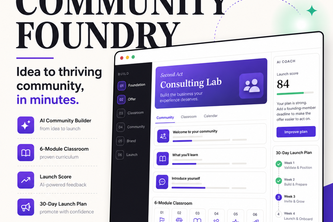
Self-reported purpose: An AI-powered studio that turns expertise into a launch-ready Skool community in minutes.
Key claim: The product helps users build a complete community strategy — including offer, curriculum, branding, and launch plan — using AI guidance.
What changed: The author describes an evolution from manual, time-consuming community-building to an AI-assisted studio with structured workflows and editable outputs.
Single most important open question: Does the author’s self-reported experience of building a “launch-ready” community translate into a product that delivers value to users beyond their own use case?
What The Product Actually Is
The description states that Community Foundry is an AI-powered studio built as a full-stack Next.js application. It uses GPT-5.6 Sol for strategy and content generation, GPT Image for brand concepts, and Supabase for storage. It supports templates based on popular online community verticals and allows users to start from scratch or use existing templates.
The product is described as an editable community-building studio where users can define:
- Community concept and positioning
- Membership offers (free, paid, freemium, tiered)
- Classroom curriculum
- Discussion categories and engagement prompts
- Branding and visual direction
- A 30-day launch and promotion plan
- Launch posts and email campaigns
- A launch-readiness score with actionable recommendations
It is not a platform that directly creates or publishes to Skool but instead generates structured outputs for users to implement manually or through export layers.
Inference: The product appears to be an AI-assisted planning tool, not a community management or publishing platform. It focuses on strategy generation and workflow structuring rather than execution.
Positioning & Claim Evolution
The author claims Community Foundry is designed to help users “turn their expertise into a launch-ready Skool community in minutes.” The positioning evolves from a personal frustration (manual community building) to a solution that automates the planning phase of community creation.
The description emphasizes:
- AI guidance for complex decisions
- Structured outputs and editable fields
- A studio-like experience with distinct stages
- Meaningful launch scores tied to actionable improvements
Inference: The positioning is centered on speed, structure, and AI-assisted decision-making. It positions itself as a tool for creators or consultants who want to plan communities efficiently but not necessarily execute them directly.
Target Customer & ICP
The description does not name specific customer personas or segments. However, it implies the product targets:
- Individuals with expertise they want to monetize through community
- Creators or consultants building Skool communities
- People looking for a structured framework to build online communities
It also mentions that the next phase includes “white-label versions for agencies and community consultants,” suggesting a potential expansion toward business-to-business (B2B) use cases.
Inference: The initial ICP likely includes solo creators or small teams with niche expertise. The long-term vision suggests B2B adoption by agencies or consultants.
Business Model & Pricing Evidence
There is no evidence in the description of pricing, monetization strategy, or business model. The author does not state whether Community Foundry will be sold as a SaaS product, freemium, or through other means.
Not evidenced: No indication of how the company intends to make money.
Technical & Delivery Signals
The project is built with:
- Next.js and TypeScript
- GPT-5.6 Sol for strategy generation
- GPT Image for branding
- Supabase for data storage
- Netlify for deployment
- Structured AI outputs and fallback handling
- Responsive web design (desktop and mobile)
- Automated testing (unit, component, browser)
The author notes that the product is designed to be usable even when external services fail — including AI or database issues.
Inference: The technical stack reflects a modern, scalable, and resilient approach. The use of structured outputs and fallbacks suggests attention to user experience and reliability.
Traction & Maturity Signals
There is no evidence of revenue, customers, or adoption beyond the author’s own use case. The project was submitted as part of a hackathon (OpenAI 2026), and no traction data is provided.
Not evidenced: No signs of product-market fit, user base, or commercial activity.
Competitive Context
The description does not mention competitors or market positioning relative to others in the space. It does not reference similar tools for community building, AI planning, or Skool integration.
Not evidenced: No competitive analysis or differentiation from existing solutions.
Open Questions & Risks
- Unproven commercial viability: The product is described as a hackathon submission with no evidence of traction or revenue.
- Limited scope: It does not publish directly to Skool or other platforms, relying on manual implementation or exports.
- AI dependency risks: Reliance on GPT-5.6 Sol and other AI services may create instability if those tools change or become unavailable.
- Lack of monetization strategy: No indication of how the company will generate revenue.
- Self-reported success only: The author’s personal experience is the only validation provided.
Inference: The product is in a very early stage, and its commercial potential remains untested.
Questions the description leaves open
- What specific problems do you observe in how people currently build communities?
- How do you plan to validate demand for this tool beyond your own experience?
- What are the key assumptions about user behavior that underpin your product design?
- Have you tested the AI-generated outputs with real users or potential customers?
- What is your path to monetization and scaling?
- How do you plan to handle platform limitations (e.g., Skool integration)?
- What metrics will you use to measure success once launched?
Overall Assessment
Confidence: Low
Assessment: Community Foundry is an early-stage, self-reported concept with no evidence of traction or commercial viability. It appears to be a prototype built during a hackathon, focused on AI-assisted community planning rather than execution.
The author’s claims about speed and structure are compelling but unvalidated. The product lacks clear monetization, customer data, or competitive positioning. While the technical approach is sound and the idea has potential, there is no evidence that it has moved beyond the prototype phase or proven its value to users outside the creator’s own use case.
Inference: This is a concept with early-stage promise but requires significant validation before any investment or partnership consideration.
User Stories BotA demo video on every pull request
Get a demo video on every new feature
GitHub App that watches your pull requests and records a narrated, captioned demo.
Save time on demo prep and make informed decisions faster with a video walkthrough of every new feature.
Source
Submitted to the OpenAI 2026 hackathon on Devpost. Project home on Devpost. Back to the full gallery on Devpost.
This competitive analysis was produced by top-founders.com (opens in a new tab)
Generated by a language model from this project's public Devpost page — its tagline, the author's own write-up and any built-with tags listed there — as captured in August 2026. Short quotations are the author's words. It is an opinion on the idea as a business, not on the people behind it, and it reflects the description as published then. If the project has moved on, request a correction below. The analysis is not independent research and contains no verified traction, revenue or customer data.
An independent guide by KFG International LLC — not affiliated with, endorsed by, or connected to Devpost or OpenAI.