

Archive position — measured, not model output
0 likes on Devpost
2,263 of the 7,850 archived projects have more likes, and 5,587 share exactly 0 — so this project's #5,421 place in the like-ranked listing is a tie-break inside that group, not a ranking.
Projects (log scale)
Likes on Devpost. ▲ marks this project's group.
Show the figures
| Likes | Projects | Share of archive |
|---|---|---|
| 0 | 5,587 | 71.2% |
| 1 | 1,758 | 22.4% |
| 2 | 284 | 3.6% |
| 3–4 | 132 | 1.7% |
| 5–9 | 75 | 1.0% |
| 10+ | 14 | 0.2% |
 User Stories BotA demo video on every pull request
Get a demo video on every new feature
GitHub App that watches your pull requests and records a narrated, captioned demo.
Save time on demo prep and make informed decisions faster with a video walkthrough of every new feature.
Executive Summary
What the company appears to be
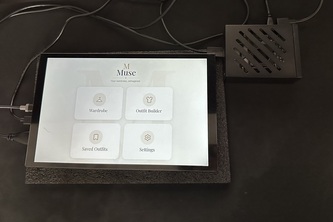
The description states that Muse is a local-first smart wardrobe running on a dedicated Raspberry Pi 5 with a touchscreen. The author describes it as a physical appliance designed to organize and visualize personal clothing collections, allowing users to create outfits from their own clothes using a QR code-based upload system.
What changed
This project was submitted by a single developer (Andy Cauwenbergh) for the OpenAI 2026 hackathon. It represents an experimental, self-built physical computing product with no evidence of prior commercial traction or funding.
The single most important open question — the commercial due-diligence read
Is there any indication that Muse has moved beyond a personal prototype or hackathon project into a scalable, repeatable product capable of serving users outside its creator’s immediate circle?
What The Product Actually Is
The description states that Muse is:
- A local-first smart wardrobe
- Running on a dedicated Raspberry Pi 5 with a touchscreen
- Designed as a physical appliance rather than a web application
- Capable of cataloging garments, creating outfits via drag-and-drop builder, and saving them locally in SQLite
- Using a React/TypeScript frontend and FastAPI backend
- Supporting phone uploads over local network via QR code
It is not evidenced that Muse has any cloud-based features or remote access capabilities beyond the temporary local upload workflow.
Positioning & Claim Evolution
The author claims:
- Muse started as an idea inspired by a sister’s need for help getting dressed due to disability
- It evolved into a tool that helps people manage their wardrobe more efficiently
- The product aims to be useful both for individuals with physical disabilities and general users who want better organization of clothing
There is no evidence of market positioning beyond the personal motivation described. No claims about target demographics, competitive differentiation, or commercial intent are made outside of the author’s own narrative.
Target Customer & ICP
The description states:
- Muse was initially built for the author's sister and himself
- It addresses challenges faced by someone receiving assistance with dressing
- The product is intended to help users visualize outfits and reduce uncertainty in garment selection
No evidence exists regarding specific customer segments, personas, or whether this extends beyond the creator’s own use case.
Business Model & Pricing Evidence
The description states:
- Muse operates locally without requiring a permanent cloud account or remote server
- Data is stored on-device using SQLite
- The system does not appear to charge for access or usage
- No pricing information, subscription models, or monetization strategies are mentioned
There is no evidence of any business model beyond the personal project.
Technical & Delivery Signals
The description states:
- Muse uses a Raspberry Pi 5 with touchscreen and runs Linux-based software stack
- It includes a React/TypeScript frontend and FastAPI backend
- The system supports local data storage, backups, and automated testing
- Deployment involves systemd services, Chromium kiosk mode, and GitHub Actions for CI/CD
- Features include QR code-based phone uploads, database migrations, and service hardening
There is no evidence of scalability, performance metrics, or production deployment beyond the single developer’s environment.
Traction & Maturity Signals
The description states:
- Muse was built as part of a hackathon submission
- It includes hundreds of automated tests covering various components
- The system survives cold reboots and handles complex service dependencies
- The author reports iterative development, debugging, and correction of issues like systemd tmpfiles configuration
However, there is no evidence of user adoption, customer feedback, or any form of traction beyond the developer’s own testing.
Competitive Context
The description does not provide any information about existing competitors or similar products in the market. No mention is made of other wardrobe management tools, smart home appliances, or digital closet applications.
Open Questions & Risks
- Single-person development: The entire project was built by one individual (Andy Cauwenbergh), which raises concerns about scalability and long-term maintenance.
- No commercial traction: There is no evidence of revenue, customers, or adoption beyond the author’s personal use.
- Limited scope: The product appears to be a prototype or proof-of-concept rather than a scalable solution.
- Hardware dependency: Reliance on Raspberry Pi hardware limits portability and may not support broader distribution.
- Unverified claims: All descriptions are self-reported and unverified; no third-party validation exists.
Questions the description leaves open
- What is the long-term vision for Muse beyond this hackathon project?
- Have you tested Muse with more than one user or in a real-world setting outside of your own home?
- Are there plans to expand beyond the Raspberry Pi platform or support other hardware configurations?
- How would you scale this product if it were to be commercialized?
- What are the key assumptions about user needs that drive the current design decisions?
Overall Assessment
Not evidenced.
There is no evidence of revenue, customer base, traction, or any commercial activity beyond a personal hackathon project. The author’s write-up describes a highly technical prototype with strong engineering execution but lacks any indication of market readiness or business viability. Any potential investment or partnership value would depend on future development and expansion beyond the current scope, which is not described in the provided materials.
User Stories BotA demo video on every pull request
Get a demo video on every new feature
GitHub App that watches your pull requests and records a narrated, captioned demo.
Save time on demo prep and make informed decisions faster with a video walkthrough of every new feature.
Source
Submitted to the OpenAI 2026 hackathon on Devpost. Project home on Devpost. Back to the full gallery on Devpost.
This competitive analysis was produced by top-founders.com (opens in a new tab)
Generated by a language model from this project's public Devpost page — its tagline, the author's own write-up and any built-with tags listed there — as captured in August 2026. Short quotations are the author's words. It is an opinion on the idea as a business, not on the people behind it, and it reflects the description as published then. If the project has moved on, request a correction below. The analysis is not independent research and contains no verified traction, revenue or customer data.
An independent guide by KFG International LLC — not affiliated with, endorsed by, or connected to Devpost or OpenAI.