

Archive position — measured, not model output
0 likes on Devpost
2,263 of the 7,850 archived projects have more likes, and 5,587 share exactly 0 — so this project's #5,422 place in the like-ranked listing is a tie-break inside that group, not a ranking.
Projects (log scale)
Likes on Devpost. ▲ marks this project's group.
Show the figures
| Likes | Projects | Share of archive |
|---|---|---|
| 0 | 5,587 | 71.2% |
| 1 | 1,758 | 22.4% |
| 2 | 284 | 3.6% |
| 3–4 | 132 | 1.7% |
| 5–9 | 75 | 1.0% |
| 10+ | 14 | 0.2% |
 User Stories BotA demo video on every pull request
Get a demo video on every new feature
GitHub App that watches your pull requests and records a narrated, captioned demo.
Save time on demo prep and make informed decisions faster with a video walkthrough of every new feature.
Executive Summary
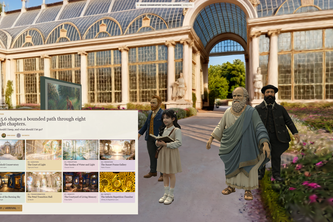
What the company appears to be: MUSE∞ — The Impossible Museum is a self-reported educational platform that uses AI-generated perspectives to guide learners through an interactive, spatial museum experience based on real artworks. It is described as an inquiry-based learning tool for students, teachers, and cultural educators.
What changed: The project was developed during OpenAI Build Week using GPT-5.6 and Codex to extend a pre-existing concept into a structured 8+1 journey with AI-generated interpretive lenses, evidence-based interaction, and deterministic spatial delivery.
The single most important open question: Is there any evidence of traction, revenue, or customer adoption beyond the authors' own description?
What The Product Actually Is
The description states that MUSE∞ is a walkable museum experience where learners examine real art through an AI-powered interpretive lens. It uses GPT-5.6 to connect a learner’s question to a curatorial journey across eight spatial worlds containing 36 open-access artworks from the Art Institute of Chicago.
Each encounter requires learners to observe, compare perspectives, cite evidence, and reflect before proceeding to a final synthesis and revision stage.
The system is built with JavaScript, Three.js, WebGL, Node.js, and integrates GPT-5.6 via Responses API with Structured Outputs for dialogue generation, perspective creation, and synthesis.
Not evidenced: whether this product has been released or used beyond the development phase.
Positioning & Claim Evolution
The authors claim MUSE∞ helps learners develop their own interpretation rather than simply providing answers. It positions itself as an inquiry-based learning experience that treats disagreement as a starting point for critical thinking, not failure.
It describes its goal as helping users ask better questions, examine disagreement, support ideas with evidence, and revise conclusions — not to produce canonical interpretations.
The project also states it is not an AI tutor giving the right answer but rather a world that helps build an interpretable conclusion.
Inference: This suggests a shift from traditional pedagogy toward experiential learning using generative AI as a facilitator of interpretation.
Not evidenced: Any market positioning, branding strategy, or prior product iteration beyond this submission.
Target Customer & ICP
The description states that MUSE∞ targets students, teachers, museum educators, and cultural education programs.
It can be used for question-led seminars, interdisciplinary art-and-philosophy activities, discussion starters, or reflective writing assignments.
Not evidenced: Specific customer segments, usage frequency, or institutional adoption data.
Business Model & Pricing Evidence
The description does not include any information about pricing, monetization, or business model.
Not evidenced: Revenue streams, subscription plans, licensing models, or commercial partnerships.
Technical & Delivery Signals
MUSE∞ is built using:
- JavaScript, Three.js, WebGL
- Node.js server for GPT-5.6 endpoints and asset delivery
- GPT-5.6 via Responses API with Structured Outputs
- Tools like Codex, Playwright, Particle, Tripo, World Labs, OpenAI APIs
It uses deterministic spatial systems to ensure bounded AI behavior and prevent unauthorized content generation.
Not evidenced: Deployment infrastructure, scalability, or performance metrics.
Traction & Maturity Signals
The project was submitted to the OpenAI 2026 hackathon on Devpost. It includes a detailed write-up of development during Build Week but lacks any evidence of real-world usage, user feedback, or product release.
Not evidenced: Customers, users, revenue, ARR, or adoption data.
Competitive Context
The description does not mention competitors or direct market comparisons.
Not evidenced: Market analysis, competitive landscape, or differentiation from existing tools in education or museum tech.
Open Questions & Risks
- Unverified claims: The entire product is self-reported and unverified.
- No traction evidence: No data on users, customers, or revenue.
- Highly experimental nature: Uses GPT-5.6 in a novel way without clear validation of effectiveness.
- Limited scope: Described as a prototype for educational use; unclear if it’s intended to scale beyond the hackathon context.
Inference: If this is not yet released or adopted, it may be premature to consider it a viable commercial product.
Questions the description leaves open
- What specific learning outcomes have been measured in pilot testing?
- Has the system been tested with actual students or educators?
- How does MUSE∞ handle edge cases where AI-generated content fails to align with visual evidence?
- Are there plans to integrate real-time collaboration features or export capabilities for teachers?
- What is the long-term vision for monetization and institutional partnerships?
Overall Assessment
This project is described as a prototype built during a hackathon, with no evidence of commercial traction, revenue, or customer adoption.
The description indicates strong conceptual alignment with emerging trends in AI-enhanced education but lacks any demonstration of real-world impact or scalability.
Assessment: Not ready for investment or partnership at this stage. Requires further validation through pilot use, user testing, and proof of concept before considering deeper engagement.
User Stories BotA demo video on every pull request
Get a demo video on every new feature
GitHub App that watches your pull requests and records a narrated, captioned demo.
Save time on demo prep and make informed decisions faster with a video walkthrough of every new feature.
Source
Submitted to the OpenAI 2026 hackathon on Devpost. Project home on Devpost. Back to the full gallery on Devpost.
This competitive analysis was produced by top-founders.com (opens in a new tab)
Generated by a language model from this project's public Devpost page — its tagline, the author's own write-up and any built-with tags listed there — as captured in August 2026. Short quotations are the author's words. It is an opinion on the idea as a business, not on the people behind it, and it reflects the description as published then. If the project has moved on, request a correction below. The analysis is not independent research and contains no verified traction, revenue or customer data.
An independent guide by KFG International LLC — not affiliated with, endorsed by, or connected to Devpost or OpenAI.