

Archive position — measured, not model output
1 like on Devpost
505 of the 7,850 archived projects have more likes, and 1,758 share exactly 1 — so this project's #1,497 place in the like-ranked listing is a tie-break inside that group, not a ranking.
Projects (log scale)
Likes on Devpost. ▲ marks this project's group.
Show the figures
| Likes | Projects | Share of archive |
|---|---|---|
| 0 | 5,587 | 71.2% |
| 1 | 1,758 | 22.4% |
| 2 | 284 | 3.6% |
| 3–4 | 132 | 1.7% |
| 5–9 | 75 | 1.0% |
| 10+ | 14 | 0.2% |
 User Stories BotA demo video on every pull request
Get a demo video on every new feature
GitHub App that watches your pull requests and records a narrated, captioned demo.
Save time on demo prep and make informed decisions faster with a video walkthrough of every new feature.
Executive Summary
What the company appears to be
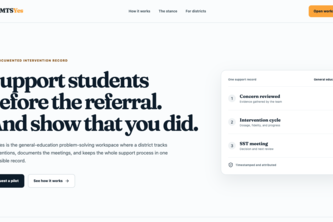
MTSYes is a self-reported software tool designed to support multi-tiered systems of support (MTSS) in schools. The author states it aims to fix data fragmentation and inconsistent interventions by creating an inspectable workspace that connects the full intervention loop — from student records, signal detection, intervention cycles, and session logging — all within one deterministic system.
What changed
This is a self-reported project built during OpenAI Build Week using Codex and GPT-5.6. It was submitted to the OpenAI 2026 hackathon on Devpost. No prior version or product history is evidenced.
Single most important open question
Is there evidence of real-world traction, customer feedback, or a functioning business model beyond this single-person demo project?
What The Product Actually Is
The description states that MTSYes is an operations system for MTSS in schools. It connects the full intervention loop within one inspectable workspace and includes:
- A district overview
- A signal queue with configurable rules
- Persistent student records
- An intervention cycle board
- Aggregate views with methodology and causal guardrails
The author claims it uses deterministic calculations to compute dosage and fidelity, and that no real student data was used in the demo.
Evidence
- The project description states these features.
- It is described as a full end-to-end system deployed live on OpenAI Sites.
- It includes synthetic data for demonstration purposes only.
Inference The system is built to be auditable and deterministic, not reliant on AI models for decision-making.
Positioning & Claim Evolution
The author positions MTSYes as a solution to the common problem in schools where MTSS processes fall apart in practice despite being sound on paper. The tool is said to address issues like:
- Data fragmentation
- Inconsistent interventions across classrooms
- Over-reliance on compliance documentation instead of student outcomes
It claims to be different from existing software by focusing on:
- Educator-driven decision-making
- Auditability and transparency
- Deterministic signal and cycle math
- Avoiding AI-generated decisions or prescriptions
Evidence
- The author’s own write-up describes the problem and solution.
- Claims are made about how it improves upon current tools.
Inference The positioning is centered on fixing a known gap in education operations, but no external validation or market feedback is provided.
Target Customer & ICP
The description states that MTSYes targets schools implementing MTSS — specifically those with general-education processes for supporting struggling students before special education referrals. It is designed for teams of educators who review interventions and make decisions.
Evidence
- The author describes the use case as involving district-level teams reviewing student support plans.
- It is built to support educators, not diagnose or place students.
Inference The ICP likely includes school districts, special education coordinators, and general education teachers involved in MTSS workflows.
Business Model & Pricing Evidence
There is no evidence of a business model or pricing structure. The author states that the project was built for a hackathon and does not mention any monetization strategy or customer acquisition plan.
Evidence
- No revenue, pricing, or customer data provided.
- The demo uses synthetic data and is not connected to real systems or users.
Inference The business model remains undefined. It is unclear whether this will be sold as a SaaS product, integrated into existing platforms, or offered through grants or pilot programs.
Technical & Delivery Signals
The author describes building MTSYes using:
- OpenAI Sites runtime
- App Router UI
- Drizzle schema and Cloudflare D1 for data storage
- Firebase auth
- A bounded workspace API
- Deterministic calculation layer (not AI-driven)
It includes a workflow where Codex was used to generate code, with the author reviewing and refining each iteration.
Evidence
- The author lists the tech stack.
- Describes how the system handles signal math and session logging deterministically.
- Mentions using visual references for UI layout improvements.
Inference The tool is built with a focus on structure, auditability, and separation of AI from decision-making. It is not yet connected to real data sources or production systems.
Traction & Maturity Signals
There is no evidence of traction, customers, or adoption beyond the single-person demo project. The author states that all records in the demo are synthetic and that no real student data was used.
Evidence
- No real-world usage or customer feedback.
- No mention of pilots, integrations, or live deployments.
- The system is described as a demo built in a short time window.
Inference The product is at an early stage — likely a prototype or proof-of-concept — with no evidence of market validation or operational maturity.
Competitive Context
The author does not mention specific competitors. However, the problem space (MTSS support tools) implies competition from:
- Existing EdTech platforms for student support
- SIS (Student Information Systems)
- Special education management tools
- Compliance and reporting software used in schools
Evidence
- The author notes that most existing software makes MTSS worse.
- No direct competitor names or products are listed.
Inference The competitive landscape is implied but not detailed. It is unclear whether MTSYes will compete with or complement existing tools.
Open Questions & Risks
Key risks and open questions include:
- No traction or revenue: The project is a demo, not a product in use.
- Unproven market fit: No evidence of customer feedback or real-world adoption.
- Single-person development: Limited team size may hinder scalability or product development.
- No integration with real systems: The tool does not yet connect to SIS, IEP, or assessment systems.
- Unverified claims: All descriptions are self-reported and unverified.
Evidence
- No customer data, revenue, or usage metrics.
- No mention of partnerships, pilots, or integrations.
- The demo is synthetic and deployed only for a hackathon.
Inference The project lacks commercial viability indicators. It may be a concept or prototype, not a product ready for market.
Questions the description leaves open
- What specific problems in current MTSS systems are you solving that existing tools don’t?
- Have you spoken to any real educators or districts about this tool?
- How do you plan to integrate with real SIS, IEP, and assessment systems while maintaining privacy compliance (e.g., FERPA)?
- What is your path to market? Are there any early adopters or pilots in progress?
- How will the product be monetized — as a SaaS tool, grant-funded pilot, or other model?
- What are the key technical challenges you expect to face in scaling this beyond a demo?
Overall Assessment
Not evidenced.
There is no evidence of revenue, customers, traction, or a clear business plan. The project is described as a single-person hackathon demo with synthetic data and no real-world deployment.
Confidence Very low. This is a self-reported concept with no external validation or commercial signals.
Assessment At this stage, MTSYes appears to be a prototype or proof-of-concept. It does not yet demonstrate a viable product or business model. Investment or partnership interest would depend on further development and evidence of traction or market demand.
User Stories BotA demo video on every pull request
Get a demo video on every new feature
GitHub App that watches your pull requests and records a narrated, captioned demo.
Save time on demo prep and make informed decisions faster with a video walkthrough of every new feature.
Source
Submitted to the OpenAI 2026 hackathon on Devpost. Project home on Devpost. Back to the full gallery on Devpost.
This competitive analysis was produced by top-founders.com (opens in a new tab)
Generated by a language model from this project's public Devpost page — its tagline, the author's own write-up and any built-with tags listed there — as captured in August 2026. Short quotations are the author's words. It is an opinion on the idea as a business, not on the people behind it, and it reflects the description as published then. If the project has moved on, request a correction below. The analysis is not independent research and contains no verified traction, revenue or customer data.
An independent guide by KFG International LLC — not affiliated with, endorsed by, or connected to Devpost or OpenAI.