

Archive position — measured, not model output
0 likes on Devpost
2,263 of the 7,850 archived projects have more likes, and 5,587 share exactly 0 — so this project's #7,383 place in the like-ranked listing is a tie-break inside that group, not a ranking.
Projects (log scale)
Likes on Devpost. ▲ marks this project's group.
Show the figures
| Likes | Projects | Share of archive |
|---|---|---|
| 0 | 5,587 | 71.2% |
| 1 | 1,758 | 22.4% |
| 2 | 284 | 3.6% |
| 3–4 | 132 | 1.7% |
| 5–9 | 75 | 1.0% |
| 10+ | 14 | 0.2% |
 User Stories BotA demo video on every pull request
Get a demo video on every new feature
GitHub App that watches your pull requests and records a narrated, captioned demo.
Save time on demo prep and make informed decisions faster with a video walkthrough of every new feature.
Executive Summary
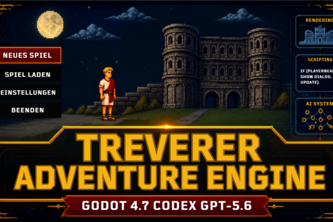
The description states that Treverer Adventure Engine (TAE) is a modular, data-driven engine for classic point-and-click adventures, built with Godot and supported by GPT-5.6 and Codex. The author claims to have built a fully playable reference project using the engine, demonstrating core systems like dialogue, quests, inventory, and save/load functionality. The engine is described as separating game content from logic, with AI-assisted development supporting architecture, implementation, and debugging.
The single most important open question is whether TAE has any commercial traction or adoption beyond its author's personal project, which is not evidenced.
This analysis is based entirely on the self-reported description provided by the author. No independent verification or external data are available. The author states that this was submitted to an OpenAI 2026 hackathon and includes no evidence of revenue, customers, or market validation.
What The Product Actually Is
The description states that TAE is a modular, data-driven engine for classic point-and-click adventures, built with Godot 4.7. It supports systems including:
- Dialogue system
- Quest system
- Inventory management
- Save & Load
- Scene transitions
- Data-driven NPC interactions
- Audio management
- Modular architecture
The author claims to have created a fully playable reference project using the engine: The Treverer Chronicles – Episode 1: Veni, Vidi, Viez.
This is an engine built for creating point-and-click adventure games, with a focus on separating game content from engine logic. It was developed using Godot and supported by AI tools (GPT-5.6 and Codex).
Positioning & Claim Evolution
The description states that the author wanted to build a reusable engine instead of a single game, aiming to separate game content from engine logic. The engine is positioned as modular and data-driven.
The author claims that this approach allows for future projects to be built more efficiently, with AI-assisted development supporting software architecture, code implementation, debugging, documentation, refactoring, and technical problem solving.
The claim evolution shows a shift from building one game to building a reusable engine, with the added value being AI support in development. The author states that the goal was not to replace software engineering but to accelerate it while maintaining clean, extensible architecture.
Target Customer & ICP
Not evidenced. The description does not state who the target customer or ideal customer profile (ICP) is for TAE. No information is provided about potential users of the engine, their needs, or how they would adopt it.
Business Model & Pricing Evidence
Not evidenced. The description does not contain any information about pricing, licensing, monetization strategy, or business model for TAE. There is no indication of whether the engine will be sold, offered as open source, or used internally.
Technical & Delivery Signals
The description states that TAE was built with Godot 4.7 and uses a modular architecture. The author claims to have worked with GPT-5.6 and Codex during development, which supported software architecture, code implementation, debugging, documentation, refactoring, and technical problem solving.
The project includes a reference game: The Treverer Chronicles – Episode 1: Veni, Vidi, Viez, which demonstrates core systems such as dialogue, quests, inventory, save/load, scene transitions, NPC interactions, audio management, and modular architecture.
Traction & Maturity Signals
Not evidenced. The description does not provide any evidence of traction or maturity beyond the author's personal project. There is no mention of users, customers, revenue, adoption, or usage metrics. The project was submitted to a hackathon, but this does not indicate commercial traction.
Competitive Context
Not evidenced. The description does not provide any information about competitors in the engine space or how TAE compares to existing solutions. No market positioning or competitive analysis is included.
Open Questions & Risks
- The project is described as a single-person effort, which raises questions about scalability and long-term maintenance.
- The use of GPT-5.6 and Codex is claimed to support development, but there's no evidence that this has led to any commercial product or adoption.
- No revenue, customer, or traction data is provided, making it difficult to assess market demand or viability.
- The engine is described as being for point-and-click adventures, a niche genre with limited market size.
- The project was submitted to a hackathon, suggesting it may be in early development and not yet ready for commercial use.
Questions the description leaves open
- What specific problems are you trying to solve with TAE that existing engines don't address?
- How do you plan to monetize the engine? Is there a pricing model or licensing structure?
- Have you identified any potential users or customers for this engine?
- What is your roadmap for expanding the engine beyond its current capabilities?
- How do you intend to support developers who want to use TAE in their projects?
- What are the key challenges you anticipate in building a sustainable business around this engine?
Overall Assessment
Not evidenced. The description does not contain sufficient information to assess whether TAE has investment or partnership potential. No evidence of traction, revenue, customer base, or commercial viability is provided. The project appears to be an early-stage personal endeavor submitted to a hackathon with no indication of market validation or scalability.
User Stories BotA demo video on every pull request
Get a demo video on every new feature
GitHub App that watches your pull requests and records a narrated, captioned demo.
Save time on demo prep and make informed decisions faster with a video walkthrough of every new feature.
Source
Submitted to the OpenAI 2026 hackathon on Devpost. Project home on Devpost. Back to the full gallery on Devpost.
This competitive analysis was produced by top-founders.com (opens in a new tab)
Generated by a language model from this project's public Devpost page — its tagline, the author's own write-up and any built-with tags listed there — as captured in August 2026. Short quotations are the author's words. It is an opinion on the idea as a business, not on the people behind it, and it reflects the description as published then. If the project has moved on, request a correction below. The analysis is not independent research and contains no verified traction, revenue or customer data.
An independent guide by KFG International LLC — not affiliated with, endorsed by, or connected to Devpost or OpenAI.