

Archive position — measured, not model output
0 likes on Devpost
2,263 of the 7,850 archived projects have more likes, and 5,587 share exactly 0 — so this project's #3,457 place in the like-ranked listing is a tie-break inside that group, not a ranking.
Projects (log scale)
Likes on Devpost. ▲ marks this project's group.
Show the figures
| Likes | Projects | Share of archive |
|---|---|---|
| 0 | 5,587 | 71.2% |
| 1 | 1,758 | 22.4% |
| 2 | 284 | 3.6% |
| 3–4 | 132 | 1.7% |
| 5–9 | 75 | 1.0% |
| 10+ | 14 | 0.2% |
 User Stories BotA demo video on every pull request
Get a demo video on every new feature
GitHub App that watches your pull requests and records a narrated, captioned demo.
Save time on demo prep and make informed decisions faster with a video walkthrough of every new feature.
Executive Summary
What the company appears to be
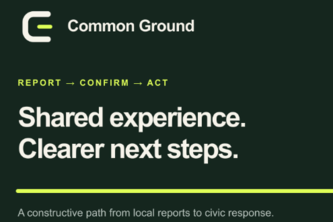
Common Ground is a civic technology project that aims to transform isolated local concerns into structured, actionable civic briefs through a three-step process: Report → Confirm → Act. It uses AI (specifically Codex and GPT-5.6) to structure user inputs, enforce privacy boundaries, and guide users toward verifiable, actionable outcomes.
What changed
The project is presented as an interactive prototype built for the OpenAI 2026 hackathon. It does not appear to have a commercial product or business model yet, nor any evidence of traction, revenue, or customers.
Single most important open question
Is there a viable path from this prototype to a scalable civic platform with institutional adoption and real-world impact?
What The Product Actually Is
The description states that Common Ground is a civic technology tool designed to help residents report local issues (e.g., blocked ramps, unsafe bus stops) and aggregate these reports into structured civic briefs. It follows a three-step loop:
- Report: A resident privately records what happened, where, and when.
- Confirm: Other people confirm only what they directly experienced, with dated evidence.
- Act: Once credible patterns emerge, it produces a concise civic brief containing facts, uncertainty, public impact, and one measurable requested action.
The system is built using:
- Cloudflare Workers
- Codex
- GPT-5.6 (used for structuring inputs and guiding language, but not for autonomous decision-making)
- HTML5, CSS3, JavaScript
It includes an interactive demo with three realistic civic cases that users can explore.
Inference The product is a prototype built to demonstrate how AI might be used in a controlled, privacy-preserving way to aggregate citizen concerns into actionable civic data. It is not a commercial SaaS offering.
Positioning & Claim Evolution
The description states that Common Ground:
- Turns local concerns into safer civic action.
- Is “stress-tested for privacy, clarity, and human review.”
- Is deliberately not a petition platform or popularity contest.
- Aims to create the “missing middle” between individual reports and institutional response.
It positions itself as a tool that:
- Rewards independent corroboration over virality.
- Preserves identity while strengthening collective evidence.
- Uses AI not for judgment, but for translation and constraint.
Inference The positioning is centered on privacy-preserving civic engagement, using AI to structure rather than automate decisions. It emphasizes credibility and human agency in the process of reporting and acting on public concerns.
Target Customer & ICP
The description states that Common Ground targets:
- Residents who experience local civic issues.
- Public bodies (institutions) that need structured, credible data to act on.
It also mentions a planned pilot with:
- One municipality
- One disability-access organisation
Inference The primary user base is likely citizens reporting problems, and the secondary audience is local government or advocacy organisations. The ICP appears to be civic actors who value structured, verifiable data over emotional or viral signals.
Business Model & Pricing Evidence
The description does not state:
- Any pricing model
- Revenue streams
- Commercial partnerships
- Subscription or usage fees
It only mentions that the project is a prototype, built for a hackathon.
Inference There is no evidence of a business model. The project appears to be in early development and has no commercial traction or monetisation strategy described.
Technical & Delivery Signals
The system uses:
- Codex and GPT-5.6 for structuring inputs, shaping language, and guiding interaction.
- A server-side Responses API contract that converts messy reports into structured outputs.
- Deterministic fallbacks to avoid exposing API keys in the browser.
- Cloudflare Workers, HTML5, CSS3, JavaScript.
The system is designed with:
- Explicit privacy boundaries
- Provenance tracking
- A bounded AI role — not for autonomous judgment or publishing claims
Inference The technical architecture shows a deliberate effort to use AI responsibly and securely. It avoids exposing sensitive data and uses structured outputs to guide user behavior.
Traction & Maturity Signals
The description states:
- It is an interactive prototype
- It was built for the OpenAI 2026 hackathon
- It includes three realistic civic cases in the demo
- It has a visible Report → Confirm → Act journey
It does not mention:
- Any live users or customers
- Revenue or funding
- Product adoption metrics
- Institutional partnerships
Inference The project is at an early stage of development. There is no evidence of real-world usage, traction, or institutional engagement.
Competitive Context
The description does not reference any competitors or similar tools.
Inference No competitive landscape is described. It is unclear whether Common Ground is positioned against existing civic platforms, petition sites, or government feedback systems.
Open Questions & Risks
- No commercial traction or revenue model: The project is a prototype with no evidence of monetisation.
- Limited team size (1 person): This raises questions about scalability and execution capacity.
- AI dependency without clear governance: While AI is used for structuring, the lack of clarity on how it's regulated or audited may be a concern.
- No institutional adoption yet: The pilot plans are not yet executed.
- Self-reported only: All claims are unverified.
Questions the description leaves open
- What is the expected timeline for moving from prototype to a functional product?
- How do you plan to validate that the system doesn’t amplify harm or bias in its structuring of reports?
- What are the key challenges in scaling this beyond a single hackathon project?
- Are there any early institutional partners or pilot users already engaged?
- How do you intend to ensure long-term sustainability and avoid over-reliance on AI for decision-making?
Overall Assessment
Not evidenced
The description provides no evidence of:
- Revenue
- Customers
- Traction
- Funding
- Product-market fit
- Commercial viability
This is a self-reported prototype, built for a hackathon, with no indication of commercial readiness or institutional adoption.
Confidence level: Low.
The project shows potential in its design and alignment with privacy-preserving civic engagement, but lacks any evidence of real-world impact or business development. It is not ready for investment or partnership at this stage.
User Stories BotA demo video on every pull request
Get a demo video on every new feature
GitHub App that watches your pull requests and records a narrated, captioned demo.
Save time on demo prep and make informed decisions faster with a video walkthrough of every new feature.
Source
Submitted to the OpenAI 2026 hackathon on Devpost. Project home on Devpost. Back to the full gallery on Devpost.
This competitive analysis was produced by top-founders.com (opens in a new tab)
Generated by a language model from this project's public Devpost page — its tagline, the author's own write-up and any built-with tags listed there — as captured in August 2026. Short quotations are the author's words. It is an opinion on the idea as a business, not on the people behind it, and it reflects the description as published then. If the project has moved on, request a correction below. The analysis is not independent research and contains no verified traction, revenue or customer data.
An independent guide by KFG International LLC — not affiliated with, endorsed by, or connected to Devpost or OpenAI.