

Archive position — measured, not model output
0 likes on Devpost
2,263 of the 7,850 archived projects have more likes, and 5,587 share exactly 0 — so this project's #7,118 place in the like-ranked listing is a tie-break inside that group, not a ranking.
Projects (log scale)
Likes on Devpost. ▲ marks this project's group.
Show the figures
| Likes | Projects | Share of archive |
|---|---|---|
| 0 | 5,587 | 71.2% |
| 1 | 1,758 | 22.4% |
| 2 | 284 | 3.6% |
| 3–4 | 132 | 1.7% |
| 5–9 | 75 | 1.0% |
| 10+ | 14 | 0.2% |
 User Stories BotA demo video on every pull request
Get a demo video on every new feature
GitHub App that watches your pull requests and records a narrated, captioned demo.
Save time on demo prep and make informed decisions faster with a video walkthrough of every new feature.
Executive Summary
What the company appears to be
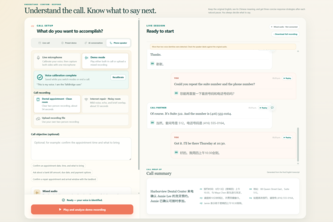
Talk Bridge is a real-time assistant for English phone calls in desktop Chrome, designed to help non-native speakers understand conversations, prepare responses, and speak with more confidence. It supports both browser-based calls and phone-speaker scenarios using audio transcription, speaker diarization, translation, and AI-powered reply suggestions.
What changed
The project is a self-reported hackathon submission (OpenAI 2026) that demonstrates an end-to-end prototype for real-time call assistance in English. It includes features like live transcription, speaker separation, Chinese translation, and response guidance — all built using browser-based audio processing and AI APIs.
Single most important open question
Is there a viable commercial market for this product, or is it limited to niche use cases or experimental prototypes?
What The Product Actually Is
The description states that Talk Bridge is a real-time assistant for English calls in desktop Chrome. It shows both sides of the conversation, provides Simplified Chinese translations, and suggests three short reply options: answer directly, ask for clarification, or move to the next step.
It supports two modes of call capture:
- For browser-based calls, it captures the selected tab and user’s microphone separately.
- For phone-speaker calls, one microphone captures both people; a calibration phrase identifies the user, and speaker diarization separates the conversation into “You” and “Call partner.”
The system uses Deepgram for transcription and OpenAI GPT-5.6 for translation, reply suggestions, and summaries.
It does not join or speak to the other person automatically. It also allows users to replay segments and download recordings.
Evidence
- The author states: "TalkBridge is a real-time assistant for English calls in desktop Chrome."
- "It shows both sides of the English conversation, provides Simplified Chinese translations, and suggests three short ways to reply."
- "TalkBridge never invents missing personal details. It uses placeholders when unknown user information is being asked."
Inference The product appears to be a browser-based tool that integrates with Chrome audio streams and leverages AI for real-time assistance during English phone calls.
Positioning & Claim Evolution
The author positions Talk Bridge as a solution for non-native English speakers who feel unprepared during phone calls due to fast speech, unfamiliar accents, or poor audio quality. It is framed as a tool that helps users understand and respond confidently without taking over the conversation.
It also claims to support both browser-based and speakerphone call modes, with an emphasis on user control and accuracy in speaker identification.
Evidence
- The author states: "My family members and many other non-native English speakers often feel unprepared when an English phone call comes in."
- "TalkBridge helps the user understand what was said, prepare a response, and speak for themselves with more confidence."
Inference The positioning is centered on accessibility and empowerment for non-native speakers, but it lacks evidence of broader commercial appeal or target market segmentation.
Target Customer & ICP
The description does not explicitly define a target customer or ideal customer profile (ICP). However, the author implies that the primary users are non-native English speakers who experience stress during phone calls involving medical appointments, home repairs, or banking.
Evidence
- "My family members and many other non-native English speakers often feel unprepared when an English phone call comes in."
- "It supports two ways to capture a call: For a call in Chrome... For a phone on speaker..."
Inference The ICP likely includes individuals who are non-native English speakers, especially those in high-stress or high-stakes communication contexts. However, no data or segmentation is provided.
Business Model & Pricing Evidence
There is no evidence of a business model or pricing structure in the description. The project is presented as a hackathon submission with no indication of monetization, licensing, or customer acquisition plans.
Evidence
- No mention of revenue streams, subscriptions, or pricing tiers.
- No indication of how the product would be sold or distributed beyond its demo.
Inference The business model remains unknown and unreported. It is unclear whether this is intended as a freemium tool, a B2B SaaS offering, or something else entirely.
Technical & Delivery Signals
Talk Bridge uses React, TypeScript, Vite for frontend; Node.js, Express, WebSockets for backend. Audio processing is done via AudioWorklet and Deepgram Nova-3 streams. Speaker diarization is handled by Deepgram, with user calibration to improve accuracy. GPT-5.6 powers translation, reply suggestions, and summaries.
It supports both real-time audio capture and prerecorded demos, and includes features like segment replay and WAV download.
Evidence
- "The frontend uses React, TypeScript, and Vite. The backend uses Node.js, Express, and WebSockets."
- "Chrome calls use two independent Deepgram Nova-3 streams... Phone-speaker calls use one mixed Nova-3 stream with diarization."
- "Final transcript segments go to the OpenAI Responses API using GPT-5.6."
Inference The technical stack is modern and browser-based, with integration of AI APIs for transcription and language processing. It shows a clear attempt at end-to-end functionality.
Traction & Maturity Signals
There is no evidence of traction or maturity beyond the hackathon submission. No customers, revenue, usage metrics, or product adoption data are provided.
Evidence
- The project was submitted to the OpenAI 2026 hackathon.
- No mention of user feedback, pilot programs, or real-world deployment.
Inference This is a prototype, not a product in use. It has no demonstrated traction or market validation.
Competitive Context
The description does not provide any information about competitors or the competitive landscape. It does not reference existing tools for real-time transcription, translation, or call assistance.
Evidence
- No mention of competing products or services.
- No indication of how Talk Bridge differentiates from other solutions in the space.
Inference Without evidence of market analysis or differentiation, it is unclear whether this product addresses a gap or overlaps with existing offerings.
Open Questions & Risks
- No commercial traction or revenue model: The project is a hackathon submission with no evidence of monetization.
- Limited scope and use case: It targets non-native English speakers in specific contexts, which may limit scalability.
- Technical limitations: Speaker diarization and overlapping speech are noted as challenges, suggesting potential reliability issues.
- Unverified claims: The product is self-reported and unverified; no independent validation of performance or accuracy.
Evidence
- "TalkBridge does not join the call or speak to the other person automatically."
- "Noise, echo, and overlapping speech remain real limitations."
Inference The project lacks commercial viability indicators and may be limited in scope or reliability for broader adoption.
Questions the description leaves open
- What is your intended customer segment beyond non-native English speakers?
- Are you planning to monetize this product? If so, how?
- How do you plan to scale beyond the current browser-based prototype?
- Have you tested the system with real users in noisy or challenging environments?
- What are the limitations of speaker diarization and overlapping speech handling that you’ve encountered?
- Are there any legal or privacy concerns with recording and processing audio in this way?
Overall Assessment
Not evidenced.
The project is a self-reported hackathon submission with no evidence of traction, revenue, customers, or commercial viability. It is not clear whether it is intended as a prototype for further development or a full product.
Confidence Low. The description provides no data to support any commercial due-diligence conclusions.
User Stories BotA demo video on every pull request
Get a demo video on every new feature
GitHub App that watches your pull requests and records a narrated, captioned demo.
Save time on demo prep and make informed decisions faster with a video walkthrough of every new feature.
Source
Submitted to the OpenAI 2026 hackathon on Devpost. Project home on Devpost. Back to the full gallery on Devpost.
This competitive analysis was produced by top-founders.com (opens in a new tab)
Generated by a language model from this project's public Devpost page — its tagline, the author's own write-up and any built-with tags listed there — as captured in August 2026. Short quotations are the author's words. It is an opinion on the idea as a business, not on the people behind it, and it reflects the description as published then. If the project has moved on, request a correction below. The analysis is not independent research and contains no verified traction, revenue or customer data.
An independent guide by KFG International LLC — not affiliated with, endorsed by, or connected to Devpost or OpenAI.