

Archive position — measured, not model output
0 likes on Devpost
2,263 of the 7,850 archived projects have more likes, and 5,587 share exactly 0 — so this project's #7,120 place in the like-ranked listing is a tie-break inside that group, not a ranking.
Projects (log scale)
Likes on Devpost. ▲ marks this project's group.
Show the figures
| Likes | Projects | Share of archive |
|---|---|---|
| 0 | 5,587 | 71.2% |
| 1 | 1,758 | 22.4% |
| 2 | 284 | 3.6% |
| 3–4 | 132 | 1.7% |
| 5–9 | 75 | 1.0% |
| 10+ | 14 | 0.2% |
 User Stories BotA demo video on every pull request
Get a demo video on every new feature
GitHub App that watches your pull requests and records a narrated, captioned demo.
Save time on demo prep and make informed decisions faster with a video walkthrough of every new feature.
Executive Summary
What the company appears to be
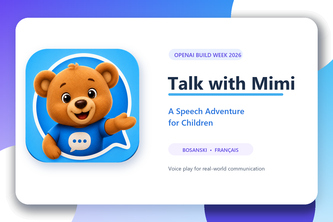
Talk with Mimi is a self-reported local-first bilingual Android app for children, designed to support communication practice through interactive voice play in Bosnian and French. It was built as a prototype by one individual developer, using Flutter, Dart, Kotlin, and AI tools like GPT-5.6 and Codex for development assistance. The app does not connect to the internet, does not collect or transmit user data, and is not intended as a diagnostic or medical tool.
What changed
The project evolved from an early prototype named PRIČAJKO into the final submission titled Talk with Mimi — A Speech Adventure for Children, during the OpenAI 2026 hackathon. The evolution included adding features such as a Daily Adventure, communication levels, parent-managed words, portable backups, and visual polish.
The single most important open question
Is there evidence of real-world usage or feedback from families beyond the developer’s own household? The description states that the app is "currently used and tested within my family," but no external traction or adoption data are provided.
What The Product Actually Is
- The description states that Talk with Mimi is a local-first bilingual Android app for children.
- It supports communication practice in Bosnian and French.
- The app uses Flutter and Dart, with Kotlin integration for Android TTS, voice activity detection, and local data storage.
- It includes features such as:
- A calm four-step Daily Adventure
- Four communication-support levels
- Parent-managed personal and family words
- Portable backup and restore with embedded images
- Local progress tracking
- No internet permission, no analytics, no advertising, and no cloud services
- It is described as a communication-support prototype, not a diagnostic or medical tool.
- The app does not transcribe speech, identify words, or grade pronunciation.
- Voice activity detection is used to confirm speech attempts; no microphone audio is retained or uploaded.
Positioning & Claim Evolution
- The description states that the app was inspired by a personal need in the developer’s family — supporting a child who speaks only a few words at home and school.
- The central product rule is: every speech attempt is communication, not an answer to be graded.
- The app positions itself as:
- A calm and encouraging tool
- A way to turn screen time into real-world communication practice
- A safe environment for children to explore language without fear of being wrong
- It was initially built as a prototype, then evolved during the Build Week hackathon.
- The app is described as not replacing speech-language professionals, and it is not a diagnostic tool.
Target Customer & ICP
- The target customer is children aged around 5 years old, who are bilingual (Bosnian at home, French at school).
- The primary user is the child.
- The secondary users are parents or caregivers, who:
- Manage personal and family words
- Review progress weekly
- Confirm communication attempts
ICP
Not evidenced. No explicit segmentation beyond age and language context.
Business Model & Pricing Evidence
- The description states that the app is a prototype.
- There is no mention of pricing, monetization, or business model.
- The app is local-first, with no cloud services or subscriptions.
- It does not include in-app purchases, advertising, or paid features.
- No revenue or customer data are provided.
Technical & Delivery Signals
- Built with Flutter and Dart, using Kotlin for Android-specific integrations.
- Uses Android TTS, local voice activity detection, and SharedPreferences for data storage.
- Data is stored locally on the device; no internet permission is requested.
- The app supports:
- Portable backups
- Imported images (copied into managed app storage)
- Checksummed, versioned backup format
- The developer used GPT-5.6 and Codex for product reasoning, UX decisions, and implementation assistance.
- The app was tested on real Samsung phones, with Android 10 and 16.
- It includes automated test coverage (118 tests) and passes Flutter analysis.
Traction & Maturity Signals
- The app is described as a prototype.
- It is currently used and tested within the developer’s own family.
- No external users, customers, or adoption data are reported.
- There is no evidence of:
- Revenue
- Customer base
- Market traction
- Product usage beyond the developer's household
Competitive Context
- Not evidenced. The description does not mention any competitors or market positioning in relation to other speech-support tools for children.
Open Questions & Risks
- No external validation or user feedback beyond the developer’s own family.
- The app is described as a prototype, not a production-ready product.
- No evidence of:
- Revenue
- Customers
- Market traction
- Product adoption
- The app is local-first, with no cloud services, which may limit scalability or advanced features.
- The developer is a single individual (1 person team), which raises questions about long-term maintenance and growth.
Questions the description leaves open
- What is the current usage pattern of the app within your family? Are there specific behaviors or outcomes you’ve observed?
- How do you plan to validate the effectiveness of the app beyond personal use?
- Do you have any plans for expanding beyond the current language pair (Bosnian and French)?
- Have you considered how this might scale if adopted by other families or educators?
- What are your thoughts on integrating feedback from speech-language professionals or educators?
Overall Assessment
- The project is described as a prototype with no evidence of traction, revenue, or customer data.
- It is not a commercial product at this stage.
- The app is built with a clear focus on privacy, safety, and calm interaction, but lacks any indication of market readiness or scalability.
- The developer has technical capability and has used AI tools effectively in development.
- Not evidenced as a viable investment or partnership opportunity without further evidence of adoption, traction, or commercial viability.
User Stories BotA demo video on every pull request
Get a demo video on every new feature
GitHub App that watches your pull requests and records a narrated, captioned demo.
Save time on demo prep and make informed decisions faster with a video walkthrough of every new feature.
Source
Submitted to the OpenAI 2026 hackathon on Devpost. Project home on Devpost. Back to the full gallery on Devpost.
This competitive analysis was produced by top-founders.com (opens in a new tab)
Generated by a language model from this project's public Devpost page — its tagline, the author's own write-up and any built-with tags listed there — as captured in August 2026. Short quotations are the author's words. It is an opinion on the idea as a business, not on the people behind it, and it reflects the description as published then. If the project has moved on, request a correction below. The analysis is not independent research and contains no verified traction, revenue or customer data.
An independent guide by KFG International LLC — not affiliated with, endorsed by, or connected to Devpost or OpenAI.