

Archive position — measured, not model output
0 likes on Devpost
2,263 of the 7,850 archived projects have more likes, and 5,587 share exactly 0 — so this project's #3,196 place in the like-ranked listing is a tie-break inside that group, not a ranking.
Projects (log scale)
Likes on Devpost. ▲ marks this project's group.
Show the figures
| Likes | Projects | Share of archive |
|---|---|---|
| 0 | 5,587 | 71.2% |
| 1 | 1,758 | 22.4% |
| 2 | 284 | 3.6% |
| 3–4 | 132 | 1.7% |
| 5–9 | 75 | 1.0% |
| 10+ | 14 | 0.2% |
 User Stories BotA demo video on every pull request
Get a demo video on every new feature
GitHub App that watches your pull requests and records a narrated, captioned demo.
Save time on demo prep and make informed decisions faster with a video walkthrough of every new feature.
Executive Summary
What the company appears to be
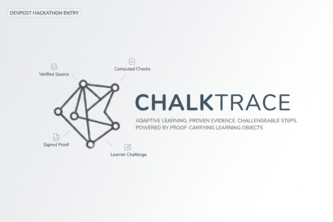
ChalkTrace is a self-reported proof-carrying adaptive learning system built as a single-person project by Marc Donovici. It claims to offer an educational platform where learning objects (lessons) must pass seven computed checks before publication and can be challenged by learners, with the system rebuilding the learner's path if a claim is disproven.
What changed
The author states that this is a vertical slice of a larger system, built in response to the asymmetric failure mode of generated tutoring content — where even polished activities may contain errors or misalignments. The product evolved from a focus on "proof-carrying learning objects" and "challengeable adaptation."
Single most important open question
Is there any evidence that this system has been used by learners, educators, or organizations beyond the author’s own development and testing?
What The Product Actually Is
The description states that ChalkTrace is a durable, multi-organization course studio plus a signed sample learning workspace. It allows educators to upload content in various formats (PDFs, IMS Common Cartridge, Moodle, ZIP, QTI/XML, HTML, Markdown, plain text), which are parsed and split into content-addressed source regions.
It introduces the concept of proof-carrying learning objects, where each lesson candidate must pass an eight-check policy before publication. These checks include schema validation, source support, executable correctness, adversarial solvability, hint leakage, accessibility, runtime safety, and educator review.
The system also supports challengeable adaptation: learners can challenge any claim made in a lesson, which triggers a rebuild of the learner's path if the claim is withdrawn.
Evidence
- The author describes the product as a course studio with upload capabilities for multiple formats.
- It includes an eight-check policy against candidate bytes.
- It has a public activity and a separate grading contract.
- Learners can challenge claims, which causes system-level updates to their learning path.
- The system uses Ed25519 ProofCards bound to exact hashes.
Inference The system is described as deterministic, with a fail-closed publication gate. It separates proposal from authority and uses cryptographic signatures for trust.
Positioning & Claim Evolution
The author states that the inspiration behind ChalkTrace was to answer a stricter question than “can a model write a lesson?” — what must an AI learning system prove before an activity is allowed to shape a learner's future?
This evolved into two core primitives:
- Proof-carrying learning objects
- Challengeable adaptation
The author also notes that the product’s own thesis was applied to its own model: GPT-5.6 was used to draft candidates, but they still had to pass all checks and educator review before publication.
Evidence
- The system is positioned around trust through evidence and interaction.
- It uses a “proof-carrying” model where each object must prove itself via checks.
- The challenge mechanism is described as causally changing the future learning path.
- The author explicitly states that the system applies its own thesis to its own model.
Inference The positioning implies a focus on trust through verifiability, not just content generation. It aims to make trust an interaction, not a disclaimer.
Target Customer & ICP
The description does not clearly define a target customer or ideal customer profile (ICP). However, the author notes that the first adoption target is an engineering or science course team running high-enrollment assessment practice.
It also mentions that the concrete two-week rollout is written up in docs/pilot-playbook.md.
Evidence
- The first adoption target is described as an engineering or science course team.
- A pilot playbook exists for a specific use case (high-enrollment assessment practice).
Inference The system seems aimed at educators and institutions who want to build or use high-quality, verifiable learning content — particularly in STEM fields.
Business Model & Pricing Evidence
There is no evidence of pricing, business model, or revenue streams in the description. The author does not mention any monetization strategy or customer acquisition plan.
Evidence
- No mention of pricing.
- No indication of a commercial model (e.g., SaaS, freemium, licensing).
- No information on how users pay or what they get for it.
Inference The business model is not evidenced, and the project appears to be in an early development stage without traction or monetization plans.
Technical & Delivery Signals
The system is built using:
- Codex, ed25519, fastapi, mcp, python, react, typescript, web-crypto
- It includes a 2,048-case executable verifier tied to both Python and TypeScript implementations.
- The system uses SQLite for durable storage, with every account, course, draft, publication, attempt, challenge, and audit event stored.
- It implements cryptographic ProofCards and DecisionCards.
- A release gate recomputes deterministically.
Evidence
- The system is built with a mix of Python, TypeScript, React, FastAPI, and web-crypto.
- It includes an 8-check policy with exact-hash evidence.
- It uses Ed25519 for signing and cryptographic verification.
- A deterministic release gate exists that recomputes results.
Inference The system is technically sophisticated, with strong emphasis on cryptographic integrity, deterministic verification, and evidence preservation.
Traction & Maturity Signals
There is no evidence of traction or adoption beyond the author’s own development. The project is described as a single-person effort, and no customers, users, or revenue data are provided.
Evidence
- Team size is listed as 1.
- No mention of users, customers, or real-world deployment.
- No data on usage, engagement, or performance metrics.
- No evidence of product-market fit or user feedback.
Inference The system is in a pre-traction phase, likely at the prototype or MVP stage. It has not yet been validated with external users or organizations.
Competitive Context
There is no mention of competitors or market context in the description. The author does not reference existing platforms or tools in the adaptive learning or educational technology space.
Evidence
- No competitor names, products, or market positioning are mentioned.
- No discussion of how ChalkTrace compares to other systems.
Inference The competitive landscape is not evidenced, and it’s unclear whether this project addresses a gap or overlaps with existing solutions.
Open Questions & Risks
- Single-person development: The system is built by one person, which raises concerns about scalability, maintenance, and long-term viability.
- No traction or user feedback: There is no evidence of real-world usage or adoption.
- Unproven business model: No indication of how the product will generate revenue or attract users.
- High technical complexity without validation: The system is technically complex but lacks evidence of being tested or used in practice.
- No external validation or third-party audits: The project is self-reported and unverified.
Evidence
- Team size: 1.
- No user data, revenue, or adoption metrics.
- No mention of external testing or feedback.
Inference The project is high-risk due to lack of traction, unclear business model, and limited validation.
Questions the description leaves open
- What are the actual use cases for which this system has been tested?
- How does the system handle edge cases in content ingestion or challenge resolution?
- Has there been any real-world feedback from educators or learners?
- What is the plan to scale beyond a single developer?
- Are there any plans to monetize or commercialize the product?
- How does the system ensure that the source material used for training models is valid and peer-reviewed?
Overall Assessment
Not evidenced
The project description provides no evidence of revenue, customers, traction, or a clear path to monetization. It is a self-reported prototype with strong technical underpinnings but no commercial validation.
Confidence Low This is a pre-traction, pre-commercialization product, built by one person and not yet tested in the market. Any investment or partnership would be highly speculative at this stage.
User Stories BotA demo video on every pull request
Get a demo video on every new feature
GitHub App that watches your pull requests and records a narrated, captioned demo.
Save time on demo prep and make informed decisions faster with a video walkthrough of every new feature.
Source
Submitted to the OpenAI 2026 hackathon on Devpost. Project home on Devpost. Back to the full gallery on Devpost.
This competitive analysis was produced by top-founders.com (opens in a new tab)
Generated by a language model from this project's public Devpost page — its tagline, the author's own write-up and any built-with tags listed there — as captured in August 2026. Short quotations are the author's words. It is an opinion on the idea as a business, not on the people behind it, and it reflects the description as published then. If the project has moved on, request a correction below. The analysis is not independent research and contains no verified traction, revenue or customer data.
An independent guide by KFG International LLC — not affiliated with, endorsed by, or connected to Devpost or OpenAI.